31 Recycling Survey Questions That Drive Better Insights
Explore 25 sample keyword recycling survey questions to boost feedback, improve sustainability insights, and support smarter recycling research.
If you are sorting through questions about recycling, a recycling survey is simply a set of recycle questions used to learn what people know, do, and need. Schools, workplaces, cities, and researchers use one to spot gaps, improve programs, and make recycling less of a mystery box.
Here’s the thing, the best questions for recycling depend on your goal, whether that is awareness, behavior, student learning, or choosing providers. Plus, this guide will walk you through practical survey types, sample recycling questionnaire ideas, and smart ways to turn answers into better results. If you need a simple online survey maker, it can help you build and share these questions quickly.
General Recycling Awareness Survey Questions
Sample questions
How confident are you that you know what materials can be recycled in your area?
Which of the following items do you believe are recyclable through your local program?
How familiar are you with recycling symbols and labels on packaging?
What is the biggest source of confusion for you when deciding whether to recycle an item?
Where do you usually look for answers to questions about recycling?
Catch confusion before it becomes contamination.
Why & When to Use
Use this type of recycling questionnaire when you want to measure baseline knowledge, not habits. These questions about recycling help you see what people think they know about rules, symbols, accepted materials, and the classic troublemakers that keep ending up in the bin.
Here’s the thing, awareness-focused recycle questions are especially useful for new programs, public education campaigns, community outreach, and pre-campaign benchmarking. They also help when people say they support recycling, but contamination rates are still acting like uninvited party guests.
A strong set of program evaluation survey questions for recycling should mix formats so you get both quick data and useful detail.
Use multiple-choice questions to test knowledge of accepted materials.
Add scaled questions to measure confidence and familiarity.
Include one open-ended prompt to uncover misconceptions in people’s own words.
Tailor examples to your local recycling system, because “recyclable” in one area can be a hard no in another.
Plus, these recycle questions give you practical direction for education content, signage, and FAQs. On top of that, they make it easier to create smarter messages around common recycling questions for students, residents, or staff.
Among 1,310 U.S. consumers, 63% remained confused about recyclability after checking product labels, highlighting the value of survey questions on recycling knowledge and confusion (source).
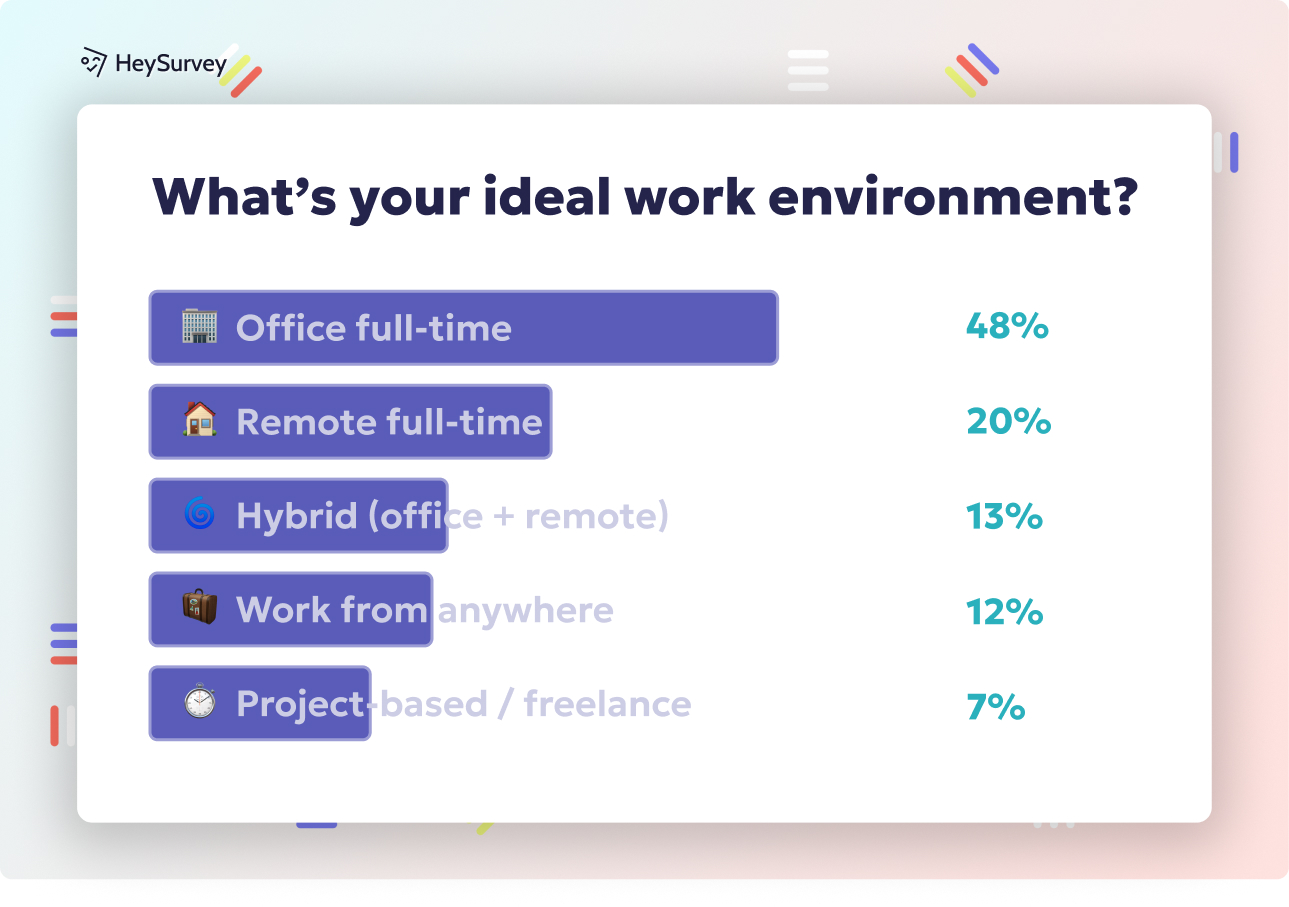
Creating a recycling survey in HeySurvey is quick and easy. You can begin by opening a template from the button below these instructions, or start from scratch if you prefer. Then follow these three simple steps:
Create a new survey
Open HeySurvey and choose a recycling survey template, an empty sheet, or text input to generate your survey. Give your survey a clear name so you can find it later.Add questions
Click Add Question and enter your recycling survey questions. Use Choice questions for multiple-choice answers, Scale questions for ratings, and Text questions for comments or suggestions. You can mark questions as required and reorder them anytime.Publish your survey
Preview your survey to check how it looks. When everything is ready, click Publish to create a shareable link. Your online survey tool is now live and ready to collect responses.
Household Recycling Behavior Survey Questions
Sample questions
How often has your household separated recyclable materials from trash in the past 30 days?
Which materials does your household recycle most consistently?
What prevents your household from recycling more often at home?
How often are items placed in your recycling bin without being cleaned or sorted properly?
Would clearer instructions or more convenient bin access increase your household’s recycling participation?
Focus on what people do, not just what they say.
Why & When to Use
Use this section when you want to measure real at-home habits, not just general opinions or good intentions. These questions about recycling help you understand what residents actually do in kitchens, garages, laundry rooms, and near that mystery drawer where old batteries go to hide.
Here’s the thing, behavior-based recycle questions work best for city recycling programs, apartment communities, residential service updates, and waste reduction campaigns. They are especially useful when you need clearer data on participation frequency, contamination causes, and the everyday barriers that slow people down.
Good questions for recycling should be specific and tied to recent behavior.
Ask about actions, not just beliefs, so you learn what households really do.
Use time frames like “in the past 30 days” to get more accurate answers.
Group responses into high, medium, and low participation to spot patterns fast.
Look at barrier data to see whether the problem is convenience, knowledge, space, or motivation.
Plus, these recycling survey questions for residents match search intent around questions on recycling and common recycle questions from households. On top of that, they give you practical insight for better bin placement, clearer instructions, and smarter outreach that does not just sound nice on a flyer.
Observational research found household recycling surveys should measure participation frequency, materials recycled, and contamination, since these capture distinct real behaviors better than attitudes alone (source).
Workplace Recycling Survey Questions
Sample questions
How easy is it to find recycling bins in your work area?
Which recyclable materials are most commonly generated in your workplace?
Have you received clear guidance on what can and cannot go into workplace recycling bins?
What is the main reason recyclable items may end up in trash at work?
What change would most improve recycling participation in your workplace?
Workplace recycle questions uncover the gaps between policy and practice.
Why & When to Use
Use this survey type for offices, warehouses, retail stores, hospitals, and other job sites where waste piles up fast and good intentions sometimes miss the bin by a mile.
These questions about recycling are ideal when you want to improve sustainability efforts, cut landfill waste, and get more employees to actually participate instead of just nodding during training.
Here’s the thing, the best questions for recycling in workplaces help you figure out what is really broken.
Bin placement may be confusing or inconvenient.
Signage may be unclear, missing, or too easy to ignore.
Training may be inconsistent across teams or shifts.
Leadership support and accountability may be weak.
Plus, employee feedback often reveals location-specific issues that management never sees, especially in large facilities where one department’s “easy” is another department’s scavenger hunt.
These recycling questions for employees also work well as internal questions to ask employees during facility-wide recycling surveys. If office staff and operational staff deal with different waste streams, separate your recycle questions so the answers stay useful.
On top of that, pair your recycling questionnaire with a simple waste audit for stronger insight. Ask about convenience, training, and accountability so your questions to ask about recycling lead to fixes, not just a very polite spreadsheet.
School and Student Recycling Survey Questions
Sample questions
How often do you recycle paper, bottles, or cans at school?
Do you know which bins to use for trash, recycling, and food waste at school?
What makes recycling difficult in your classroom, cafeteria, or dorm?
How important is recycling to you as a student?
What would help students recycle more correctly at school?
Student recycle questions turn everyday habits into useful feedback.
Why & When to Use
Use this section for K-12 schools, colleges, student clubs, and campus sustainability programs that want better questions about recycling without making students feel like they are taking a pop quiz.
These questions for recycling work especially well when educators need age-appropriate, practical feedback they can actually use.
Here’s the thing, good recycling questions for students help you measure more than awareness.
They show what students know about bins and sorting.
They reveal habits in classrooms, cafeterias, and dorms.
They highlight barriers like confusion, missing bins, or rushed lunch periods.
They uncover interest in environmental projects, clubs, or peer-led efforts.
Plus, you should match the reading level to the age group. Younger students need simpler recycle questions, while older students can answer more behavior-focused questions about habits, responsibility, and campus systems.
On top of that, adding visual examples of common items in the final recycling questionnaire can make answers more accurate, especially for younger students who may think every shiny thing is recyclable. Sneaky, but adorable.
If composting is part of the program, include cafeteria and food waste questions to ask about recycling too. These questions about recycling can guide better signage, peer education, and classroom activities so your 10 questions about recycling lead to action, not just well-meaning nods.
A 2024 school study found 93% of students valued recycling, but only 59% knew bin locations, highlighting knowledge-access gaps survey questions should measure (source).
Recycling Program Feedback Survey Questions
Sample questions
How satisfied are you with the current recycling program in your building, school, or community?
How clear are the current recycling instructions provided to you?
Have you experienced any recurring problems with bin access, overflow, or pickup reliability?
Which part of the recycling program needs the most improvement?
How likely are you to recommend the current recycling program to others in your community or organization?
This is your go-to recycling questionnaire for fixing a program that already exists.
Why & When to Use
Use these questions about recycling after you launch, update, or expand a program and want real feedback from the people using it.
They work well for municipalities, property managers, campuses, events, and nonprofits that need practical questions for recycling, not vague opinions about saving the planet.
Here’s the thing, this type of survey helps you spot what is working and what is quietly driving people bananas.
It measures satisfaction with the current program.
It reveals communication gaps in signage, emails, or onboarding materials.
It highlights service issues like missed pickups, full bins, or poor bin placement.
It uncovers quick operational wins that are often easy to fix.
Plus, the best recycle questions mix rating scales with open-text responses. A score tells you something feels off, while a comment tells you exactly why.
On top of that, include questions to ask about recycling communication channels, instruction clarity, and service reliability. Those details turn general complaints into useful action items.
Use this recycling questionnaire after policy changes, new bin rollouts, or education campaigns. If people are confused, annoyed, or pleasantly surprised, this is when you want to catch it before the bins start collecting mystery junk.
Questions to Ask Recyclers and Haulers
Sample questions
What materials do you currently accept, and what contamination limits apply?
How do you track recycling volumes, contamination rates, and diversion performance?
What happens to collected materials after pickup, and how transparent is your reporting?
What support do you provide for education, signage, or contamination reduction?
What service changes would you recommend to improve recycling results at our site?
These questions for recycling vendors help you compare promises, proof, and actual performance.
Why & When to Use
Use these questions about recycling when you are evaluating waste haulers, recyclers, material recovery partners, or commercial service providers.
They are best for businesses, schools, apartment communities, and municipalities reviewing service quality, contract terms, or program results.
Here’s the thing, these are not public-facing recycle questions.
They are stakeholder interview questions to ask recyclers & haulers, designed to help you make smarter service decisions before a contract locks you in like a clingy gym membership.
Transparency matters a lot when comparing vendors.
If one company gives clean, regular reports and another stays fuzzy about rejected loads or contamination thresholds, that tells you plenty before pickup day even starts.
Ask questions for recycling that cover the nuts and bolts, including:
reporting frequency and what data is included
contamination thresholds and how rejected loads are handled
training, signage, and education support for your staff or residents
service flexibility if your material volume, layout, or schedule changes
Plus, these recycling questions for service providers can shape contract decisions and help you set realistic recycling goals.
On top of that, strong answers show whether a partner can support improvement, not just collect bins and disappear.
Best Practices for Writing Effective Recycling Survey Questions
Sample questions
Is each question focused on one idea only?
Does the survey use language the target audience will easily understand?
Are answer choices specific enough to produce useful insights?
Does the survey include a balance of closed and open-ended questions?
Will the responses clearly inform a decision or action?
Strong recycle questions are short, clear, and built to drive a real next step.
Why & When to Use
Use this section as your quality-control step before sending out any recycling questionnaire.
It helps you sharpen questions about recycling for any audience, whether you are writing recycling questions for students, residents, employees, or customers.
Here’s the thing, good survey design matters just as much as good recycling knowledge.
If your questions for recycling are vague, stacked with jargon, or too broad, your results will be about as useful as a bin with no label.
Keep your recycle questions practical, brief, and tied to local recycling rules.
Plus, if your audience is not industry-specific, skip technical terms and use examples they actually recognize from daily life.
When reviewing questions to ask about recycling, make sure you do this:
match each question to one clear survey goal
use plain language and locally accurate examples
ask time-based behavior questions when possible
offer balanced answer choices and logical scales
test your recycling questionnaire for confusion before launch
include at least one open-ended question for unexpected insights
And avoid these common mistakes in 10 questions about recycling or any survey length:
vague questions that cannot guide action
double-barreled questions with two ideas packed into one
assuming everyone follows the same recycling rules
too many open-text fields
leading questions that push “green” answers
collecting data you will never use
How to Analyze Recycling Survey Results
Sample questions
Which recycling barriers appear most often across respondents?
Are knowledge gaps different from behavior gaps in the results?
Which locations, groups, or age segments report the lowest participation?
What problems are mentioned most frequently in open-ended responses?
Which findings can be addressed quickly versus requiring long-term investment?
Good questions about recycling only become useful when you turn answers into clear priorities.
Why & When to Use
Use this section after you collect responses and need to make sense of what people actually told you.
It works best when you want to spot patterns, compare groups, and decide what to fix first instead of staring at a pile of recycle questions like it might magically organize itself.
Here’s the thing, not every result deserves the same weight.
When reviewing questions for recycling, group findings into a few practical buckets so the patterns are easier to see:
awareness issues, such as not knowing what belongs in the bin
access issues, such as missing bins or inconvenient locations
behavior issues, such as forgetting or not bothering
service issues, such as contamination, overflow, or poor signage
Plus, compare responses by audience type.
For example, recycling questions for students may reveal confusion, while employee responses may point to bin placement, and resident feedback may highlight pickup or service problems.
On top of that, pay close attention to open-ended answers in your recycling questionnaire.
Repeated words, complaints, or suggestions often reveal the biggest problems hiding inside longer comments.
When analyzing questions to ask about recycling, focus on high-impact issues first:
problems affecting the most people
barriers you can fix quickly
changes likely to improve participation fast
longer-term issues that need planning and budget
That way, your 10 questions about recycling lead to action, not just a very tidy spreadsheet.
Turning Recycling Survey Insights Into Action
Sample questions
What is the top issue our recycling survey revealed?
What one change could we implement in the next 30 days?
Which audience needs targeted communication or training first?
How will we measure whether the improvement worked?
When should we repeat the recycling survey to track progress?
Good questions about recycling earn their keep when you turn answers into visible improvements.
Why & When to Use
Use this final section when you are ready to move from survey feedback to real-world action.
It works best after reviewing recycle questions and identifying the biggest barriers, because insight is nice, but better bins and clearer signs are nicer.
Here’s the thing, your next step should be a short action plan, not a giant strategy document that naps in a folder.
For each issue raised in your questions for recycling, assign an owner, a timeline, and a simple success metric.
Focus first on practical fixes that are easy to act on:
clearer signage that shows what goes in and what stays out
better bin placement in high-traffic or confusing areas
short staff or student training where knowledge gaps showed up
updated expectations for vendors, recyclers, or haulers
Plus, make sure your recycling questionnaire results shape communication and policy too.
If one audience struggled more than others, use targeted messaging instead of blasting the same reminder to everyone like a recycling-themed weather report.
On top of that, measure what changed after you act.
Track contamination rates, participation levels, overflow complaints, or satisfaction scores, then repeat your recycle questions later to compare results.
That is how questions to ask about recycling become outcomes, and how smart recycling questions for students, staff, or residents lead to measurable progress.
Related Program Evaluation Surveys
29 Non Profit Survey Questions
Explore 25 non profit survey questions with sample questions to improve donor feedback, volunteer...
29 Activity Survey Questions for Seniors
Discover 25 activity survey questions for seniors with sample questions, insights, and ideas to i...
31 Program Evaluation Survey Questions
Explore 25 program evaluation survey questions with sample questions to improve feedback, measure...