29 Customer Satisfaction Examples Survey Questions
Explore 25 customer satisfaction examples survey questions to improve feedback, measure loyalty, and boost service quality with practical insights.
Want better customer feedback instead of vague shrug emojis in survey form? Customer satisfaction surveys help you measure how people feel about your product, service, or support, and the right question type can improve response quality, reveal useful next steps, and even help you keep more customers with the right online survey tool.
customer satisfaction examples survey questions
In this guide, you’ll explore customer satisfaction examples survey questions across different formats, when to use each one, and sample questions your team can tweak without reinventing the wheel.
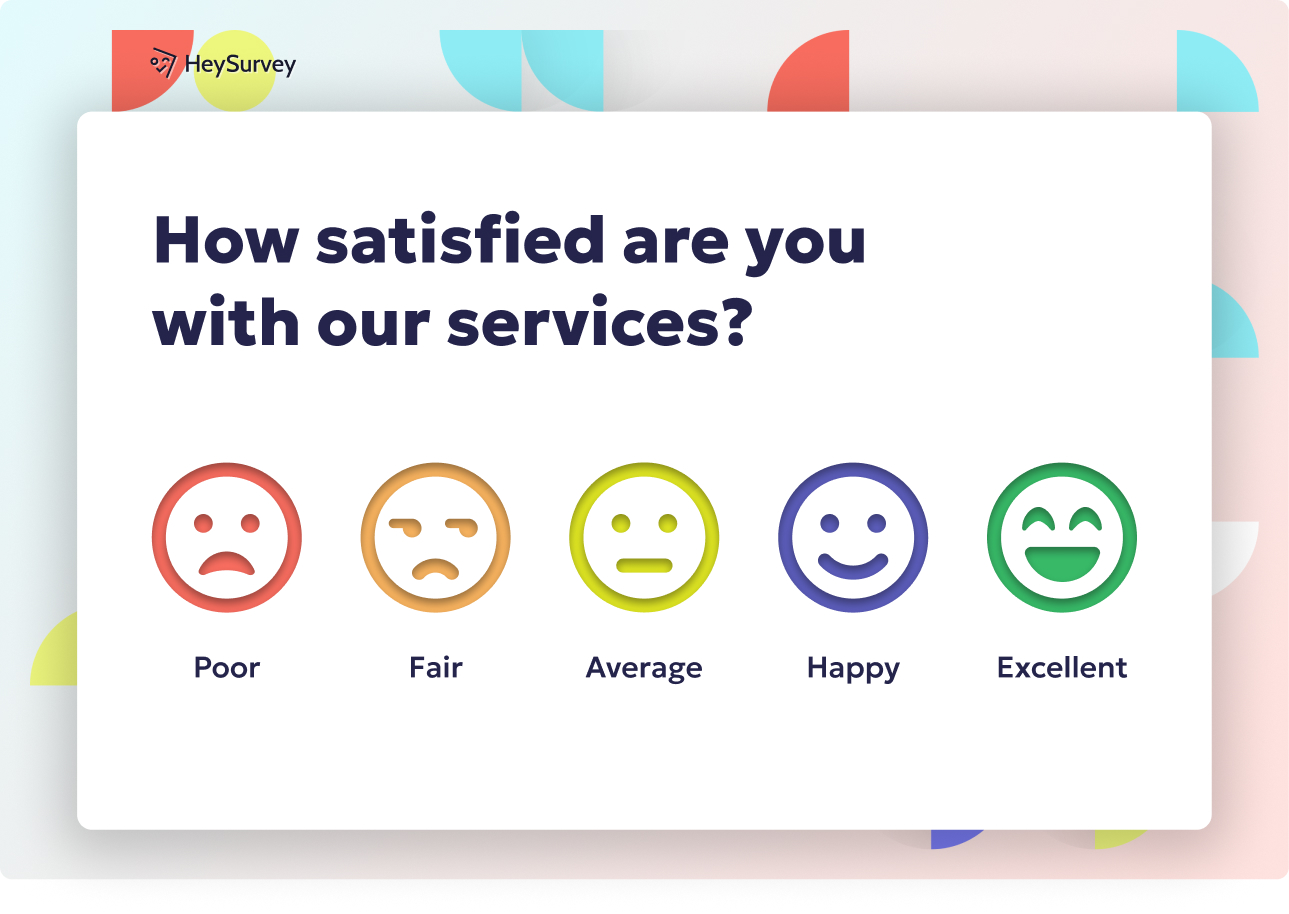
Customer Satisfaction Rating Scale Questions
Sample questions
How satisfied are you with your overall experience with our company?
On a scale of 1 to 10, how satisfied are you with the product you purchased?
How would you rate your recent customer service experience?
How satisfied are you with the speed of resolving your issue?
How likely are you to describe your experience as satisfactory overall?
quick, clean satisfaction tracking
Why & When to Use
Rating scale questions are your go-to move when you want fast, consistent feedback without making customers write a mini memoir.
They work especially well for post-purchase surveys, support interactions, onboarding check-ins, and recurring customer health tracking.
Here’s the thing, these questions make it much easier to spot patterns over time and compare results across teams, locations, or time periods.
If support scores dip this month or onboarding jumps next quarter, you can actually see it instead of guessing with crossed fingers.
To make rating scale questions more useful, keep your format consistent and easy to understand.
Use the same scale range across surveys whenever possible, such as 1 to 5 or 1 to 10.
Label what the endpoints mean, like 1 = very dissatisfied and 10 = very satisfied.
Add a follow-up open-ended question for low scores so customers can explain what went wrong.
Review results regularly to benchmark performance across teams and track trends over time.
Plus, when you keep the scale simple, customers answer faster and your data behaves a lot better.
Consistent, clearly labeled rating scales improve survey accuracy and make customer satisfaction results easier to compare over time (Qualtrics).
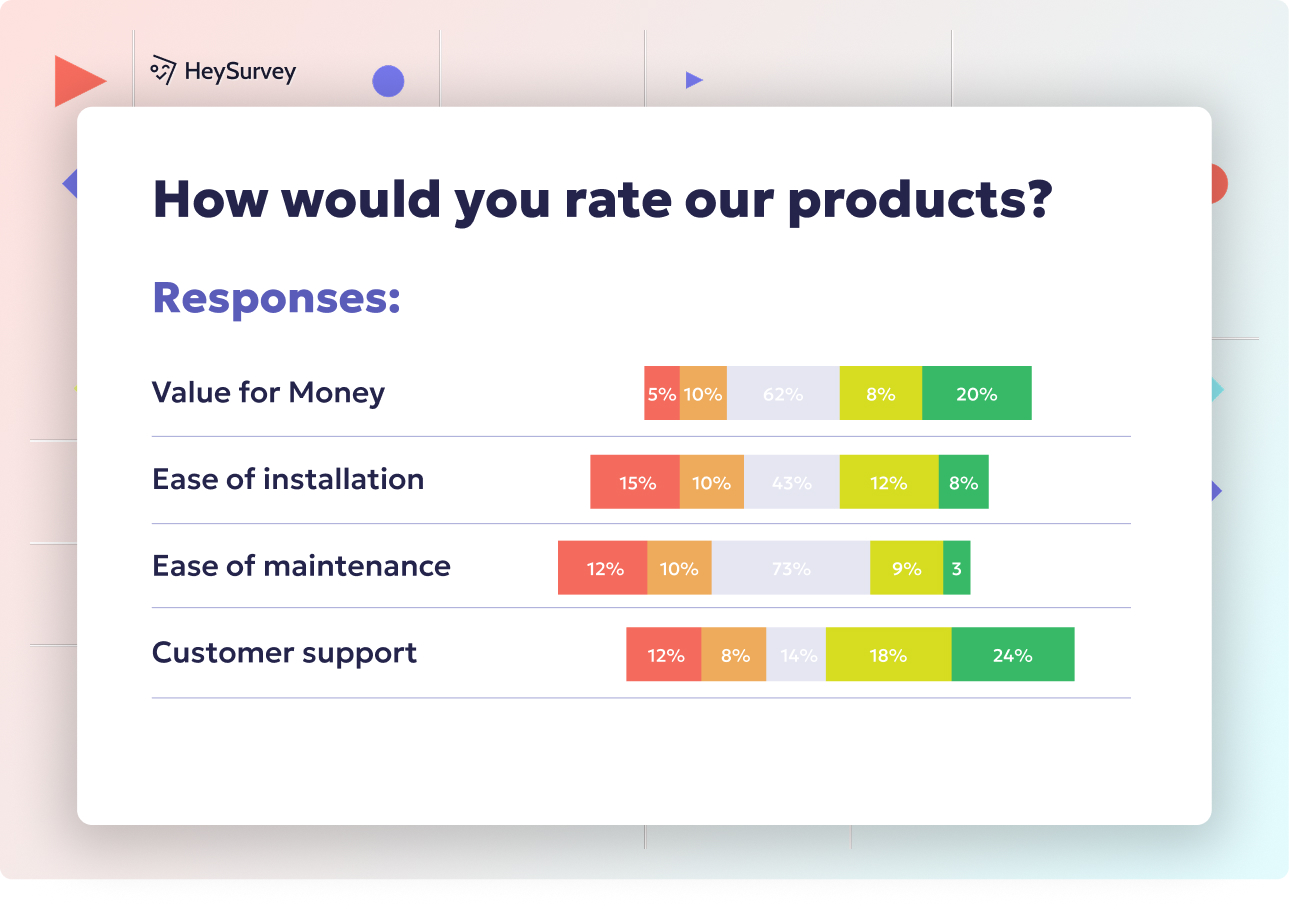
How to create a customer satisfaction survey in HeySurvey
1. Create a new survey
Start by opening a template with the button below, or choose a blank survey if you want to build from scratch. Give your survey a clear name so you can find it easily later. If needed, add your logo or adjust the survey settings before you begin.
2. Add questions
Click Add Question to insert the questions you need. For customer satisfaction examples survey questions, use Scale, NPS, or Choice questions to measure overall satisfaction, product experience, and likelihood to recommend. You can also add a short text question for extra comments, such as “What could we improve?” Mark important questions as required if you want every respondent to answer them.
3. Publish survey
When your survey is ready, click Preview to check how it looks. If everything is correct, press Publish to create a shareable link. You can then send the survey to customers and start collecting responses right away.
Net Promoter Score (NPS) Survey Questions
Sample questions
On a scale of 0 to 10, how likely are you to recommend our company to a friend or colleague?
What is the primary reason for your score today?
What could we do to improve your experience?
What do you value most about our product or service?
What nearly stopped you from giving a higher score?
loyalty feedback with teeth
Why & When to Use
Net Promoter Score, or NPS, is a loyalty-focused survey question that measures how likely your customers are to recommend you to someone else.
Here’s the thing, that first 0 to 10 question is the standard NPS item, and the follow-up questions are where the good stuff lives.
NPS works especially well when you want to track customer sentiment at scale without turning your survey into a homework assignment.
It also helps you group responses into promoters, passives, and detractors, so you can quickly see who loves you, who is lukewarm, and who is mentally packing a suitcase.
Use NPS after meaningful product usage, after a customer completes an important milestone, or during regular relationship reviews.
Plus, timing matters a lot, because asking too early is like requesting a movie review during the opening credits.
To get more value from NPS, keep these practical tips in play:
Treat the first question as your benchmark and use the follow-ups to understand the why behind the score.
Segment responses by customer type, product line, or lifecycle stage to find patterns that would otherwise hide.
Follow up quickly with detractors so you can recover at-risk accounts before frustration turns into churn.
Review promoter feedback too, because it often reveals your strongest selling points.
Survey research recommends pairing the standard 0–10 NPS question with brief open-ended follow-ups like “why?” to make loyalty scores actionable (Source).
Customer Effort Score (CES) Survey Questions
Sample questions
How easy was it to resolve your issue with us today?
The company made it easy for me to complete my purchase.
How easy was it to find the information you needed?
How much effort did you personally have to put in to get your problem resolved?
How easy was it to navigate our website or app?
make it easy, win more loyalty
Why & When to Use
Customer Effort Score, or CES, measures how easy or difficult it was for your customer to complete a specific task.
Here’s the thing, satisfaction tells you how someone feels, while effort tells you how hard they had to work to get there.
That difference matters more than it sounds, because a customer can be fairly satisfied and still think the process was annoyingly clunky.
CES is best used right after a clear interaction, when the experience is still fresh and the memory has not wandered off for coffee.
It works especially well after moments like these:
support ticket resolutions
returns or exchanges
account setup and onboarding
checkout flows
self-service help center experiences
Lower effort often connects with stronger satisfaction, repeat business, and loyalty, because people usually come back to what feels simple.
Plus, CES is great for spotting friction in your service and digital journeys before small hassles turn into big drop-offs.
Use it to find where customers get stuck, where forms feel too long, where navigation gets messy, or where support solves the issue but makes people do Olympic-level clicking first.
On top of that, keep your CES questions tied to one moment, one task, and one touchpoint so the feedback stays sharp and useful.
Post-Purchase Satisfaction Survey Questions
Sample questions
How satisfied are you with your recent purchase?
Did the product or service meet your expectations?
How satisfied are you with the checkout process?
How satisfied are you with the delivery or fulfillment experience?
What could we have done to improve your buying experience?
catch the feedback while it’s fresh
Why & When to Use
Post-purchase surveys help you collect immediate feedback right after someone buys from you.
That timing matters, because first impressions are still fresh and the tiny annoyances have not had time to hide under the rug.
These surveys work especially well for:
ecommerce orders
retail purchases
subscription signups
service bookings
Here’s the thing, a customer might like what they bought but still feel frustrated by the buying process.
That is why it helps to separate product satisfaction from purchase process satisfaction, so you can tell whether the issue came from expectations, checkout, delivery, or the overall first experience.
Use post-purchase surveys to uncover problems like these:
the product did not match expectations
checkout felt confusing or too slow
delivery or fulfillment disappointed
the first impression after purchase felt shaky
Plus, send the survey shortly after delivery or right after the transaction is complete, depending on what you are measuring.
If you ask too late, details blur and your feedback gets a little mushy, like fries left in the bag too long.
On top of that, review responses alongside refund rates, return patterns, and repeat-purchase data.
That gives you a clearer picture of what customers say, what they do next, and where your buying experience needs a tune-up.
Qualtrics recommends sending post-purchase surveys as close to the interaction as possible because fresher experiences yield higher response rates and better-quality data (source).
Customer Service Satisfaction Survey Questions
Sample questions
How satisfied are you with the support you received today?
Did our team resolve your issue completely?
How would you rate the professionalism of the support representative?
How satisfied are you with the time it took to get help?
What could our support team have done better?
great support is remembered, bad support is legendary
Why & When to Use
Customer service satisfaction surveys help you measure how people feel about the support they received and whether their issue was actually resolved.
Here’s the thing, a fast reply means very little if the customer still walks away annoyed, confused, or stuck.
These surveys work well after service interactions like:
live chat sessions
phone support calls
email support exchanges
in-person service visits
Use them to evaluate key parts of the support experience, including:
agent professionalism
response and wait times
empathy and tone
resolution effectiveness
Plus, it helps to measure both outcome and experience quality.
A problem can be solved correctly, but if the interaction feels cold or painfully slow, your customer may still leave with a bad taste in their mouth.
Keep these surveys short so more people actually finish them.
A long support survey right after someone spent 20 minutes getting help is a bit like handing them homework after recess.
On top of that, use the results for more than reporting.
They can guide agent coaching, reveal staffing gaps, highlight slow processes, and show where your service experience needs polishing.
When you track both resolution and satisfaction together, you get a clearer view of what your team fixed, how they handled it, and what should improve next.
Product and Feature Satisfaction Survey Questions
Sample questions
How satisfied are you with the product overall?
Which feature do you find most valuable?
How easy is the product to use for your needs?
Have you experienced any issues with product performance or reliability?
What feature or improvement would most increase your satisfaction?
product feedback shows you what users love, tolerate, and quietly wish would disappear
Why & When to Use
Product and feature satisfaction surveys help you understand how people feel about usability, reliability, and whether your features are actually useful in real life.
Here’s the thing, a feature can sound brilliant in planning and still land with all the grace of a shopping cart with one wobbly wheel.
These surveys work especially well at key moments like:
after onboarding, when users are forming first impressions
after a feature release, when reactions are fresh
during beta tests, when you want early signals before a wider launch
during recurring account reviews, when you need broader satisfaction trends
Plus, these questions help your product team make smarter roadmap choices.
They show what to fix, what to improve, and which features deliver the most value to different users.
For stronger feedback, target active users whenever possible.
They are more likely to give useful answers based on real experience instead of guesses or vague memories.
On top of that, group responses by feature usage or customer segment.
That makes it easier to spot whether power users, new customers, or specific industries are having very different experiences.
Balance rating questions with open-ended ones too.
The numbers show you where satisfaction rises or drops, and the written comments explain why, which is where the roadmap magic usually starts.
Best Practices for Writing Customer Satisfaction Survey Questions
Sample questions
Is this question clear and easy for customers to understand?
Does this question measure one idea at a time?
Is the response scale consistent with the rest of the survey?
Are we asking this question at the right moment in the customer journey?
Will the answer help us make a specific business decision?
strong survey questions make your feedback cleaner, sharper, and way more useful
Why & When to Use
Best practices help you collect better data without tiring people out halfway through the survey.
Plus, they make responses easier to trust, compare, and actually use.
This section matters before you launch any customer satisfaction survey, whether it is a quick post-purchase check-in or a bigger relationship survey.
Here’s the thing, even a well-meaning survey can go sideways if the questions are fuzzy, biased, or longer than a Monday morning.
A few smart rules can help you avoid that.
Do this:
Keep questions short and specific.
Use neutral wording so you do not nudge answers.
Match every question to a clear goal.
Limit survey length to protect response quality.
Test the survey before sending it to everyone.
Avoid this:
Asking leading or biased questions.
Combining two ideas in one question.
Overusing open-ended questions.
Sending surveys too often.
Collecting feedback without a plan to act on it.
On top of that, check whether each question earns its place.
If it does not help you improve retention, service, onboarding, or product decisions, it is probably just taking up valuable space in your survey.
How to Choose the Right Customer Satisfaction Survey Type
Sample questions
Are you trying to measure overall satisfaction or a specific interaction?
Do you want to understand loyalty, effort, or immediate satisfaction?
At what stage of the customer journey are you collecting feedback?
Do you need a benchmark metric or detailed diagnostic feedback?
Which team will act on the results once the survey is complete?
the right survey type turns feedback from random noise into useful direction
Why & When to Use
The best survey type depends on what you want to learn, where the customer is in their journey, and how much detail you actually need.
Plus, this is your practical pick-the-right-tool guide if you are in marketing, CX, support, product, or running the whole show yourself.
Here’s the thing, not every survey should try to do everything because that is how you end up with muddy data and a team-wide shrug.
Choose based on the job:
Use CSAT when you want a quick read on satisfaction after a purchase, support chat, or service moment.
Use NPS when you want to measure loyalty and understand how likely people are to recommend you.
Use CES when you want to know how easy or frustrating an experience felt.
Use service-specific surveys when one team, like support or onboarding, needs targeted feedback.
Use post-purchase surveys when you want to learn about buying experience, expectations, or checkout friction.
Use product surveys when you need feedback on features, usability, or overall product experience.
On top of that, pick one primary metric per survey.
If you mix loyalty, effort, satisfaction, and product discovery into one mega-survey, your results can get messy fast, like stuffing five remotes into one couch cushion and hoping for clarity.
Align the survey with a business outcome, keep the goal focused, and make sure the right team is ready to act on what you learn.
Turning Customer Satisfaction Survey Insights Into Action
Sample questions
What are the top three satisfaction issues customers mention most often?
Which low-scoring touchpoints have the biggest business impact?
What quick fixes can we implement immediately?
Which trends appear across customer segments or channels?
How will we close the loop with customers after receiving feedback?
insights only matter when you actually do something with them
Why & When to Use
Collecting feedback is useful, but it only starts paying off when you turn comments and scores into clear next steps.
Here’s the thing, this is the final step in your customer feedback strategy, where survey results stop being interesting and start being useful.
Start by grouping feedback into simple themes so patterns are easier to spot.
Service
Product
Price
Usability
Communication
Plus, do not treat every complaint like a five-alarm fire.
Prioritize issues based on two things:
How often the issue shows up
How much business impact it creates
That helps you separate small annoyances from problems that hurt retention, conversion, or trust.
On top of that, look for fast wins you can fix right away, like confusing checkout steps, slow support replies, or messy onboarding copy.
Then share findings across teams so the right people can act.
Support can fix service gaps
Product can improve features and usability
Marketing can adjust messaging and expectations
Leadership can fund bigger changes
Close the loop, too.
Let customers know you heard them, what changed, and what comes next because silence after feedback feels a bit like waving at someone who never waves back.
Finally, keep monitoring results over time so you can see whether scores improve and whether your fixes actually worked.
Related Surveys
29 Social Media Survey Questions
Explore 25 social media survey questions with practical sample prompts to help gather insights on...
31 Job Satisfaction Survey Questions
Explore **25 job satisfaction survey questions** with sample prompts to improve employee feedback...
29 Quantitative Survey Questions Guide
Explore 25 quantitative survey questions with sample questions, examples, and tips to build effec...