29 Quantitative Survey Questions Guide
Explore 25 quantitative survey questions with sample questions, examples, and tips to build effective surveys and improve data-driven insights.
If you want clearer decisions, start with quantitative survey questions. These structured, measurable prompts produce numerical or countable data, unlike qualitative questions that explore open-ended opinions.
Businesses, researchers, marketers, and HR teams use sample quantitative survey questions, number survey questions, and data survey questions to spot patterns, compare groups, and track change over time. Plus, this guide will walk you through the main types, when to use each, sample quantitative survey questions, a helpful quantitative survey questions sample, and how to turn results into decisions without making your spreadsheet cry.
Sample questions
How satisfied are you with our product overall on a scale of 1 to 5?
How strongly do you agree with the statement: “This service is easy to use”?
How likely are you to recommend our brand to a friend or colleague on a scale of 1 to 7?
How would you rate the value for money of our product?
How confident are you in our company’s ability to meet your needs?
Likert Scale Questions
Likert scale questions turn feelings into numbers you can actually compare.
Why & When to Use
Likert scale questions are some of the most useful sample quantitative survey questions because they measure attitudes, opinions, satisfaction, agreement, and perception intensity on a fixed scale.
If you want number survey questions that quantify sentiment instead of collecting long written responses, this format is your friend.
Common setups include 5-point and 7-point scales, and both work well for data survey questions when you want to compare answers across teams, customer groups, or time periods.
Here’s the thing, these are among the most common sample quantitative survey questions in customer research, employee feedback, and market research because they make trends easier to spot without needing a detective board and red string.
When you write them, keep answer choices balanced so positive and negative options feel equally weighted.
Plus, use consistent scale labels throughout your survey so respondents do not have to relearn the scale every few questions.
That consistency improves response quality and makes your data survey questions easier to analyze later.
A strong quantitative survey questions sample in this category usually uses clear wording, one idea per statement, and a scale that matches the level of detail you need.
Use 5-point scales for simplicity and speed.
Use 7-point scales when you want slightly more nuance.
Keep labels clear, balanced, and consistent across every Likert item.
Sample questions
On a scale from 1 to 10, how would you rate your overall shopping experience?
How would you rate the quality of our customer support?
How would you rate the ease of finding information on our website?
On a scale of 1 to 5, how useful was this training session?
How would you rate the speed of our delivery service?
A 2026 PubMed-indexed study found 7-point Likert scales yielded more information than 5-point scales without increasing respondent confusion or effort (source).
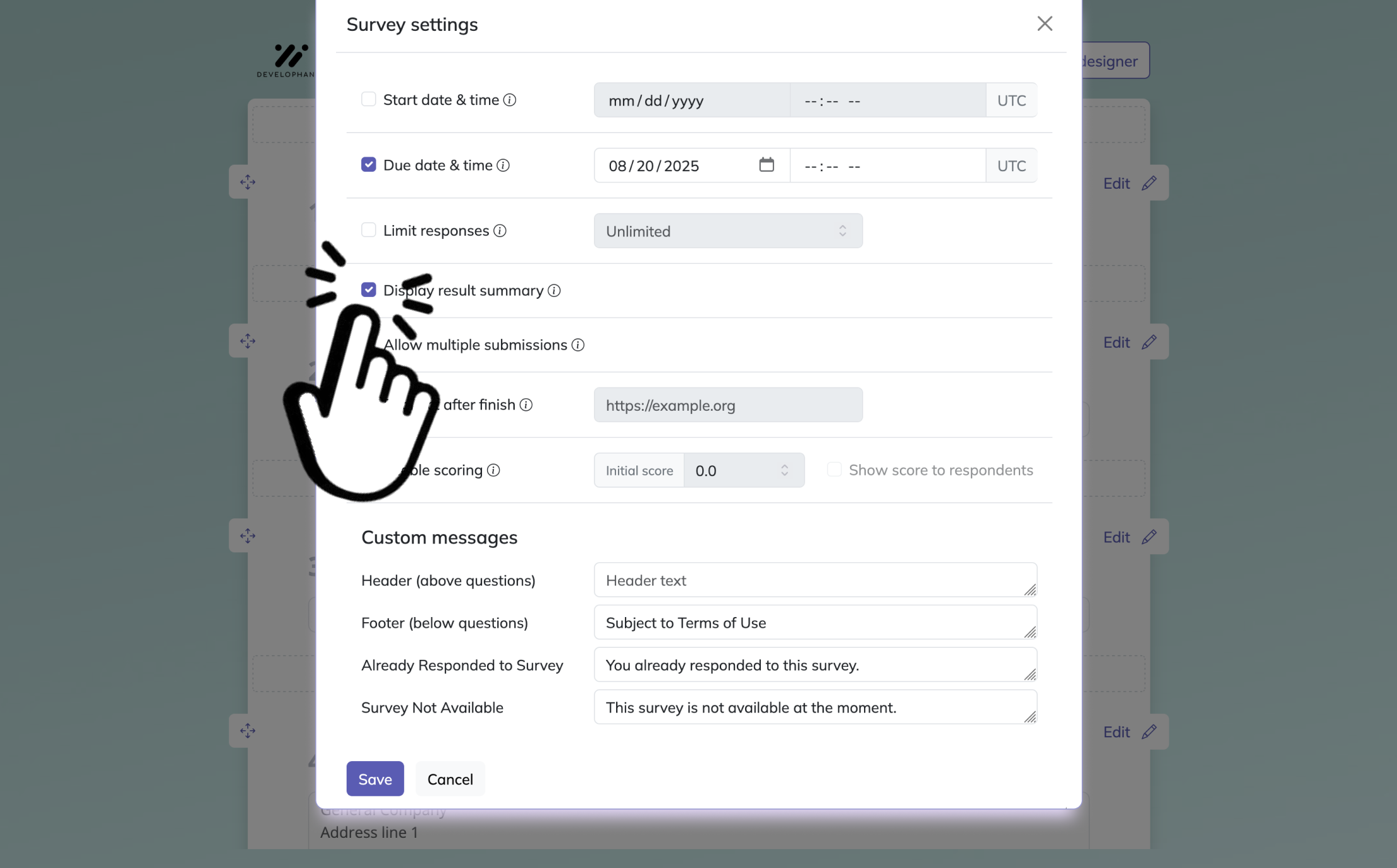
Creating a quantitative survey in HeySurvey is quick and simple. You can start from a template using the button below, or build your survey from scratch.
1. Create a new survey
Open HeySurvey and choose Empty Sheet or a template that fits your research goal. If needed, you can begin without an account. Give your survey a clear name so you can find it later in the editor.
2. Add questions
Click Add Question and choose the best question types for numerical data, such as Number, Scale, NPS, Choice, or Matrix. Write clear, measurable questions and mark important ones as Required. You can also add answer options, set value ranges, and customize labels to keep responses consistent and easy to analyze.
3. Publish survey
When your questions are ready, click Preview to check the survey flow, then choose Publish to create a shareable link. After publishing, you can send the survey to respondents and start collecting quantitative data immediately.
Rating Scale Questions
Rating scale questions help you score performance in a clean, measurable way.
Why & When to Use
Rating scale questions are classic sample quantitative survey questions because they ask people to assign a numerical score to a product, service, feature, or experience.
Unlike Likert items, which usually measure agreement with a statement, rating scale questions often focus more directly on quality, performance, or usefulness.
That makes them especially handy for data survey questions tied to benchmarking, score tracking, and KPIs.
If you want number survey questions that show whether customer support improved, delivery got faster, or training became more useful, this format does the heavy lifting without making your spreadsheet cry.
Here’s the thing, rating scales work best when you clearly define what the lowest and highest scores mean.
If a 1 means “very poor” and a 10 means “excellent,” say so plainly so respondents are not left guessing.
Plus, keep your scale length consistent across the survey whenever possible.
Mixing a 1 to 5 scale with a 1 to 10 scale too often can confuse respondents and muddy your results.
A strong quantitative survey questions sample in this category keeps wording simple, focuses on one topic at a time, and uses scales that are easy to interpret later.
Define the meaning of the lowest and highest score.
Use the same scale length across similar data survey questions.
Choose rating questions when you want easy comparisons over time.
Sample questions
Have you purchased from us before?
Did you find the information you needed today?
Are you currently employed full-time?
Have you used this feature within the last 30 days?
Would you be interested in receiving future updates?
Clear endpoint labels and consistent response scales improve survey measurement quality and make results easier to compare over time. Source
Binary Questions
Binary questions give you fast, tidy answers when the choice is truly one or the other.
Why & When to Use
Binary questions offer just two answer choices, usually yes/no, true/false, or selected/not selected.
That makes them some of the simplest sample quantitative survey questions you can use when you want quick answers without making people pause, squint, and overthink it like they are decoding a cereal box.
These number survey questions work best for qualification, screening, and straightforward factual checks.
If you need data survey questions that identify who has purchased, who has used a feature, or who wants follow-up, binary formats keep things clean and easy to count.
Here’s the thing, binary questions shine when the issue is clear-cut.
If the real answer could be “sometimes,” “it depends,” or “sort of,” this format may flatten useful nuance and leave you with less insight than you hoped for.
Plus, they are especially useful near the start of a survey.
You can use them to filter respondents, separate groups, and guide people toward the most relevant next questions without adding friction.
A strong quantitative survey questions sample in this category stays specific, time-bound when needed, and focused on facts rather than layered opinions.
Use binary questions when the answer is genuinely one of two options.
Choose them for fast screening, qualification, and simple factual measurement.
Avoid them when you need detailed attitudes, motivations, or shades of opinion.
Sample questions
Which age range do you belong to?
What is your primary reason for using our product?
Which device do you use most often to access our service?
What is your highest level of education completed?
Which of the following best describes your current job role?
Multiple-Choice Questions with Single Answer
Single-answer multiple-choice questions help you sort responses neatly and spot the most common choice fast.
Why & When to Use
These sample quantitative survey questions ask people to pick one option from a predefined list.
That makes them perfect when you want one clear answer, not a dramatic internal debate over six almost-right choices.
You will often use these number survey questions for classification, preference measurement, and finding out which option people choose most often.
They are especially useful when your goal is to compare groups, summarize patterns, or turn responses into clean charts without extra cleanup later.
Here’s the thing, this format creates tidy data survey questions that are easy to analyze because every response fits into a set structure.
Plus, that structure makes reporting smoother when you need quick counts, percentages, or side-by-side comparisons.
To make these questions work well, keep answer choices mutually exclusive so respondents do not get stuck between overlapping options.
On top of that, add an “Other” option only when it is truly needed, since too many open ends can muddy a strong quantitative survey questions sample.
It also helps to order options logically so the list feels easy to scan.
Arrange choices by frequency, chronology, or category.
Use one-answer format when only one option should represent the respondent.
Review choices carefully so options are clear, distinct, and not sneaky twins.
Sample questions
Which of the following social media platforms do you use regularly?
What factors influenced your purchase decision? Select all that apply.
Which features of our product have you used in the past month?
Where did you hear about our company? Select all that apply.
What challenges have you faced while using our service?
Research on questionnaire design finds single-answer multiple-choice items work best when response options are mutually exclusive and exhaustive, improving data quality and analysis clarity (NCBI).
Multiple-Choice Questions with Multiple Answers
Multiple-answer questions help you capture the full picture instead of forcing one lonely choice to do all the work.
Why & When to Use
These sample quantitative survey questions let respondents choose more than one option from a list.
That makes them useful when one answer is not enough, which is often the case in real life because people rarely behave like spreadsheets before coffee.
You can use these number survey questions for behavior mapping, feature usage, purchase drivers, and channel discovery.
Plus, they are great for showing breadth, meaning you learn how many different options apply to a person rather than only their top preference.
This makes them especially helpful when building data survey questions around habits, influences, pain points, or product interactions.
Here’s the thing, this quantitative survey questions sample works best when you clearly tell people to “Select all that apply.”
If you skip that instruction, responses can get messy fast because people may assume they should pick only one option.
On top of that, too many answer choices can lower response quality and make the question feel like a scavenger hunt.
To keep your sample quantitative survey questions easy to scan, group similar choices together so the list feels organized and readable.
Clearly label the question with “Select all that apply.”
Keep the option list focused so respondents do not lose steam.
Group related answers together to improve readability and cleaner analysis.
Sample questions
How many times have you purchased from us in the past 6 months?
How much do you typically spend on this product category each month?
How many employees work at your company?
How many hours per week do you use our software?
What is your age in years?
Numeric Entry Questions
Numeric entry questions give you exact figures, which is gold when you want clean data instead of educated guessing with a smile.
Why & When to Use
Numeric entry questions ask people to type in a number instead of picking from a set of answer choices.
That makes them one of the most useful sample quantitative survey questions when you need precise measurement, not broad categories.
You can use these number survey questions for things like age, purchase frequency, amount spent, employee count, or hours of product use.
Plus, they work especially well in data survey questions because the answers are easier to total, compare, average, and analyze statistically.
Here’s the thing, numeric entry works best when respondents are likely to know the answer or can estimate it reasonably well.
If they probably do not know the exact number, asking for precision can hurt accuracy faster than a toddler with a permanent marker.
To make your sample quantitative survey questions stronger, always specify the unit you want.
Use clear units like days, dollars, hours, years, or times per week.
Define the time frame, such as past 30 days or past 6 months.
Avoid asking for exact figures when a rough range would be more realistic.
On top of that, this format fits naturally into any quantitative survey questions sample because it produces direct, countable responses that are easy to chart and use in reporting.
Sample questions
Is each question written so it asks about only one thing at a time?
Are the response options clear, complete, and free from overlap?
Does every timeframe say exactly what period you mean, such as the last 30 days?
Are similar number survey questions using the same scale direction and format?
Have you tested these data survey questions with a small group before sending them out?
Best Practices for Writing Quantitative Survey Questions
Great survey writing is really about making it ridiculously easy for people to give you useful answers.
Why & When to Use
When you build sample quantitative survey questions, good writing matters just as much as good analysis.
Here’s the thing, even strong research goals can fall apart if your questions are vague, leading, or annoyingly hard to answer.
Use these best practices anytime you are writing number survey questions or broader data survey questions for customer feedback, market research, employee surveys, or academic work.
Dos
Keep your quantitative survey questions sample clean and practical:
Use plain language and ask one idea per question.
Keep scales consistent across similar questions.
Define timeframes clearly, like “in the last 30 days.”
Make response options exhaustive and non-overlapping.
Pilot test before launch to catch confusion early.
Match the question type to your goal, whether that is attitude, behavior, frequency, or demographics.
Use real-world wording people understand without needing a decoder ring.
Don'ts
Avoid mistakes that muddy your data fast:
Do not ask double-barreled questions.
Do not use leading or loaded phrasing.
Do not switch scale direction mid-survey.
Do not ask too many nearly identical questions.
Do not use vague words like “often” or “affordable” without context.
Do not force exact numeric answers when ranges make more sense.
Do not create overlapping answer choices, especially in age or income bands.
Sample questions
Are any sample quantitative survey questions using words like “regularly” or “often” without a clear number attached?
Do any number survey questions ask about more than one idea in the same sentence?
Are your data survey questions giving answer choices that miss likely responses?
Could respondents realistically remember the information you are asking for?
Have you removed questions that do not clearly support your survey goal?
Common Mistakes That Weaken Quantitative Survey Data
Tiny survey mistakes can quietly wreck perfectly good data.
Why & When to Use
Even well-planned sample quantitative survey questions can fail if the wording, structure, or sampling logic is sloppy.
Here’s the thing, this section works like a quality-control checkpoint before you publish, share, or send your survey into the wild like an overconfident paper airplane.
Bad question design can produce biased answers, skipped items, and messy results you cannot trust.
Plus, weak number survey questions often create problems that show up too late, usually when you are staring at a spreadsheet and questioning your life choices.
5 Common Mistakes to Watch For
Watch for these issues before launch:
Unclear scales, such as “sometimes” or “frequently,” can mean very different things to different people.
Recall-heavy data survey questions, like asking someone how many times they bought coffee in the last year, often produce rough guesses instead of useful data.
Double-barreled wording combines multiple ideas, like asking whether a product is “affordable and high quality,” which makes answers hard to interpret.
Incomplete response options leave out likely answers, forcing people into choices that do not fit.
Irrelevant or unnecessary questions reduce completion rates and annoy respondents, which is never a great research strategy.
On top of that, reviewing your quantitative survey questions sample for these mistakes helps protect data quality before the first response comes in.
Sample questions
Which sample quantitative survey questions point to the biggest problem you should fix first?
How do your number survey questions compare across customer types, employee groups, or time periods?
Which data survey questions show high importance but low satisfaction or performance?
Can your quantitative survey questions sample help you set clear benchmarks for the next quarter or year?
Which sample quantitative survey questions should you repeat later to measure progress?
Turning Quantitative Survey Insights Into Action
Good survey data should move decisions, not just fill slides.
Why & When to Use
Getting results is only half the job.
Here’s the thing, the real value of sample quantitative survey questions comes from using the numbers to spot trends, rank priorities, compare groups, and measure whether your fixes actually worked.
Before you analyze anything, decide which metrics matter most.
Plus, when you know your key goals first, your number survey questions become decision tools instead of decorative spreadsheet confetti.
You will usually learn more by comparing results across groups than by looking at one big average.
For example, data survey questions may reveal that one product line, customer segment, or employee group is having a very different experience.
5 Ways to Act on Survey Results
Use your findings in practical ways:
Identify the lowest-rated areas and focus first on the issues with the biggest business impact.
Segment sample quantitative survey questions by audience, product line, or time period to uncover hidden differences.
Use numeric patterns from number survey questions to set benchmarks and realistic future targets.
Share data survey questions results with stakeholders in a simple format that highlights decisions, not just details.
Re-run core sample quantitative survey questions over time so you can track progress reliably and see whether improvements changed the numbers.

Related Surveys
29 Social Media Survey Questions
Explore 25 social media survey questions with practical sample prompts to help gather insights on...
31 Job Satisfaction Survey Questions
Explore **25 job satisfaction survey questions** with sample prompts to improve employee feedback...
29 Family Survey Questions
Explore 25 family survey questions with sample questions to gather honest feedback, improve engag...