29 Ad Testing Survey Questions
Explore 25 ad testing survey questions with sample prompts to refine ad performance, gather insights, and improve campaign effectiveness.
Ever wonder why some ads click while others just politely exist? An ad testing survey is a simple way to ask real people what your ad is doing before launch and after it goes live.
The right advertising survey helps you measure attention, clarity, brand recall, relevance, and conversion intent, so you are not guessing with your budget.
Plus, this guide walks you through useful survey types, sample advertising questions, best practices, and how to turn findings into smarter campaigns with an online survey maker.
Sample questions
Which brand do you remember seeing in this ad?
What product or service do you think this ad was promoting?
Before today, how familiar were you with this brand?
After seeing this ad, how likely are you to remember this brand later today?
What part of the ad made the brand easiest to recognize?
Brand Recall and Recognition Survey Questions
Memory beats mystery.
Why & When to Use
This type of ad testing survey helps you find out whether people actually remember the brand, product, or message after seeing your ad. A flashy creative can get attention, but if viewers remember the joke and not your brand, your ad is basically doing cardio for someone else.
Use this advertising survey for display ads, video ads, social campaigns, and other awareness-stage efforts where recognition matters before clicks do. It also works especially well when you are comparing multiple creative concepts in brand perception survey questions advertisement effectiveness survey templates.
Here’s the thing, brand recall usually falls into two buckets:
Unaided recall asks people to name the brand without prompts, which is great when you want a clean read on what stuck.
Aided recall gives answer choices or hints, which is useful when you want to test recognition more than memory.
On top of that, weak brand linkage can quietly tank a strong-looking ad. If your visuals are memorable but your branding is tiny, late, or easy to miss, your advertising questions may reveal that people liked the ad but cannot connect it to you.
Plus, compare results across formats and audience segments. Your ad survey might show that one version wins on Instagram, while another performs better in video or with colder audiences.
Sample questions
What is the main message of this ad in your own words?
How clear was the offer or benefit presented in the ad?
What action do you think the ad wants you to take?
Was there anything confusing or unclear in this ad?
Which phrase or claim stood out to you the most?
Nielsen found branded content produced 86% brand recall versus 65% for pre-roll ads, underscoring why ad-testing surveys should measure recall explicitly (source)
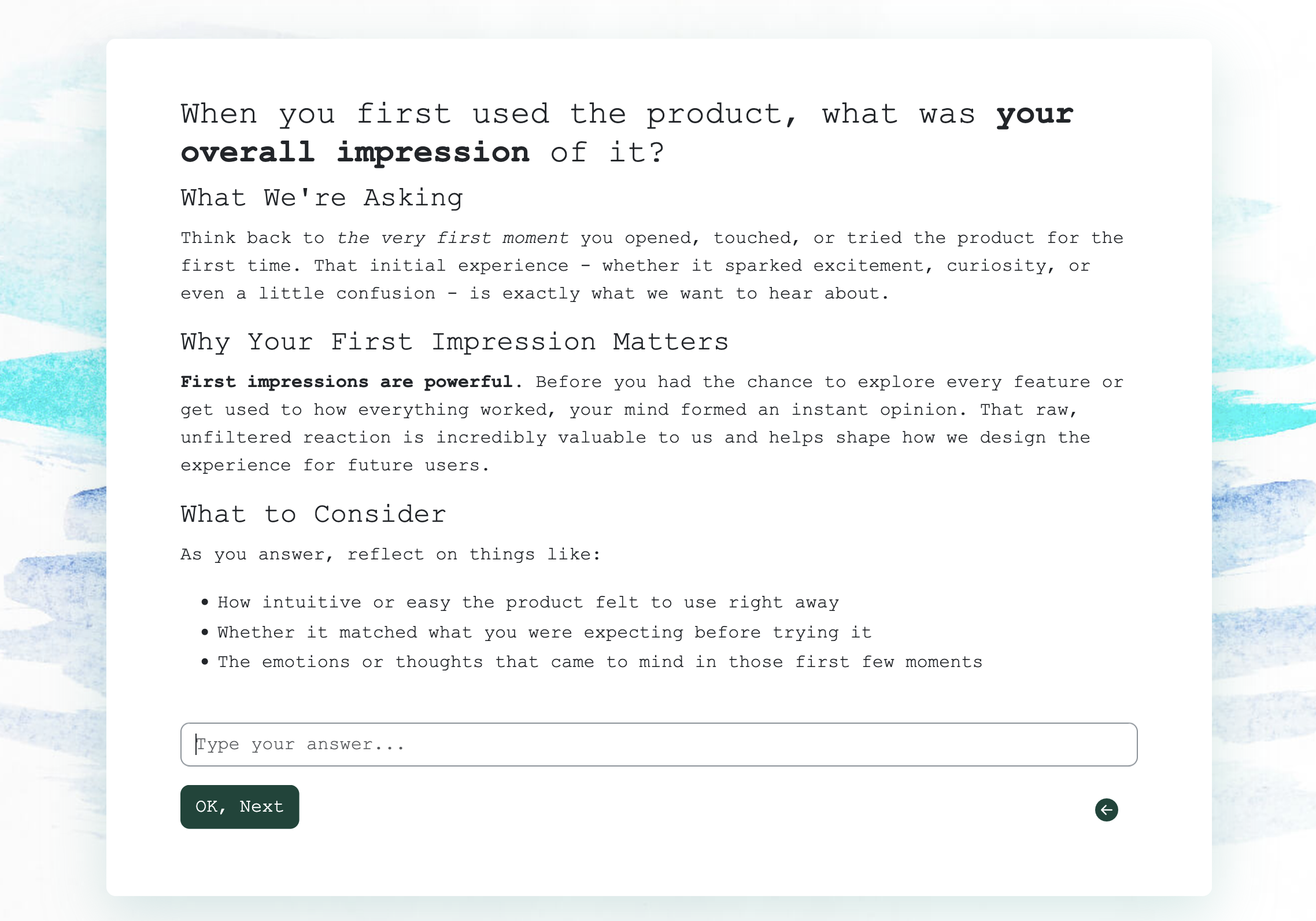
Creating an ad testing survey in HeySurvey is quick, even if you’ve never used the tool before. You can start from a template using the button below, or build one from scratch with our online survey tool.
1. Create a new survey
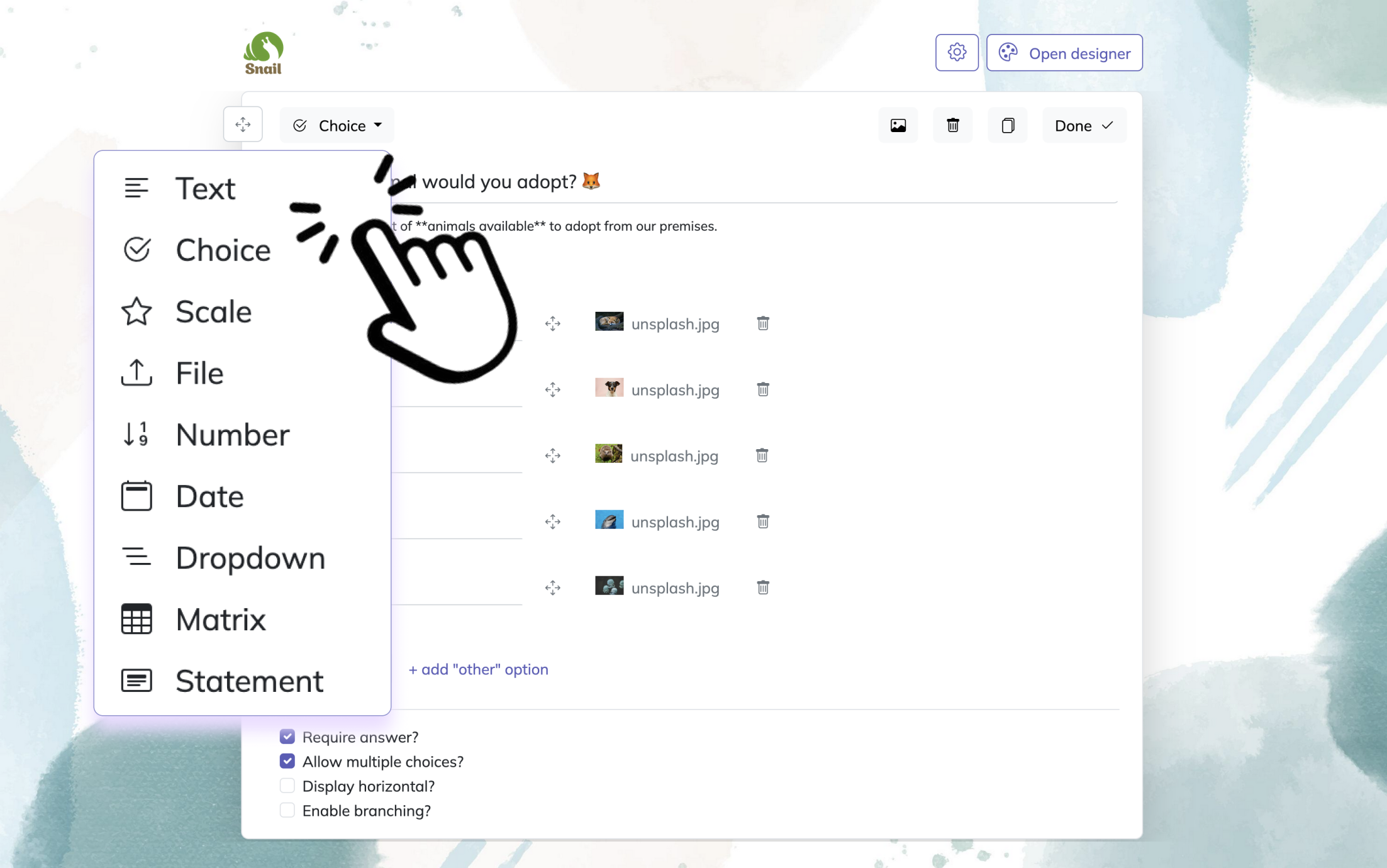
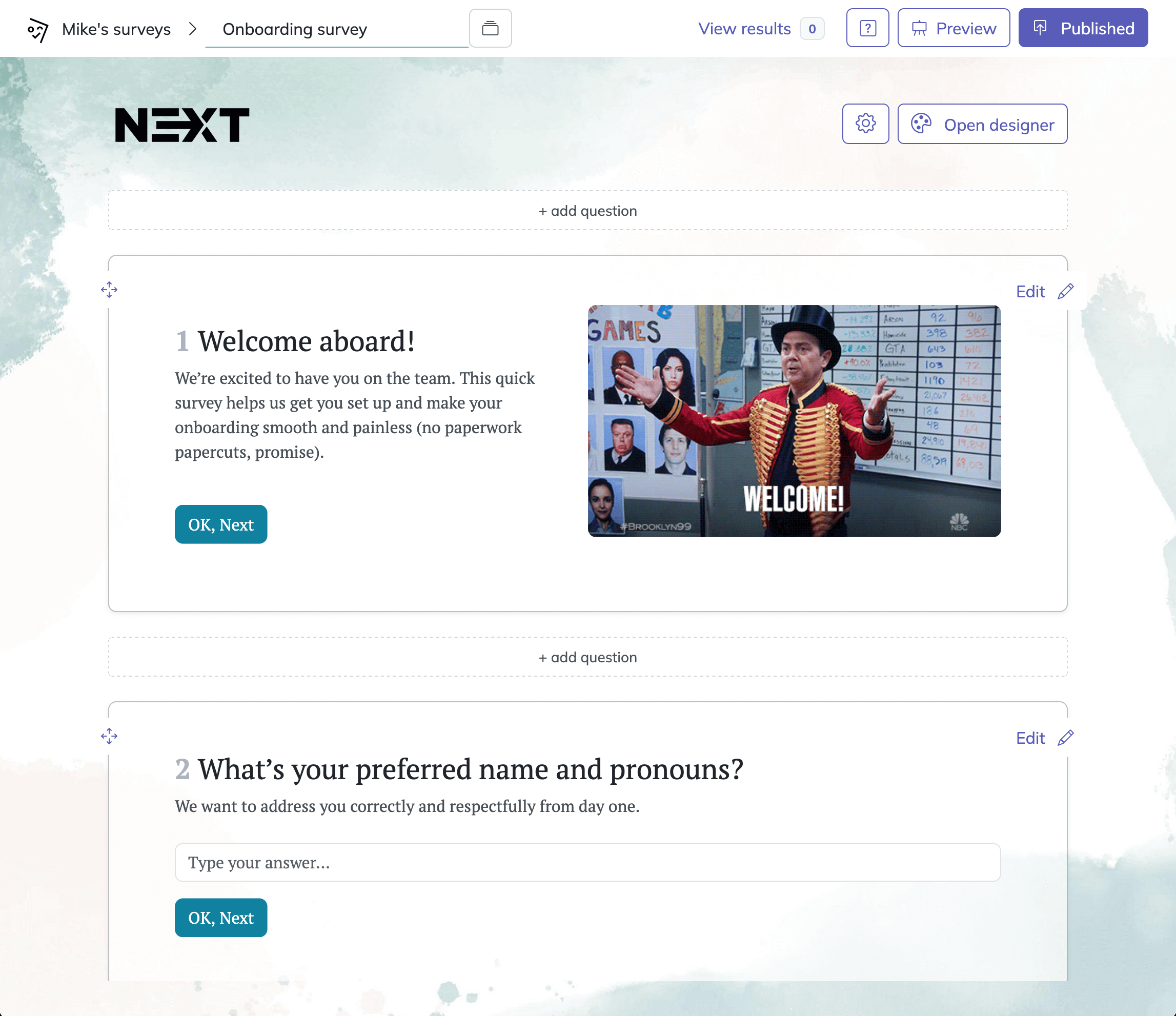
Open HeySurvey and choose New Survey. If you want a faster start, select an ad testing template. This gives you a ready-made structure you can edit for your campaign, product, or concept test.
2. Add questions
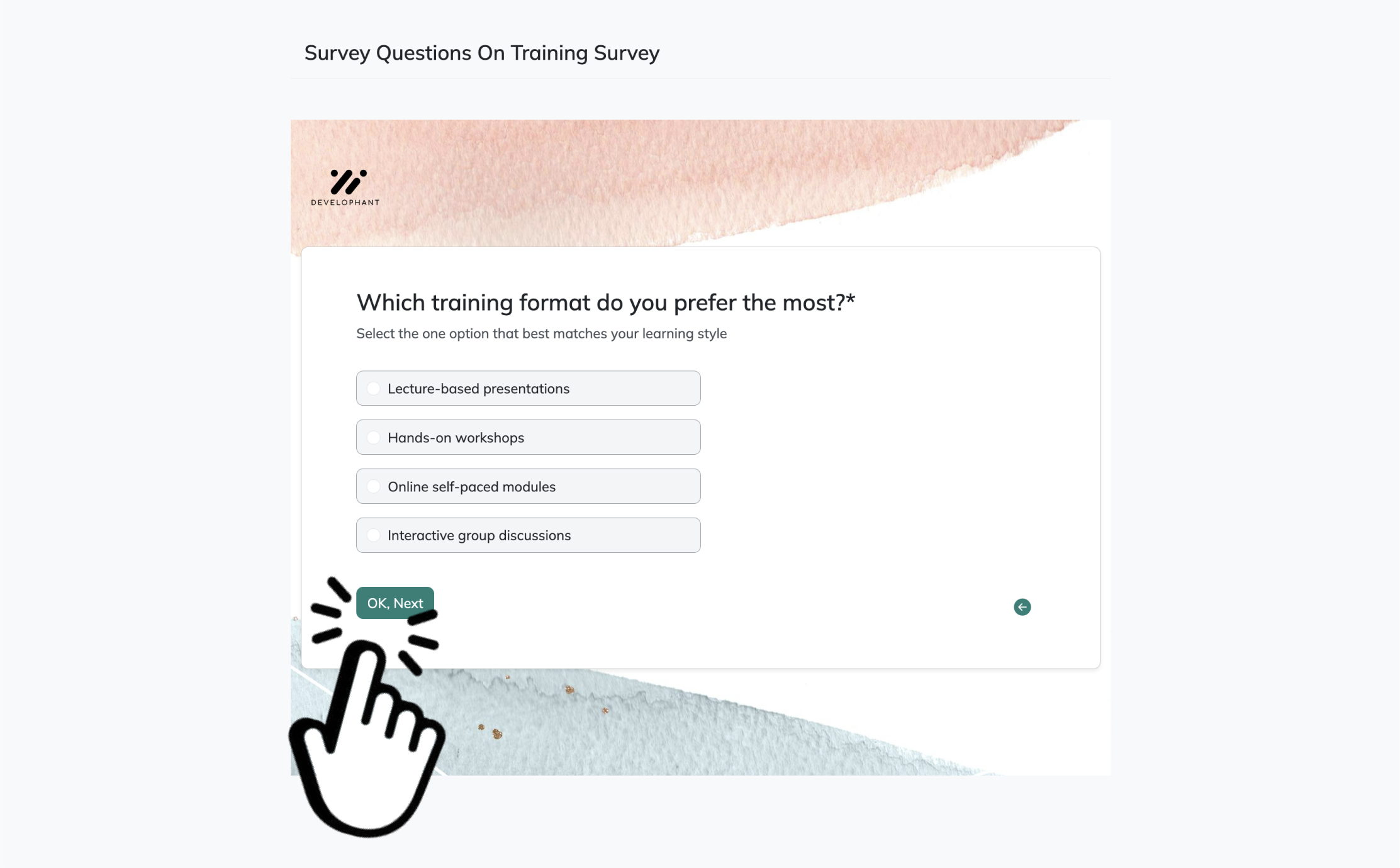
Click Add Question and include the most useful ad testing questions, such as a first-impression choice question, a rating scale for appeal, a preference question comparing ad versions, and an open text question for feedback. Keep questions short and clear so respondents can answer quickly.
3. Publish survey
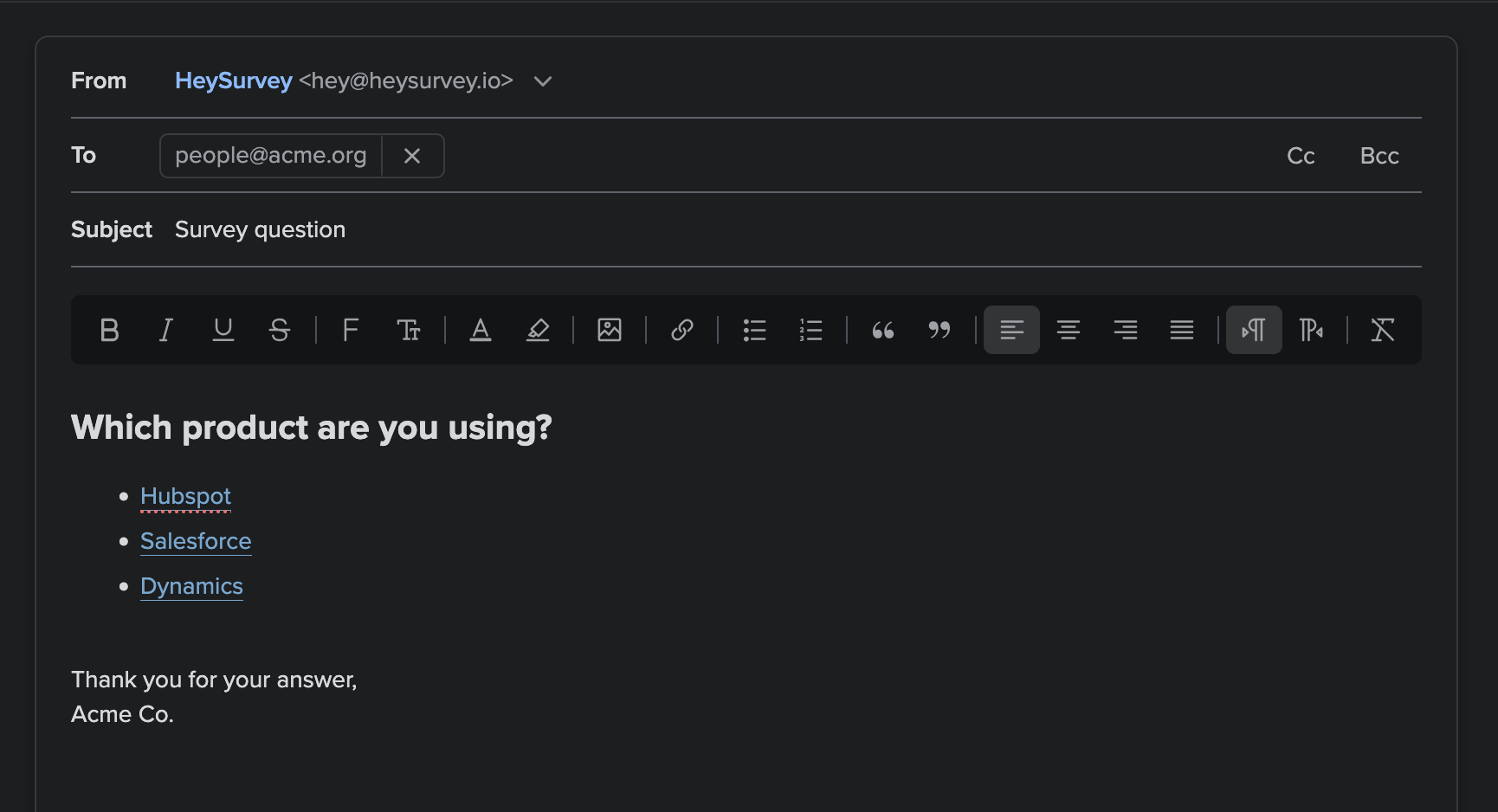
Review the survey in Preview to check how it looks on desktop and mobile. When everything is ready, click Publish to generate a shareable link. Send it to your audience and start collecting responses.
Message Clarity and Comprehension Survey Questions
Clear ads win faster.
Why & When to Use
This type of ad testing survey helps you figure out whether people actually understand your ad’s main point, offer, and value proposition. If viewers cannot explain the message back in simple words, your ad probably needs a tune-up, not a standing ovation.
It is especially useful for new product launches, promotional campaigns, and any ad with layered or technical messaging. Plus, it works beautifully in an online advertising questionnaire or google ads questionnaire when you want to test search, display, and YouTube messaging.
Here’s the thing, strong creative is not enough if the headline says one thing, the visual hints at another, and the CTA wanders off like it forgot the assignment. Your advertising survey should check whether all three are communicating the same idea.
Use these advertising questions to spot friction before you spend more budget. On top of that, they can reveal confusion around pricing, product features, or the next step you want people to take.
A good advertising questionnaire in this category should help you uncover:
Whether people can restate the message simply and accurately
Whether the offer or benefit feels obvious
Whether the CTA matches the promise in the ad
Whether any wording, claims, or visuals create confusion
Plus, this kind of advertising research questions set is great for comparing survey ads and tightening weak copy before launch.
Sample questions
What emotions did this ad make you feel?
How engaging did you find this ad overall?
Did this ad feel relatable to you? Why or why not?
What moment or element of the ad had the strongest emotional impact?
Did the tone of this ad fit the brand? Why or why not?
Google recommends survey questions be concise, specific, and jargon-free to produce cleaner data—critical for testing whether ad messaging is clearly understood (source).
Emotional Response and Appeal Survey Questions
Feelings drive clicks, but the right feelings drive results.
Why & When to Use
This ad testing survey helps you understand how your ad makes people feel and whether that emotional reaction supports your real brand goal. That matters because an ad can spark a big reaction and still miss the mark, kind of like fireworks at a budget meeting.
Use this type of advertising survey for storytelling ads, cause-based campaigns, lifestyle branding, and video creative where mood, tone, and atmosphere do a lot of the heavy lifting. Plus, it fits naturally into advertising surveys when you want to measure memorability, persuasion, and brand connection.
Here’s the thing, strong emotion is not always the same as effective persuasion. Your advertising questions should uncover whether people felt inspired, amused, reassured, skeptical, pressured, or a mix of all of the above.
A smart advertising survey should help you evaluate:
Whether the emotional response matches the campaign goal
Whether viewers had positive, negative, or mixed reactions
Whether humor, urgency, inspiration, or trust strengthened the message
Whether the ad felt relatable without feeling off-brand
Whether emotional moments improved recall and persuasion
On top of that, these advertising research questions are useful when testing survey ads that rely on brand personality more than product details. If the tone feels memorable and on-brand, your ad survey is doing its job nicely.
Sample questions
How relevant was this ad to your needs or interests?
Did this ad feel like it was meant for someone like you?
Which part of the ad felt most relevant to your situation?
Was anything in the ad not applicable to you?
How well did this ad match what you would expect from a solution in this category?
Relevance and Audience Fit Survey Questions
The best ads feel less like interruptions and more like, "Wait, this is actually for me."
Why & When to Use
This ad testing survey helps you figure out whether your message feels personally relevant to the people you want to reach. If viewers see the ad and think, "nice try, but not my problem," your targeting or message probably needs a tune-up.
Use this kind of advertising survey for segmented campaigns, retargeting, local advertising, B2B ads, and niche offers where audience-message fit really matters. Plus, it can help answer broader advertising questions about when, where, and to whom your campaign should show up.
Here’s the thing, relevance is rarely one-size-fits-all. A strong set of advertising questions can show whether your ad connects with the right persona, or just waves vaguely at everyone like an awkward neighbor.
A useful advertising survey should help you evaluate:
Whether the ad aligns with specific audience personas
Whether different segments respond differently by age, intent stage, customer status, or industry
Whether the message feels tailored or too generic
Whether low relevance points to weak targeting, unclear positioning, or bland copy
Whether the ad matches expectations for the category and solution
On top of that, these advertising research questions work well in survey ads and ad survey workflows where you need segment-based analysis, not just overall performance.
Sample questions
After seeing this ad, how likely are you to consider this product or service?
How likely would you be to click on this ad?
Did this ad increase your interest in learning more?
What, if anything, makes you hesitant to take action after seeing this ad?
How convincing did you find the ad compared with similar ads you have seen?
Nielsen reports effective ad testing should measure whether creative resonates with the intended audience, since reaching the desired audience alone does not guarantee resonance. Source
Purchase Intent and Persuasion Survey Questions
This is where your ad testing survey stops being interesting and starts being useful.
Why & When to Use
Persuasion-focused advertising survey questions help you measure whether an ad actually nudges people toward action. That could mean clicking, signing up, requesting a demo, or buying, which is the whole party trick of advertising in the first place.
Use this ad testing survey for performance campaigns, landing page support ads, lead generation, ecommerce, and product comparison creative. Plus, it is one of the most valuable parts of your advertising questions because it connects ad response to real business outcomes.
Here’s the thing, stated intent is directional, not a crystal ball. If someone says they are likely to click or buy, that does not guarantee conversions, but it does show whether your message is moving in the right direction.
A strong advertising survey in this category can help you evaluate:
Whether the ad increases interest and consideration
Whether viewers feel motivated enough to click or learn more
What objections, doubts, or friction points are blocking action
How persuasive your creative feels compared with competing survey ads
Whether your online advertising questionnaire results line up with CTR, CVR, and bounce-rate data
On top of that, open-ended follow-ups make these advertising research questions much more useful. They help you uncover hesitation points fast, which is often where the money is hiding.
Sample questions
Which part of this ad caught your attention first?
How effective was the headline in making you want to keep reading or watching?
How appealing was the visual or design of this ad?
How clear and compelling was the call to action?
If you could change one element of this ad, what would it be?
Creative Evaluation and Ad Element Feedback Questions
This is the part of your ad testing survey where you stop judging the whole ad and start inspecting the moving parts.
Why & When to Use
A creative-focused advertising survey helps you isolate reactions to specific elements like the headline, image, video hook, CTA, offer, layout, or branding. Instead of asking whether people liked the ad in general, you learn what actually pulled its weight and what just showed up looking busy.
Use this kind of ad testing survey when you are A/B testing concepts, improving underperforming creative, or reviewing survey ads across channels. Plus, it is especially useful when your team wants to refine ads before scaling spend, because fixing weak elements early is cheaper than feeding your budget to the algorithm and hoping for a miracle.
Here’s the thing, strong creative feedback works best when you break responses down by element instead of treating the ad as one unit. That makes your advertising questions more actionable and helps you compare static ads, carousel formats, video creative, and even search copy inside the same ad survey process.
A solid advertising questionnaire in this category can help you spot:
Which element grabs attention first
Whether the headline earns the next second of attention
How visuals, layout, and branding land across different advertising surveys
Whether the CTA is clear, persuasive, or just sitting there decoratively
False positives, where people like one element but still do not want to click or buy
On top of that, these advertising research questions help you make smarter edits faster, which is a lot more fun than rewriting ads based on vibes alone.
Sample questions
Is this question neutral, or does it push respondents toward a certain answer?
Does this question measure one idea at a time?
Is the wording simple enough for your target audience to understand quickly?
Will the answer help you make a real creative or targeting decision?
Are you pairing scaled questions with open-ended follow-up where needed?
Best Practices for Writing and Using Ad Testing Survey Questions
Great ad testing survey questions give you decisions, not just opinions.
Why & When to Use
Best practices matter because a good advertising survey should give you reliable, useful answers instead of fuzzy feedback like "it seems fine" or "I kind of liked it." Whether you are building a short google ads questionnaire, a full ad testing survey, or an advertisement effectiveness survey template, the goal is the same: ask advertising questions that lead to action.
Here’s the thing, even strong creative can look weak if your ad survey is confusing, biased, or overloaded. Plus, better structure helps you compare survey ads more fairly across audiences, platforms, and campaign goals.
Use these best practices when writing new advertising research questions, reviewing an old advertising questionnaire, or tightening an ad testing survey before launch. On top of that, they help you avoid the classic mistake of collecting a mountain of answers that somehow says absolutely nothing. Cute for a diary, not for ad performance.
Quick rules that improve advertising surveys:
Do keep questions neutral and specific.
Do mix rating-scale and open-text questions.
Do test one objective at a time.
Do segment results by audience type and platform.
Do keep surveys short enough to protect response quality.
Don’t ask leading or loaded advertising questions.
Don’t overload one survey with every possible metric.
Don’t rely only on vanity feedback like "Do you like this ad?"
Don’t ignore low-sample-size limitations.
Don’t treat survey feedback as a replacement for performance data.
Plus, pay attention to survey order, exposure timing, and benchmark tracking so your advertising survey results stay consistent and actually useful.
Sample questions
Did respondents actually view the full ad before answering?
Are you surveying the right target audience for this campaign?
Are you asking about too many concepts in a single ad testing survey?
Could the order of your advertising questions be shaping the answers?
Are you confusing ad preference with ad effectiveness?
Common Mistakes That Make Advertising Survey Results Misleading
A smart ad testing survey can still go sideways if the setup is sloppy.
Why & When to Use
Even strong advertising questions can produce weak insights when the audience, timing, or structure is off. Here’s the thing, a messy advertising survey can make a decent ad look bad, or worse, make a weak ad look like a winner.
Use this section when you want to catch problems before they turn into poor creative decisions, shaky targeting, or overconfident reporting. Plus, it helps you spot when your ad survey is measuring noise instead of real audience response.
Common mistakes to watch for in an ad testing survey include:
surveying people who are not part of the target audience
using samples that are too small to trust
asking leading or overly obvious advertising questions
stuffing too many ideas into one advertising survey
placing questions in an order that nudges later answers
treating "I like this" as proof that the ad will perform
Liking an ad and responding to it are not the same thing. Someone may say an ad is fun, yet still fail to remember the brand, understand the message, or click when it matters.
On top of that, stated feedback should not work alone. Validate your advertising survey findings with campaign metrics, follow-up testing, or another ad testing survey, because confidence without proof is basically marketing in a clown wig.
Sample questions
Which survey findings point to the biggest creative weakness?
What should be tested next based on the feedback?
Which audience segments responded most positively, and why?
What messaging themes should be emphasized or removed?
How will we measure whether the next ad version performs better?
How to Turn Ad Testing Survey Insights Into Better Campaigns
The best ad testing survey does not end with answers, it starts your next smarter move.
Why & When to Use
The point of an ad testing survey is not to admire a spreadsheet like it is modern art. It is to improve your creative, targeting, offers, and media choices in ways that actually lift performance.
Here’s the thing, this is the bridge between interesting advertising research questions and practical campaign optimization. A strong advertising survey helps you decide what to fix first, what to test next, and what to leave alone.
Start by prioritizing findings by impact:
fix clarity problems first, because if people do not understand the ad, nothing else matters
address relevance next, especially if the message misses the audience
improve persuasion after that, such as weak value props or soft calls to action
polish creative details last, like visuals, tone, or formatting
Plus, turn feedback into testable hypotheses for your next round of survey ads or campaign experiments.
For example:
if brand recall is low, test stronger branding earlier in the ad
if one segment responds better, build targeting and messaging around that audience
if an offer underperforms, compare a new value prop in the next advertising survey
On top of that, connect your advertising questions to channel metrics, sales outcomes, and audience segments. Strong ad testing survey insights should help you make smarter advertising decisions, not just collect more data for the marketing drawer of doom.
Related Brand Survey Surveys
31 Brand Positioning Survey Questions
Explore 25 brand positioning survey questions with sample answers to sharpen strategy, compare pe...
31 Rebranding Survey Questions
Explore 25 sample rebranding survey questions to refine your brand strategy, gather customer insi...
31 Brand Image Survey Questions
Explore 25 brand image survey questions with sample answers to measure perception, improve brandi...