27 360 Feedback Template Survey Questions
Explore 25 sample questions for a 360 feedback template survey questions guide, designed to improve employee reviews and team performance.
If you want feedback that is actually useful, a 360 feedback survey is a smart place to start. It helps you gather balanced input from managers, peers, direct reports, and cross-functional partners, so you get the full picture, not just the office selfie.
Ready-to-use 360 questionnaire examples
In this guide, you’ll get practical 360 questionnaire examples and 360 management survey questions by category, plus tips on when to use each set and how to turn responses into action. If you’re hunting for general or leadership-focused templates, you’re in the right place. For a simple online survey tool, you can also build and share these surveys quickly.
Sample questions
How effectively does this person set clear expectations and direction for the team?
How well does this person support team members in achieving goals and overcoming obstacles?
How consistently does this person make fair, timely, and well-informed decisions?
To what extent does this person create an environment of trust, accountability, and ownership?
How effectively does this person recognize performance and provide constructive support when improvement is needed?
Leadership and Management Effectiveness Survey Questions
Strong managers make your whole team better
Why & When to Use
These 360 questionnaire examples work best when you want to evaluate managers, team leads, department heads, and high-potential employees stepping into people leadership roles.
They are especially useful if you are searching for practical 360 management survey questions that go beyond gut feelings and focus on day-to-day leadership behavior.
Here’s the thing, this category fits several common moments where better feedback can make a real difference:
Annual performance reviews
Leadership development programs
Promotion readiness assessments
Manager coaching conversations
Succession planning
On top of that, leadership feedback is most useful when the questions focus on visible actions, not vague personality labels.
Ask about what the manager does, like setting direction, removing roadblocks, and making fair decisions, instead of whether they are “naturally inspiring” because, frankly, nobody can coach a shrug.
Plus, it helps to pair rating-scale questions with optional comment prompts so people can add context without writing a novel.
You’ll also get sharper insight when you compare a manager’s self-rating with feedback from direct reports and peers, since leadership often looks very different from the other side of the meeting table.
Sample questions
How clearly does this person communicate expectations, updates, and next steps?
How effectively does this person listen to others and show understanding before responding?
How well does this person tailor communication to different audiences or stakeholders?
How consistently does this person share relevant information in a timely manner?
How constructively does this person handle difficult or sensitive conversations?
Research indicates 360-degree leadership feedback is most useful when comparing self, peer, and direct-report ratings, since each perspective captures different aspects of effectiveness (source).
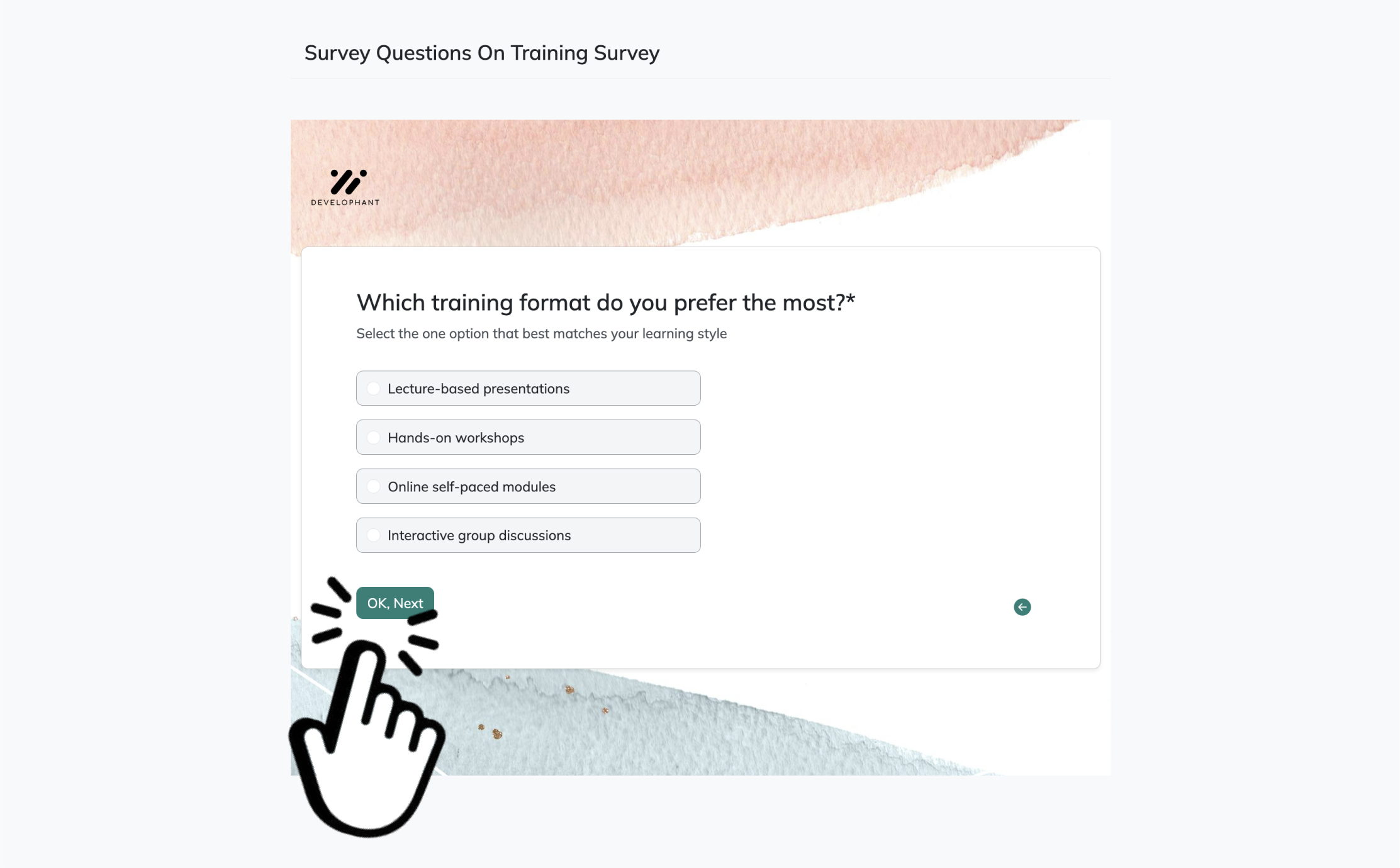
How to create a 360 feedback template survey in HeySurvey
Create a new survey
Start by opening the 360 feedback template with the button below, or choose a blank survey if you want to build it yourself. HeySurvey will open the survey editor, where you can rename the survey and adjust basic settings such as the survey title, logo, and response options.Add questions
Click Add Question to include the feedback items you need. For a 360 review, use Scale or Matrix questions for ratings, and Text questions for written comments. Add questions about communication, teamwork, leadership, and goal achievement. You can mark important questions as required and use descriptions to give respondents clear instructions.Publish survey
When your survey looks ready, click Preview to check it first. If everything is correct, press Publish to create a shareable link. You can then send the survey to managers, peers, and team members and start collecting feedback right away.
Communication Skills 360 Feedback Questions
Clear communication keeps good work from turning into guesswork
Why & When to Use
Communication belongs in almost every set of 360 questionnaire examples because it shapes how well you work, collaborate, and actually get things done.
If expectations are fuzzy or updates arrive late, even strong teams can end up playing accidental charades.
These 360 management survey questions are especially useful during key moments when communication habits really show up:
Performance reviews
Onboarding follow-up
Team conflict resolution
Role expansion or stretch assignments
Here’s the thing, this section works across roles and levels, which makes it one of the most flexible parts of broad 360 questionnaire examples.
For individual contributors, look at behaviors like writing clear messages, asking smart follow-up questions, and keeping teammates informed.
For managers, focus more on meeting communication, context-setting, active listening, and handling sensitive conversations with clarity and calm.
Plus, make sure your questions cover the full picture:
Written communication
Verbal communication
Meeting communication
On top of that, avoid double-barreled questions that mash two skills into one, like asking whether someone is “clear and empathetic” in the same prompt.
Split those apart so feedback stays specific, fair, and much easier to act on.
Sample questions
How effectively does this person work with others to solve problems and move work forward?
How willing is this person to share knowledge, resources, and credit with teammates?
How well does this person build positive working relationships across teams or departments?
How constructively does this person handle disagreements or differing viewpoints?
How reliable is this person in following through on commitments that affect others?
Research on 360 feedback question design shows single-competency, non-leading items produce clearer, more actionable communication feedback than double-barreled prompts (source).
Teamwork and Collaboration Survey Questions
Strong collaboration turns a group of busy people into an actual team
Why & When to Use
Teamwork deserves a central spot in practical 360 questionnaire examples because great results rarely come from solo effort alone.
Here’s the thing, collaboration is not just about being nice in meetings. It is about helping work move across people, priorities, and departments without everything catching fire.
These 360 management survey questions work especially well in settings where people need influence more than authority:
Cross-functional teams
Matrix organizations
Project-based work
Hybrid or distributed environments
Plus, this category is especially useful after real collaboration pressure has happened, not just in theory.
Use it during moments like:
Post-project retrospectives
Team effectiveness initiatives
Development planning for employees who lead through influence
On top of that, make sure your questions look beyond within-team behavior and include cross-functional collaboration too.
A person may be fantastic with their immediate team but mysteriously vanish when another department needs support. Funny how that happens.
Balance cooperation with accountability so your 360 questionnaire examples capture both sides of collaboration:
Shares ideas, knowledge, and credit
Builds trust across teams
Handles disagreement constructively
Follows through on commitments that affect others
When questions touch interpersonal friction, anonymity can help people give more honest, useful feedback.
Sample questions
How effectively does this person identify the root causes of problems rather than only the symptoms?
How well does this person evaluate options before making decisions?
How confidently does this person make decisions when information is incomplete or time is limited?
How often does this person involve the right people when solving problems or making decisions?
How effectively does this person learn from mistakes and apply those lessons going forward?
Problem-Solving and Decision-Making Survey Questions
Good judgment shows up when things get messy, not when everything is easy
Why & When to Use
This category adds real depth to 360 questionnaire examples because it looks beyond personality and into how someone thinks, decides, and responds when the path is not obvious.
Here’s the thing, plenty of people sound smart in calm moments. The real test is what they do when priorities clash, information is incomplete, and the clock is being a little rude.
These 360 management survey questions are especially useful for roles where judgment shapes results:
Project leads
Managers
Analysts
Technical specialists
Employees being considered for broader responsibility
Plus, this section is a smart choice when you want 360 feedback that goes beyond soft skills alone and captures critical thinking in action.
Keep questions tied to real business situations, not vague guesses about intelligence or potential.
On top of that, separate strategic decision-making from day-to-day operational choices when needed, because deciding next quarter’s direction is not the same as fixing today’s workflow snag.
Focus on observable behaviors and outcomes like these:
Finds root causes, not just surface issues
Weighs options before acting
Makes sound decisions under pressure or ambiguity
Involves the right people at the right time
Learns from mistakes and adjusts going forward
If possible, ask raters to think of specific examples, because “good thinker” is fuzzy and “solved the bottleneck without creating two new ones” is much more useful.
Sample questions
How consistently does this person meet commitments and deadlines?
How effectively does this person take ownership of results, including setbacks or missed goals?
How proactive is this person in identifying issues before they become larger problems?
How well does this person prioritize work to focus on the most important outcomes?
How reliably does this person follow through without needing excessive oversight or reminders?
Research suggests 360-degree feedback is most effective when survey items target specific, observable behaviors rather than vague traits, improving rating usefulness for development (source).
Accountability and Performance Survey Questions
Accountability is where good intentions stop talking and start delivering
Why & When to Use
This category earns a clear spot in strong 360 questionnaire examples because it helps you evaluate execution, dependability, and real ownership, not just effort or enthusiasm.
Here’s the thing, being busy is not the same as being accountable. A full calendar can look impressive, but results are the part that actually pays rent.
These 360 management survey questions work especially well when you need feedback that leads to practical next steps:
Annual performance reviews
Performance improvement plans
Promotion decisions
Goal-setting cycles
Plus, this category makes a 360 feedback template survey more action-oriented because it focuses on whether someone follows through, flags risks early, and delivers on what they said they would do.
When using this section, encourage raters to separate effort from outcomes.
On top of that, do not use these questions as a replacement for objective performance metrics like sales numbers, project completion rates, or quality scores, because feedback adds context but data keeps the scoreboard honest.
It also helps to add comment prompts like these:
Share an example of strong ownership
Describe a time follow-through was missed
Note whether reminders or oversight were needed
That way, your 360 questionnaire examples produce feedback people can actually use, instead of vague notes that sound polite and fix nothing.
Sample questions
How open is this person to receiving constructive feedback from others?
How actively does this person seek opportunities to learn and improve?
How well does this person adapt when priorities, processes, or expectations change?
How consistently does this person apply feedback to improve future performance?
How willing is this person to step outside their comfort zone to develop new skills?
Growth Mindset and Development Survey Questions
Growth-minded feedback helps you measure potential, not just polish
Why & When to Use
This category belongs in strong 360 questionnaire examples because it looks at coachability, adaptability, and willingness to learn, which matter even more when your organization is changing fast.
Here’s the thing, a person can perform well today and still struggle tomorrow if they resist feedback, avoid change, or cling to the old playbook like it is a family recipe.
These 360 management survey questions are especially useful when you want feedback to support coaching conversations, not just score past performance.
Use this section in moments like these:
Career development conversations
Leadership pipeline planning
New role transitions
High-change teams or departments
Learning-focused workplace cultures
Plus, this section makes your 360 process more future-focused because it helps you understand how someone grows, adjusts, and builds new skills over time.
It also works especially well when paired with a personal development plan, since the feedback can point directly to growth goals, coaching actions, and next-step learning priorities.
On top of that, ask raters to share examples of adaptive behavior during change, such as learning a new system, adjusting to shifting priorities, or applying feedback in a visible way.
That way, your 360 questionnaire examples produce development feedback that is useful, specific, and a lot more inspiring than a vague “shows potential.”
Sample questions
Which competencies are most important for success in this role right now?
Who interacts with this person often enough to provide meaningful feedback?
What decisions will be made from this feedback, and what evidence is needed?
Which behaviors should be measured consistently across all employees versus customized by role?
How long can the survey be before response quality starts to drop?
How to Choose the Right 360 Feedback Template Survey Questions
The best 360 survey is the one that fits your real goal, not the one with the most questions
Why & When to Use
Not every feedback process needs every category from your favorite 360 questionnaire examples, and that is actually good news because fewer, better questions usually beat a giant survey nobody wants to finish.
Here’s the thing, the right mix of 360 management survey questions depends on the role, the person’s seniority, and what you plan to do with the feedback after it lands in your inbox.
Use this section as a selection guide when you are building surveys for situations like these:
Leadership assessments
General employee reviews
Succession planning
Team resets
Culture initiatives
Plus, many people searching for 360 questionnaire examples are not really looking for more questions, they are trying to narrow the list without accidentally creating a marathon disguised as a survey.
For most use cases, aim for about 15 to 30 total questions so raters stay thoughtful instead of clicking through on autopilot.
On top of that, align your 360 management survey questions with competencies your organization already uses, such as communication, decision-making, or collaboration.
That way, your survey results connect more easily to hiring frameworks, performance reviews, coaching plans, and promotion discussions, which is a lot more useful than a random pile of opinions in spreadsheet clothing.
Sample questions
Is this question asking about something the rater can actually observe?
Does every item use the same rating scale from start to finish?
Are these 360 management survey questions specific enough to lead to action?
Will anonymity help people give more honest feedback in this situation?
Is this survey short enough to finish without eye-glaze setting in?
Best Practices for Writing and Using 360 Feedback Surveys
Good 360 surveys are clear, fair, and useful, not long, vague, and dramatic.
Why & When to Use
When you review 360 questionnaire examples, the goal is not to collect more words. It is to collect better evidence you can actually use.
Here’s the thing, strong 360 management survey questions focus on observable behavior, use consistent scales, and give raters a fair shot at answering accurately.
Dos
Use clear, behavior-based wording like: "Shares updates that keep the team aligned."
Keep rating scales consistent throughout the survey, such as 1 to 5 from "Never" to "Consistently."
Mix core competencies with role-specific items so your 360 questionnaire examples feel relevant, not generic.
Add optional comment boxes for examples and context.
Protect anonymity where appropriate, especially for peer and direct-report feedback.
Explain the survey’s purpose before launch so people know this is for growth, not a surprise boss battle.
Review every item for bias, leading language, and ambiguity.
Don’ts
Avoid broad items like "Has a great personality" when "Responds calmly under pressure" is more rateable.
Do not make the survey too long or repetitive. Around 15 to 30 well-written items is usually plenty.
Do not combine ideas, like "Communicates clearly and meets deadlines."
Do not use 360 management survey questions as the only basis for pay or promotion decisions.
Do not ask raters to judge things they rarely see.
Do not ignore cultural context, role differences, or reporting lines.
Do not deliver results without coaching, discussion, and a follow-up plan.
Sample questions
What 2-3 strengths appear most consistently across respondent groups?
What 1-2 development themes would create the biggest positive impact if improved?
Where do self-ratings differ most from ratings provided by others?
What specific behaviors should this person start, stop, or continue based on the feedback?
What follow-up goals, check-ins, or support resources will help turn feedback into progress?
Turning 360 Feedback Insights Into Action
Feedback only earns its keep when it turns into clear next steps.
Why & When to Use
After you collect responses, the real job begins. 360 questionnaire examples and 360 management survey questions are helpful, but the value shows up when you use the results to sharpen priorities, improve coaching, and create measurable behavior change.
Use this step after every 360 cycle, whether you are supporting individual growth, manager development, or team effectiveness. Plus, it helps you move from "interesting feedback" to "here is what you will actually do on Monday."
Here’s a simple action process you can use every time:
Review patterns across groups instead of reacting to one surprising comment.
Prioritize 1 to 2 themes that will make the biggest positive difference.
Set specific goals based on behaviors, not vague intentions.
Assign support through manager coaching, peer accountability, or development planning.
Revisit progress in regular check-ins so the feedback does not vanish into the corporate sock drawer.
On top of that, pay close attention to gaps between self-ratings and others’ ratings. Those differences often reveal blind spots, hidden strengths, or areas where clearer communication can help.
Your best move is to adapt these 360 questionnaire examples to your role, goals, and survey purpose, then turn insight into action you can actually see.
Related Surveys
29 Social Media Survey Questions
Explore 25 social media survey questions with practical sample prompts to help gather insights on...
31 Job Satisfaction Survey Questions
Explore **25 job satisfaction survey questions** with sample prompts to improve employee feedback...
29 Quantitative Survey Questions Guide
Explore 25 quantitative survey questions with sample questions, examples, and tips to build effec...