29 Voice of the Customer Survey Questions
Explore 25 voice of the customer survey questions with sample prompts to improve feedback, uncover insights, and strengthen customer experience.
If you want better patient feedback, the right questions change everything. VoC surveys, or voc survey questions for healthcare, help you hear what patients actually think so you can spot problems, improve care, and make smarter decisions with an online survey tool.
Here’s the thing, weak surveys get vague answers. In this guide, you’ll see voice of the customer example questions, a practical voice of the customer survey example, how many questions does the voice of the customer service survey have?, and when to use each type so you can turn responses into real improvements.
Sample questions
How satisfied were you with your overall experience today?
How well did our product or service meet your expectations?
What was the main reason for your satisfaction rating?
What, if anything, could we have done better?
How easy was it to get the result you needed?
Customer Satisfaction Survey Questions
Satisfaction surveys give you a quick read on the customer experience.
Why & When to Use
Customer satisfaction surveys help you measure how people feel after a purchase, service interaction, onboarding experience, or support resolution. If you are building a VoC program, this is often the easiest place to start because the feedback is simple, clear, and highly usable.
These surveys work especially well at transactional touchpoints, but they are also useful for tracking the overall relationship over time. That makes them a smart choice whether you are improving one moment or watching long-term trends.
Here’s the thing, satisfaction is not the same as loyalty. A customer can be satisfied today and still leave tomorrow, so voc survey questions for healthcare and other industries should separate "Was this experience good?" from "Would you stay with us or recommend us?"
For best results, send the survey shortly after the interaction while the experience is still fresh. Plus, pair rating questions with one open-ended follow-up so you learn the why behind the score, which is where the good stuff lives.
Use these surveys when you want to:
Measure a recent experience quickly
Track service quality across touchpoints
Collect voice of the customer example questions that reveal friction points
Answer practical questions like how many questions does the voice of the customer service survey have?, usually just enough to stay focused and finishable
Sample questions
On a scale from 0 to 10, how likely are you to recommend us to a friend or colleague?
What is the primary reason for your score?
What is one thing we could improve to earn a higher score?
What do you value most about our product or service?
How likely are you to continue using our product or service over the next 6 months?
AHRQ’s CAHPS research shows adding open-ended narrative questions to standardized experience surveys reveals important issues closed-ended questions may miss. Source
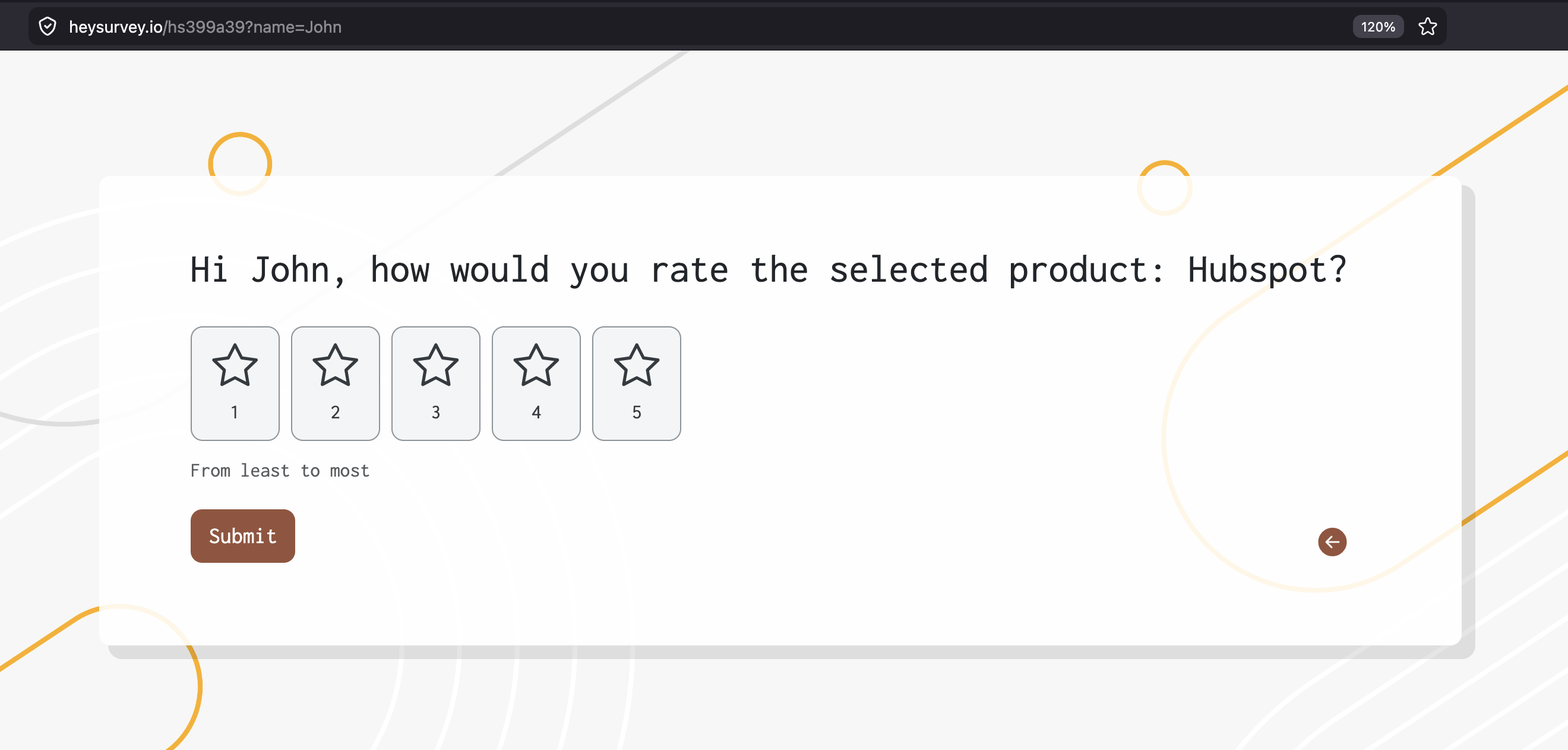
How to create a voice of the customer survey in HeySurvey
1. Create a new survey
Start by clicking the button below to open a ready-made template, or choose a blank survey if you want to build it yourself. In the survey editor, give your survey a clear internal name and, if needed, add your logo or adjust the settings. You can also preview the survey at any time to check how it will look for respondents.
2. Add questions
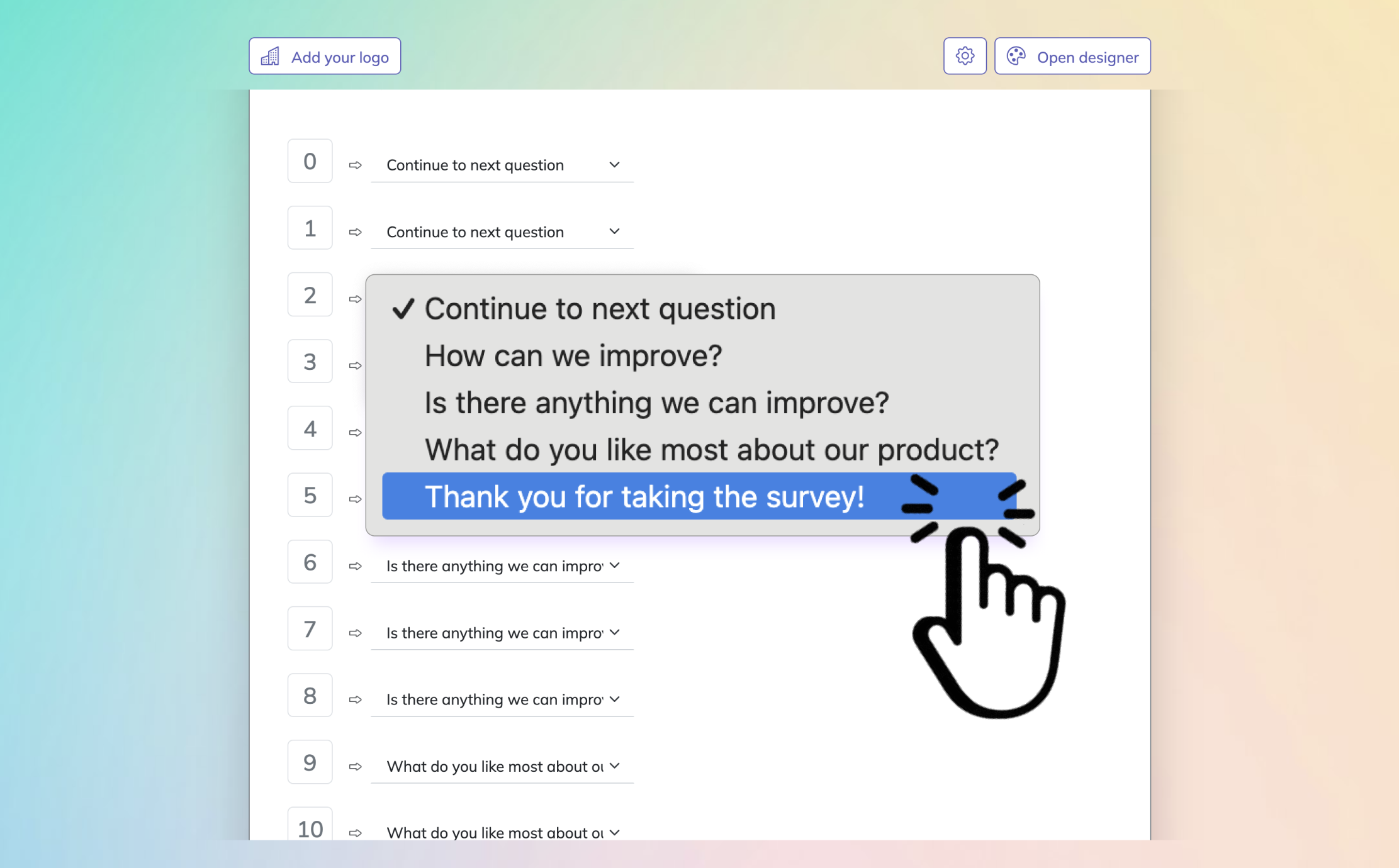
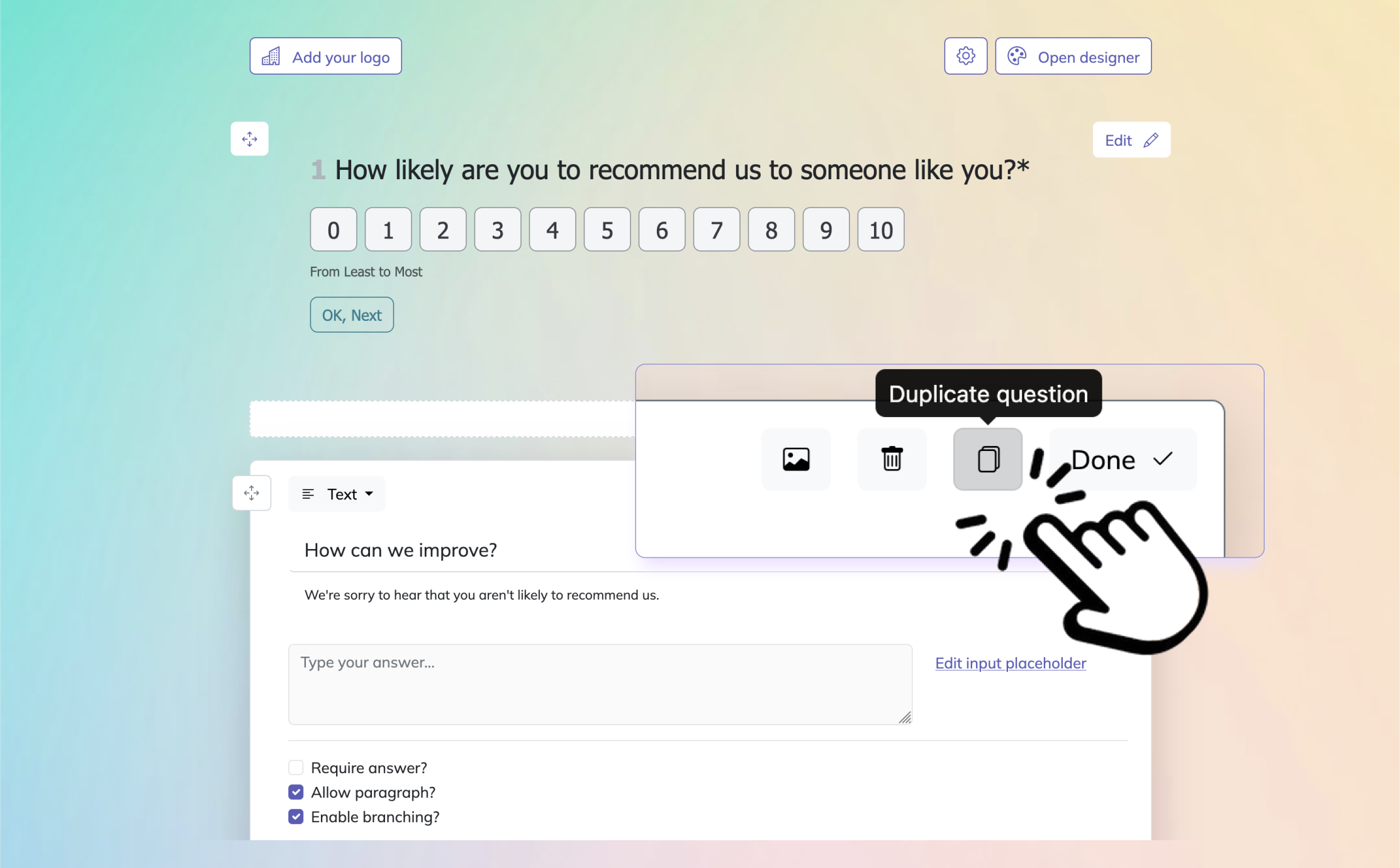
Click Add Question to include the questions you want to ask. For a voice of the customer survey, use a mix of NPS, Scale, Choice, and Text questions to measure satisfaction, loyalty, and open feedback. Keep questions short, clear, and focused on the customer experience. You can mark important questions as required and reorder them anytime.
3. Publish your survey
When your survey is ready, click Publish to generate a shareable link. You can send it to customers by email, embed it on your website, or share it directly. After publishing, you’ll be able to view and analyze responses in the online survey maker Results page.
Net Promoter Score (NPS) Survey Questions
NPS helps you spot loyalty trends before they turn into revenue surprises.
Why & When to Use
NPS-style voc survey questions for healthcare, SaaS, retail, and service brands are built to measure loyalty and referral intent. In plain English, they help you see whether customers would cheer you on, shrug politely, or run for the hills.
That is why NPS is useful for tracking brand health over time and grouping respondents into promoters, passives, and detractors. Plus, those segments give you a practical way to prioritize follow-up, retention, and improvement efforts.
Here’s the thing, NPS works best when you do not use it alone. Pair the score with voice of the customer example questions so you learn why someone gave that number, because the score without context is basically a weather report without the sky.
Use relationship NPS when you want a big-picture read on the customer relationship. Use transactional NPS after a specific moment, like onboarding, a support interaction, or a renewal event.
For periodic surveying, a steady cadence usually works best:
Quarterly for fast-moving customer experiences
Biannually for more stable relationships
After key milestones for transactional feedback
If you are wondering how many questions does the voice of the customer service survey have?, NPS surveys are often short, commonly 2 to 3 questions. On top of that, overall VoC survey length depends on your goal, so keep it focused.
Sample questions
How easy was it to resolve your issue today?
How much effort did you personally have to put in to get your problem solved?
Were you able to complete your task without unnecessary steps?
What part of the process felt most difficult or frustrating?
What could we change to make this experience easier?
Bain research says effective NPS surveys use one recommendation question plus a follow-up asking the primary reason for the score, adding essential context for action (source).
Customer Effort Score (CES) Survey Questions
CES helps you find the friction that quietly pushes customers away.
Why & When to Use
Customer Effort Score focuses on how easy or difficult it was for someone to complete a task. That makes it one of the most practical voc survey questions for healthcare, support teams, financial services, and other service-heavy businesses.
Here’s the thing, effort matters a lot more than many teams expect. When customers have to repeat themselves, click through extra steps, or chase down help, retention can drop fast because nobody enjoys turning a simple task into a side quest.
CES works best right after a single interaction or process, not weeks later when details get fuzzy. Use it after support conversations, returns, onboarding, scheduling, billing updates, or account changes.
Plus, wording matters. In many cases, asking how "easy" something was performs better than asking about "effort," because it feels simpler and more natural to answer.
Use voice of the customer example questions alongside the rating so you know where the friction lives. If you are asking how many questions does the voice of the customer service survey have?, CES surveys are often short, usually around 2 to 5 questions, depending on the follow-up detail you want.
Look for patterns across:
Support channels
Teams or locations
Specific processes like returns or onboarding
Repeated complaints about delays, handoffs, or confusing steps
On top of that, this voice of the customer survey example is especially useful when your goal is not just feedback, but making life easier for your customers.
Sample questions
Which feature do you find most valuable, and why?
What task are you mainly trying to accomplish with our product?
Was there anything confusing or difficult while using the product?
What feature or improvement would make this product more useful for you?
If you stopped using the product, what would be the main reason?
Product Feedback Survey Questions
Product feedback surveys show you what customers love, what they ignore, and what they wish existed yesterday.
Why & When to Use
Product-focused VoC surveys help you understand feature value, usability issues, missing pieces, and unmet needs. They are some of the most useful voc survey questions for healthcare platforms, SaaS tools, ecommerce brands, and digital product teams that want clearer direction.
Here’s the thing, customers do not always use your product the way you expected, which is both helpful and a tiny bit humbling. That is exactly why voice of the customer example questions matter so much.
These surveys work best after meaningful product moments, like onboarding completion, trial usage, feature adoption, or a major update. If you are wondering how many questions does the voice of the customer service survey have?, product surveys often stay concise, usually around 3 to 7 questions, depending on how specific the feedback needs to be.
To make the feedback more useful, tie questions to real product behaviors or milestones.
Look for patterns across:
New users versus power users
People who adopted a feature versus those who ignored it
Trial users, paying customers, and churned users
Open text responses that reveal customer language you can reuse in messaging, content, and SEO
Plus, a smart voice of the customer survey example does more than collect opinions. It helps you build a product people actually want to keep using.
Sample questions
How satisfied were you with the support you received?
Did our team fully resolve your issue?
How clear and helpful was the communication from our representative?
How long did it take to get the help you needed?
What could we do to improve our customer service experience?
SurveyMonkey recommends purposeful VoC questions using closed-ended metrics plus open text, because question design determines whether feedback reflects real customer opinions (source).
Customer Service VoC Survey Questions
Customer service VoC surveys help you spot whether your support feels fast, clear, and genuinely helpful, or like a game of polite ping-pong.
Why & When to Use
Customer service surveys are designed to capture feedback on support quality, responsiveness, and resolution effectiveness. They are some of the most practical voc survey questions for healthcare teams, retail brands, SaaS companies, and any business where service moments shape loyalty.
These surveys work best right after a live chat, phone call, email exchange, or in-person support interaction. Here’s the thing, if you wait too long, the details get fuzzy and the feedback gets less useful.
This section also lines up neatly with the search intent behind how many questions does the voice of the customer service survey have? In most cases, the sweet spot is short and simple, usually around 3 to 5 questions, because long support surveys tend to lose people fast.
To get better insight, balance agent-specific questions with process-level questions.
Review feedback across:
Courtesy, clarity, and professionalism of the representative
Speed of response and time to resolution
Whether the issue was fully solved
Verbatim comments that explain why a rating was high or low
Plus, do not look at scores alone. Voice of the customer example questions become far more useful when your support team reviews ratings and written comments together, because the number tells you what happened and the comment tells you why.
Sample questions
How clearly did our staff explain your care or next steps?
How easy was it to schedule, access, or attend your appointment?
Did you feel listened to and treated with respect during your visit?
Was there any point in your experience that felt confusing or stressful?
What is one thing we could improve to provide better patient service?
Industry-Specific VoC Survey Questions for Healthcare
The best voc survey questions for healthcare focus on clarity, empathy, access, trust, and care coordination, not just satisfaction scores.
Why & When to Use
If you are searching for voc survey questions for healthcare, this is the section you actually want, because healthcare feedback needs a more thoughtful touch than a standard customer survey.
Patients, caregivers, and service users are often sharing feedback when they feel tired, stressed, or overwhelmed, so your wording should stay simple, calm, and sensitive. Here's the thing, nobody wants to decode survey jargon while holding discharge papers and a snack-size level of patience.
Use shorter surveys in high-stress moments or right after a visit, appointment, or support interaction. On top of that, keep questions broadly applicable so they can work across clinics, hospitals, specialty practices, and other healthcare services without drifting into regulatory promises.
Strong voice of the customer example questions in healthcare usually explore:
How well staff explained care, instructions, or next steps
How easy it was to schedule or access care
Whether the patient felt heard, respected, and supported
Wait times, handoffs, and coordination across the experience
Overall confidence in the care received
Plus, a good voice of the customer survey example should ask about both the emotional side and the practical side of care. That balance gives you feedback you can actually use, without turning the survey into a second appointment.
Sample questions
What specific customer moment are we trying to measure?
What decision will we make based on the answers?
Which customers should receive this survey?
What is the minimum number of questions needed to learn what we need?
Which follow-up question will help explain the rating we collect?
How to Choose the Right Voice of the Customer Survey Questions
The right VoC survey questions depend on where your customer is, what just happened, and what you plan to do with the answers.
Why & When to Use
Not every survey should ask the same thing, even if you are using solid voc survey questions for healthcare or borrowing from general voice of the customer example questions.
Here's the thing, the best survey is not the longest or fanciest one. It is the one that helps you make a clear decision without making your customer feel like they accidentally opened a school exam.
Use this section as your decision framework when choosing the best survey type for a moment, channel, or goal.
Match the survey to what you want to learn:
Satisfaction for overall experience
Loyalty for likelihood to recommend
Effort for ease and friction
Product for feature or usability feedback
Support for service quality and resolution
Plus, think hard about attention span. If you are wondering, "how many questions does the voice of the customer service survey have?", the honest answer is usually fewer than you think.
A strong voice of the customer survey example should be adapted, not copied word for word, because audience, timing, and context change everything.
On top of that, choose who gets the survey, when they get it, and which format fits best:
Rating scales for quick benchmarking
Multiple-choice for patterns and comparison
Open-ended questions for nuance and explanation
That is how voice of the customer example questions become useful, not just nice-looking.
Sample questions
Are your voc survey questions for healthcare clear enough that a patient or customer can answer them fast without needing a decoder ring?
Does each question ask only one thing, or are you sneaking in two questions dressed as one?
Are you using neutral wording that captures honest feedback instead of nudging people toward nice answers?
Have you included at least one open-ended prompt to learn the reason behind the rating?
If you are asking how many questions does the voice of the customer service survey have?, have you tested whether fewer questions improve completion?
Best Practices for Writing Voice of the Customer Survey Questions
Good survey writing is simple, neutral, timely, and useful.
Why & When to Use
If your survey is hard to read, too long, or oddly timed, even strong voice of the customer example questions can flop.
Here's the thing, better writing usually beats more writing.
Use these best practices when you are building, reviewing, or tightening voc survey questions for healthcare, support, product, or service teams.
Dos
Keep your survey sharp and human:
Keep questions clear, specific, and easy to answer.
Use neutral wording that does not lead the respondent.
Ask one thing at a time instead of combining multiple ideas.
Include at least one open-ended question for context.
Align survey timing with the experience being measured.
Test survey length and completion rates over time.
Use customer language in questions wherever possible.
Don’ts
Avoid the usual survey potholes:
Don’t ask too many questions in a single survey.
Don’t rely only on rating scales without asking why.
Don’t use jargon, vague wording, or internal company terms.
Don’t ask biased questions that push customers toward positive answers.
Don’t survey every customer at every touchpoint without a plan.
Don’t collect feedback without assigning ownership for follow-up.
Don’t ignore differences between industries, especially sensitive areas like healthcare.
On top of that, a strong voice of the customer survey example should feel easy for you to analyze and easy for your customer to finish.
Sample questions
After collecting voc survey questions for healthcare or service feedback, do you sort responses into themes like pricing, usability, communication, service speed, and trust?
When you review voice of the customer example questions, are you also deciding who owns the follow-up actions?
If you are asking how many questions does the voice of the customer service survey have?, are you also checking whether those questions lead to decisions, not just dashboards?
Do you share survey findings with product, support, marketing, sales, and leadership so the right teams can act?
When customers point out a problem, do you close the loop after a fix so they know their feedback actually mattered?
Turn Voice of the Customer Survey Insights Into Action
Feedback only becomes valuable when you do something with it.
Why & When to Use
The real value of voc survey questions for healthcare, service, or product teams shows up after the responses roll in.
Here's the thing, even a smart voice of the customer survey example is just a pile of comments until you turn it into action.
This is the operational next step after writing the right voice of the customer example questions.
Start by grouping responses into themes so patterns pop faster.
Pricing
Usability
Communication
Service speed
Trust
Plus, once themes are clear, prioritize fixes by two things: how often the issue appears and how much it affects the customer experience.
That keeps your team from chasing tiny annoyances while bigger problems tap-dance in the corner.
On top of that, share findings across teams so product, support, marketing, sales, and leadership are working from the same customer truth.
Then close the loop with customers when changes are made.
A short follow-up message can build trust, strengthen loyalty, and prove their feedback did not vanish into the survey abyss.
Strong VoC survey design leads to clearer insights, better decisions, and improvements your customers can actually feel.
Related Surveys
29 Social Media Survey Questions
Explore 25 social media survey questions with practical sample prompts to help gather insights on...
31 Job Satisfaction Survey Questions
Explore **25 job satisfaction survey questions** with sample prompts to improve employee feedback...
29 Quantitative Survey Questions Guide
Explore 25 quantitative survey questions with sample questions, examples, and tips to build effec...