29 Types of Survey Questions
Explore 25 sample survey questions with key question types, examples, and tips for creating effective surveys and collecting better feedback.
Survey questions are the building blocks behind customer feedback, market research, employee input, and UX research, and the right ones help you get answers you can actually use.
hotjar survey questions
Choose the right format and your hotjar survey questions can boost response quality, completion rates, and smarter decisions, while better choices for questionnaires keep people clicking instead of ghosting you. Plus, you’re about to see the main survey question types, when to use each one, sample questions, and best practices for turning answers into action, not just into another spreadsheet that stares back. If you’re looking for an online survey tool, the right questions make all the difference.
Sample questions
Which of the following best describes your job role?
How did you first hear about our brand?
Which product category are you most interested in?
What is your primary reason for visiting our website today?
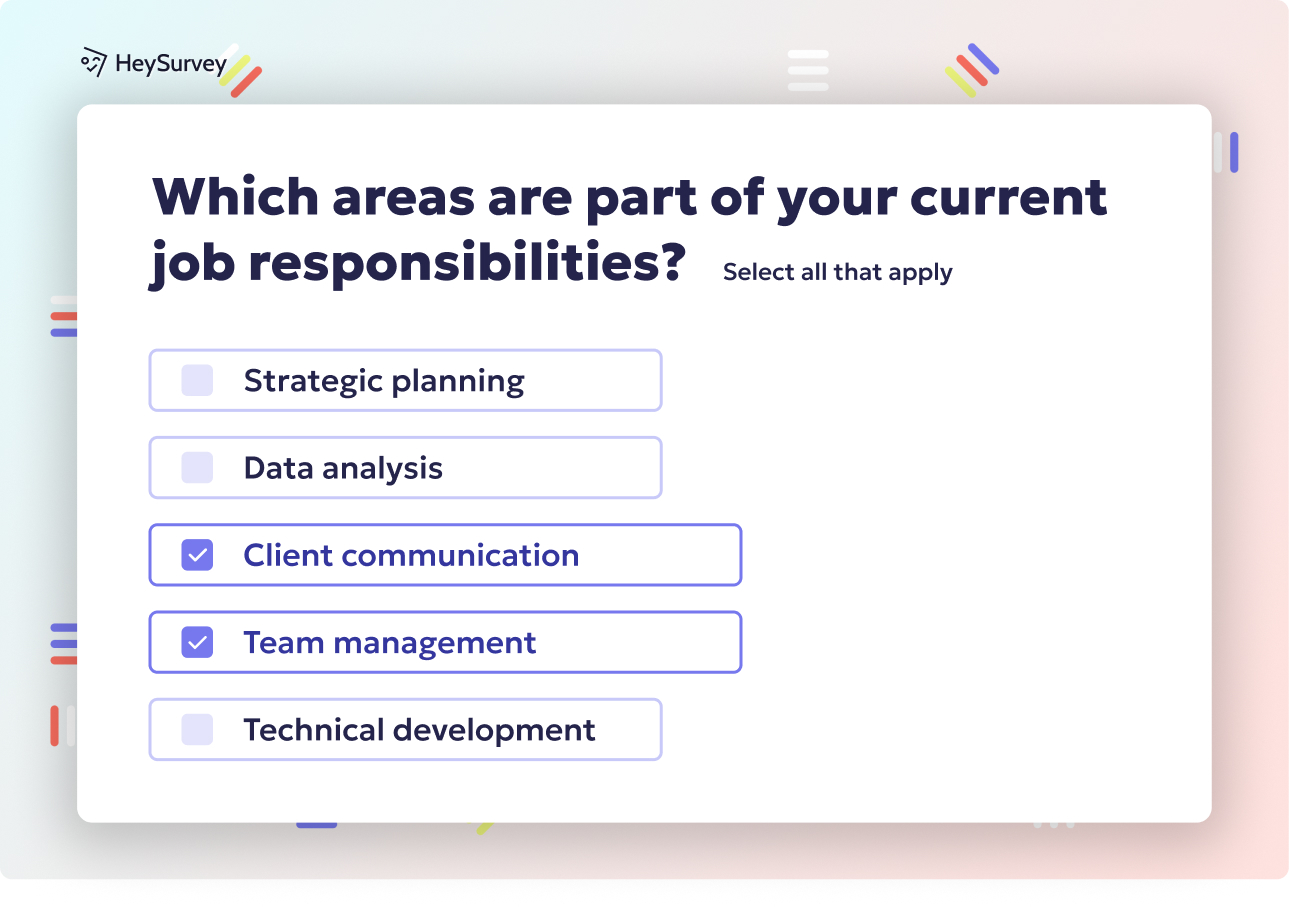
Which features do you use most often? Select all that apply.
Multiple-Choice Survey Questions
Easy to answer, easy to analyze
Why & When to Use
Multiple-choice hotjar survey questions work best when you want people to choose from predefined answers instead of typing everything out.
They are one of the most reliable choices for questionnaires because they speed up responses and make your data much simpler to sort, compare, and act on.
Here’s the thing: there are two main formats.
Single-select means the respondent picks one answer.
Multi-select means they can choose more than one.
This question type is especially useful for demographics, product preferences, purchase behavior, and website feedback.
If you want to know why someone came to your site, which product they like, or how they found you, multiple-choice hotjar survey questions usually do the heavy lifting without making your visitor feel like they just sat down for an exam.
To make them work well, keep your answer choices clean and clear.
Make options mutually exclusive whenever possible.
Avoid overlapping ranges or fuzzy categories.
Use “Other” only if there is a real chance your list misses something important.
Limit the number of options so people do not stall out from decision fatigue.
Plus, better choices for questionnaires mean better answers, and fewer “uhh, maybe this one?” clicks.
Sample questions
On a scale of 1 to 5, how satisfied are you with your recent purchase?
How easy was it to find what you needed on our website?
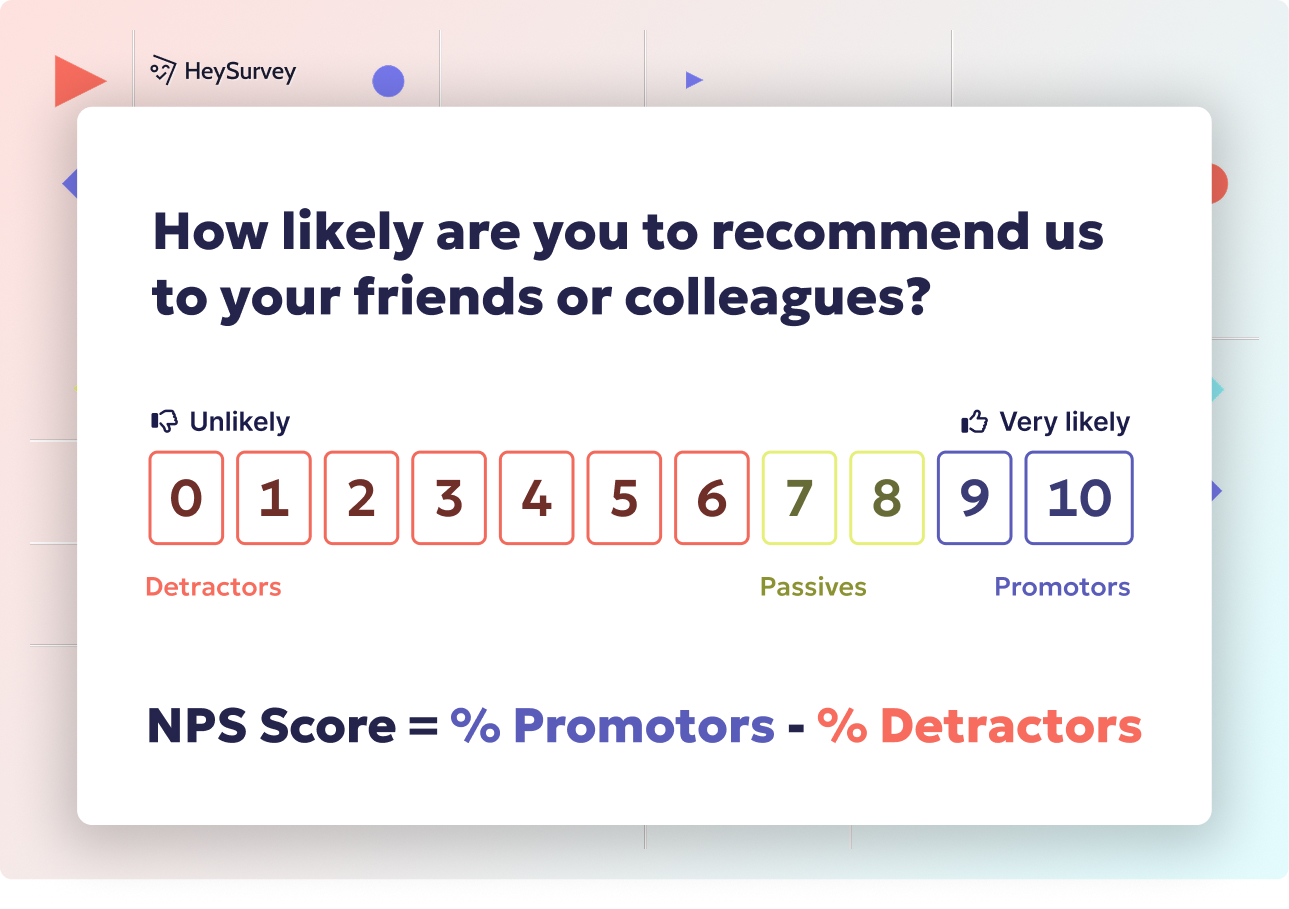
How likely are you to recommend our company to a friend or colleague?
How strongly do you agree with the statement: Our onboarding process was clear.
How would you rate the overall quality of our customer support?
Closed-ended multiple-choice questions generally reduce respondent burden and are easier to interpret and analyze than open-ended questions, though they can shape answers (AAPOR).

How to create a survey with HeySurvey
1. Create a new survey
Start by opening a template using the button below, or create a survey from scratch. HeySurvey lets you begin without an account, so you can explore first and decide later. In the editor, you can name your survey and adjust basic settings as needed.
2. Add questions
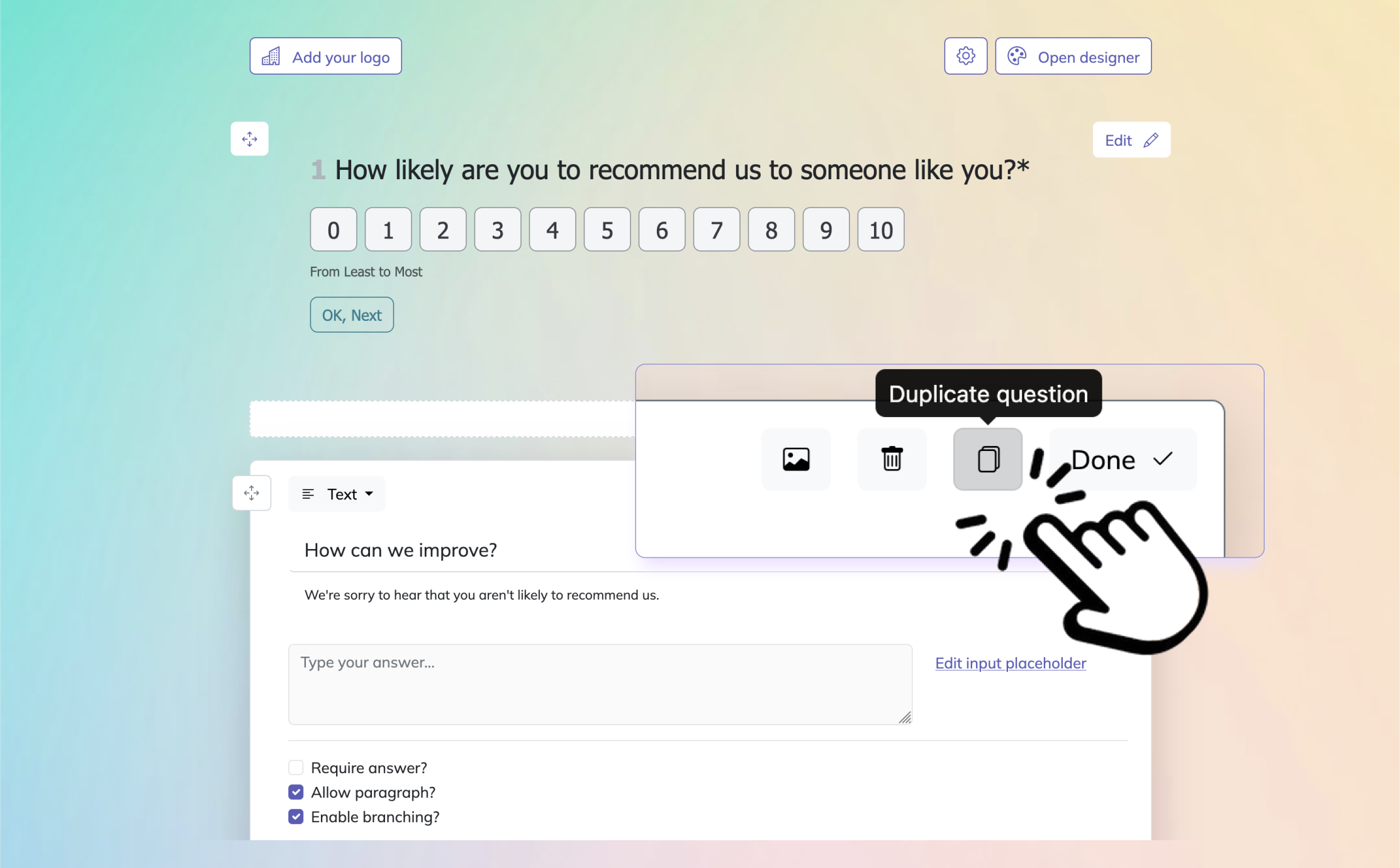
Click Add Question to build your survey. For a survey about types of survey questions, you can mix different question formats such as Choice, Text, Scale, Dropdown, Ranking, or Date. Add one question at a time, write your question text, and choose whether it should be required. You can also add descriptions, images, or branching if you want to guide respondents to different follow-up questions.
3. Publish survey
When your survey is ready, click Preview to check how it looks. If everything is correct, press Publish to create a shareable link. After publishing, you can send the survey to respondents and later review all answers in the online survey maker Results page.
Rating Scale Questions
Great for measuring how strongly someone feels
Why & When to Use
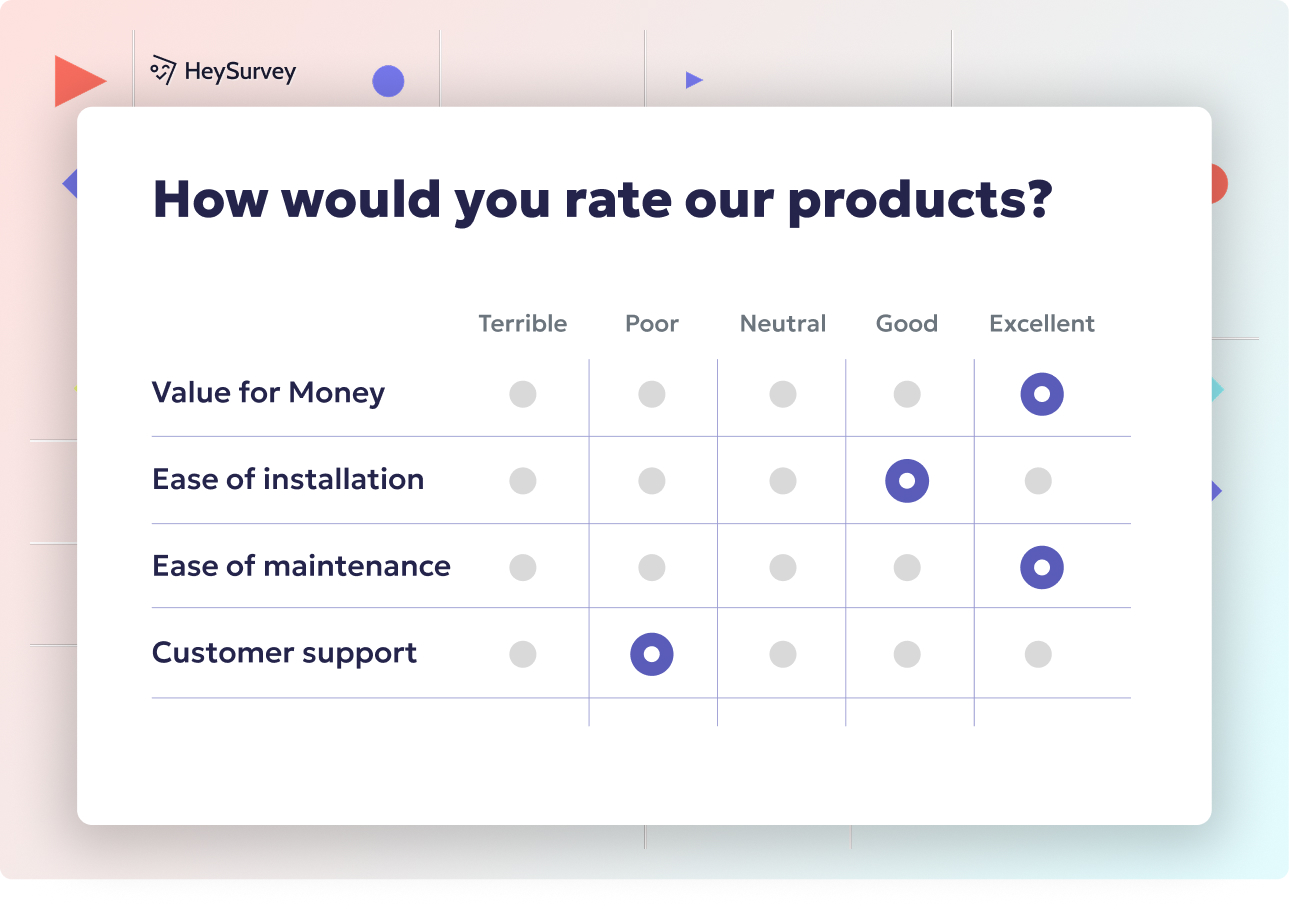
Rating scale questions help you measure intensity, satisfaction, agreement, or likelihood using a simple number or labeled scale.
They are one of the most practical choices for questionnaires when you want feedback that is quick to answer but still easy to compare across groups.
You will usually see formats like 1 to 5, 1 to 7, or 0 to 10.
These are especially useful in customer satisfaction surveys, employee engagement checks, event feedback, and post-purchase follow-ups.
Plus, hotjar survey questions often use rating scales because they fit naturally into on-site and post-experience feedback.
If you want to know how happy, frustrated, confident, or loyal someone feels, rating scales do the job without making people write a mini novel. Your respondents will thank you silently.
To make rating scale questions work well, keep the structure consistent from start to finish.
Keep the scale direction the same throughout the survey.
Label the endpoints clearly, such as 1 = Very dissatisfied and 5 = Very satisfied.
Choose the scale length based on how much precision you actually need.
Avoid switching between “high is good” and “low is good.”
On top of that, better choices for questionnaires lead to cleaner data, faster analysis, and fewer confused clicks.
Sample questions
I find this product easy to use.
The pricing feels fair for the value provided.
The website provides all the information I need before purchasing.
I trust this brand more than competing brands.
The checkout process was straightforward.
Survey research commonly finds that 5- to 7-point rating scales improve reliability over 2- to 3-point scales, making them a strong default for measuring attitudes (Frontiers).
Likert Scale Questions
Perfect for measuring opinions with more nuance
Why & When to Use
Likert scale questions are a specific type of rating question that help you measure agreement, attitudes, and opinions in a consistent way.
Unlike broader rating formats, Likert questions begin with a statement and follow it with response choices such as strongly agree, agree, neutral, disagree, and strongly disagree.
That structure makes them one of the most useful choices for questionnaires when you want to understand what people think, not just how much they liked something.
You will often see hotjar survey questions use this format when teams want quick feedback on trust, clarity, value, or ease of use.
They work especially well for brand perception studies, employee sentiment surveys, course evaluations, and product experience research.
Here's the thing, a strong Likert question should focus on one idea at a time so your respondent knows exactly what they are reacting to.
Avoid double-barreled wording like “The product is affordable and easy to use” because that asks about two things at once, which is a tiny chaos goblin for your data.
To get better results, keep these tips in mind:
Write clear statements with only one idea in each.
Decide whether a neutral option helps or hurts your research goal.
Group related statements together so the survey feels smooth and logical.
Use consistent response choices throughout your hotjar survey questions.
On top of that, smart choices for questionnaires make your results easier to trust and much easier to compare.
Sample questions
What almost stopped you from completing your purchase today?
What is the main reason for your satisfaction score?
What could we improve about your experience with our product?
Which feature would you most like us to add next?
Is there anything else you would like to share about your experience?
Open-Ended Survey Questions
Best for uncovering the real story behind the click
Why & When to Use
Open-ended survey questions let people answer in their own words, which is where you often find the gold.
Instead of forcing neat little boxes, these choices for questionnaires reveal motivations, frustrations, objections, and surprising ideas you did not know to ask about.
That makes them especially useful in exploratory research, voice-of-customer programs, website feedback, and follow-up prompts after closed questions.
You will also see hotjar survey questions use this format when teams want to understand the why behind user behavior, not just what happened.
Here's the thing, open-ended questions are powerful, but they work best when you use them with intention.
If you add too many, people get tired fast and start typing the digital equivalent of a shrug.
To make them more effective, keep these practical tips in mind:
Use them sparingly so your survey stays easy to complete.
Place them after a closed question when you want a deeper explanation.
Ask focused prompts instead of broad questions like “What do you think?”
Plan ahead for how you will group, tag, and analyze responses.
Plus, smart hotjar survey questions often pair a rating or multiple-choice item with an open text follow-up, giving you both measurable data and the human context behind it.
On top of that, this combo creates stronger choices for questionnaires because you get numbers for trends and words for meaning.
Sample questions
Rank the following product features from most important to least important.
Rank these support channels in order of preference.
Rank the top reasons you chose our company.
Rank the following content topics based on what you want to learn first.
Rank these pricing plan benefits from most valuable to least valuable.
Open-ended survey questions capture respondents’ answers in their own words, providing nuance that helps explain closed-ended results despite higher nonresponse risk (source).
Ranking Survey Questions
Best for spotting what people value most, not just what they kind of like
Why & When to Use
Ranking questions ask people to put options in order by preference, priority, or importance.
That makes them especially useful when you want clearer choices for questionnaires and need to understand what wins, what loses, and what gets politely shoved to the bottom.
You can use ranking survey questions for feature prioritization, content planning, benefit comparison, and trade-off analysis.
Plus, they are handy in hotjar survey questions when you want to learn what matters most to users instead of hearing that everything is "very important." Shocking, right?
Here's the thing, ranking reveals relative preference better than rating scales because people have to choose between options.
That forced choice gives you sharper insight when you need to decide what to build, promote, or improve first.
To make ranking questions work well, keep these tips in mind:
Limit the number of items so the task stays quick and clear.
Use ranking only when respondents are familiar with all the options.
Avoid very similar choices that feel hard to tell apart.
Think about analysis before using this format at scale, since ranked data takes more effort to interpret.
On top of that, strong hotjar survey questions often use ranking when you need prioritization, not just positive feedback.
Sample questions
Have you purchased from us before?
Did you find the information you were looking for today?
Are you currently using a competitor’s product?
Would you like to be contacted for a follow-up interview?
Did our support team resolve your issue?
Dichotomous Questions
Best when you need a fast, clean answer and not a life story
Why & When to Use
Dichotomous questions give people just two answer choices, most often yes/no, true/false, or agree/disagree.
That makes them one of the simplest choices for questionnaires, especially when speed and clarity matter more than detail.
They work best for screening, branching logic, eligibility checks, and quick pulse feedback.
Plus, they fit naturally into hotjar survey questions when you want a fast read on user actions or outcomes without slowing people down.
Here's the thing, this format is easy for respondents and easy for you to analyze, but it is also limited in depth.
If someone has mixed feelings, a yes or no can flatten the truth faster than a pancake.
Use dichotomous questions well by keeping these practical rules in mind:
Use them only when a binary answer is genuinely appropriate.
Add a follow-up question when you need context, reasons, or nuance.
Avoid yes/no questions for complex opinions, preferences, or experiences.
Check that your wording stays neutral and does not push people toward one answer.
On top of that, strong hotjar survey questions often use dichotomous formats at the start of a flow, then follow with more detailed choices for questionnaires only when the answer calls for it.
Sample questions
Is this question clear enough that anyone in your audience would understand it right away?
Does this question match the exact insight you want to learn?
Are your answer options balanced, distinct, and easy to choose from?
Have you tested this survey with a small group before launch?
Are you only including relevant choices for questionnaires in this survey?
Best Practices for Writing Better Survey Questions
Great surveys feel easy to answer and even easier to trust
Why & When to Use
Strong survey writing helps you get cleaner data, better completion rates, and fewer confused clicks.
Plus, better hotjar survey questions make it much easier to spot what users actually think, not what your wording accidentally nudged them to say.
Dos
Keep these habits in your back pocket when writing survey questions:
Use simple, specific language.
Match the question type to the research goal.
Keep answer choices balanced and non-overlapping.
Use consistent scales and formatting throughout the survey.
Ask one thing at a time.
Place sensitive or demographic questions later in the survey when possible.
Test the survey before launch with a small sample.
Include only relevant choices for questionnaires to keep completion rates high.
Don’ts
Here’s the thing, a few common mistakes can quietly wreck otherwise solid surveys.
Don’t ask leading or loaded questions.
Don’t use jargon your audience may not understand.
Don’t overload respondents with too many open-ended questions.
Don’t create answer options that are vague, uneven, or biased.
Don’t mix multiple ideas in one question.
Don’t make every question required if it is not essential.
Don’t ignore mobile readability or survey length.
Don’t collect feedback without a plan to use it.
On top of that, if your survey feels like homework, your respondents may ghost you faster than a bad date.
Sample questions
Did you enjoy our website, or would “How easy was it to complete your task on our website?” give you more useful feedback?
If you ask “Why do you like our brand?”, would a better fit be “Which of the following best explains why you chose our brand?”
Are you asking people to rank too many items, such as 15 features, when they should first pick their top 5?
If you use a rating scale, are the labels clear enough that every respondent reads the scale the same way?
Are you using yes or no questions where attitudes really need more nuance, such as separate ratings for affordability and quality?
Common Mistakes to Avoid When Choosing Survey Question Types
The wrong format can turn decent survey goals into gloriously messy data
Why & When to Use
Use this section like a quick diagnostic check when your hotjar survey questions are not producing useful answers.
Here’s the thing, poor question-type selection can muddy your data, lower response quality, and push you toward conclusions that sound confident but wobble on contact.
A common mistake is forcing multiple-choice when people need space to explain themselves. For example, asking “Why do you like our brand?” may work better as “Which of the following best explains why you chose our brand?” only if you already know the likely reasons. If you do not, open-ended is often the smarter move.
Other slip-ups are just as sneaky:
Asking users to rank too many items, like 15 features, which usually leads to rushed answers and tired brains.
Using rating scales without clear labels, which makes one person’s 4 look like another person’s 2.
Relying on binary questions for complex opinions, even when choices for questionnaires need more nuance.
Combining two ideas in one item, like affordability and quality, when each deserves its own scale.
Plus, better hotjar survey questions are often less about clever wording and more about choosing the format that actually fits the job.
Sample questions
Which survey findings point to the biggest barriers in the customer journey?
What patterns appear when you compare responses across audience segments?
Which issues are mentioned most often in open-ended feedback?
Which improvements would have the highest business or user impact?
How will you measure whether changes made from survey insights actually worked?
How to Turn Survey Insights Into Action
Great survey feedback only matters when you actually do something with it
Why & When to Use
Use this section as your wrap-up when you want hotjar survey questions to lead to real decisions, not just a lovely pile of charts collecting digital dust.
Here’s the thing, feedback becomes valuable when you sort it, prioritize it, share it clearly, and turn it into action across marketing, product, UX, customer experience, or the business as a whole.
Start by segmenting responses by audience type, behavior, or customer stage. That helps you see whether new visitors, loyal customers, or high-intent users are running into totally different problems.
Plus, do not look at quantitative and qualitative answers in isolation. Ratings show you where friction exists, while open comments explain why, which makes your choices for questionnaires far more useful after the survey ends.
Focus on the issues that show up most often and would create the biggest impact if fixed.
Segment results by user type, journey stage, or behavior.
Compare score-based trends with open-text feedback.
Prioritize problems by frequency, severity, and business value.
Share key themes with stakeholders instead of dumping raw data on them.
Close the loop by telling customers what changed.
On top of that, measure what happens next. If your hotjar survey questions inspired a fix, track conversion, satisfaction, retention, or task completion to see whether the change actually worked.
Related Surveys
29 Social Media Survey Questions
Explore 25 social media survey questions with practical sample prompts to help gather insights on...
31 Job Satisfaction Survey Questions
Explore **25 job satisfaction survey questions** with sample prompts to improve employee feedback...
29 Quantitative Survey Questions Guide
Explore 25 quantitative survey questions with sample questions, examples, and tips to build effec...