29 Training Feedback Survey Questions
Explore 25 sample training feedback survey questions to improve sessions with clear examples, practical insights, and useful feedback tips.
If you want better training outcomes, start by asking better questions. The right survey questions turn polite smiles into useful feedback.
This guide walks you through sample training satisfaction survey questions, practical training questionnaire sample questions, and smart training questionnaire questions you can use right away. Plus, if you need fresh ideas for training satisfaction survey examples or an upskill/refresher training survey - new item, you are in the right place. Because guessing what worked is brave, but not in a good way.
Introduction
Sample questions
Did this training help you feel more confident doing your job?
Which part of the session was most useful to you?
Was the trainer clear, prepared, and easy to follow?
What should be improved before this training is offered again?
Would you recommend this session to a coworker with a similar role?
Training feedback surveys help you turn opinions into action. They are short questionnaires you use after a session to find out what people learned, what confused them, and what should change next time.
When you use the right training feedback survey question, you get more than a thumbs-up score. You get practical insight that can improve employee learning outcomes, sharpen instructor performance, and make future training design much more useful for real work.
Here's the thing, strong feedback helps you spot what landed and what flopped before it becomes a repeat performance. Nobody wants to rerun a workshop that only impressed the breakroom coffee.
This article covers several training feedback survey question types so you can choose the right ones for the right moment.
You will find sample training satisfaction survey questions for post-training reactions.
You will see practical training questionnaire sample questions for skills, delivery, and relevance.
You will get clear training questionnaire questions you can adapt for live, virtual, onboarding, and refresher sessions.
Plus, we will touch on training satisfaction survey examples and upskill/refresher training survey needs so your surveys fit the training goal, not just the template.
Why & When to Use
Use training feedback surveys right after training, after a short delay, or both if you want better insight. On top of that, they work best when you plan to act on responses, not just collect them and let them nap in a spreadsheet.
Research shows utility-focused training survey questions predict learning transfer and job performance better than satisfaction-only questions (Alliger et al., 1997).
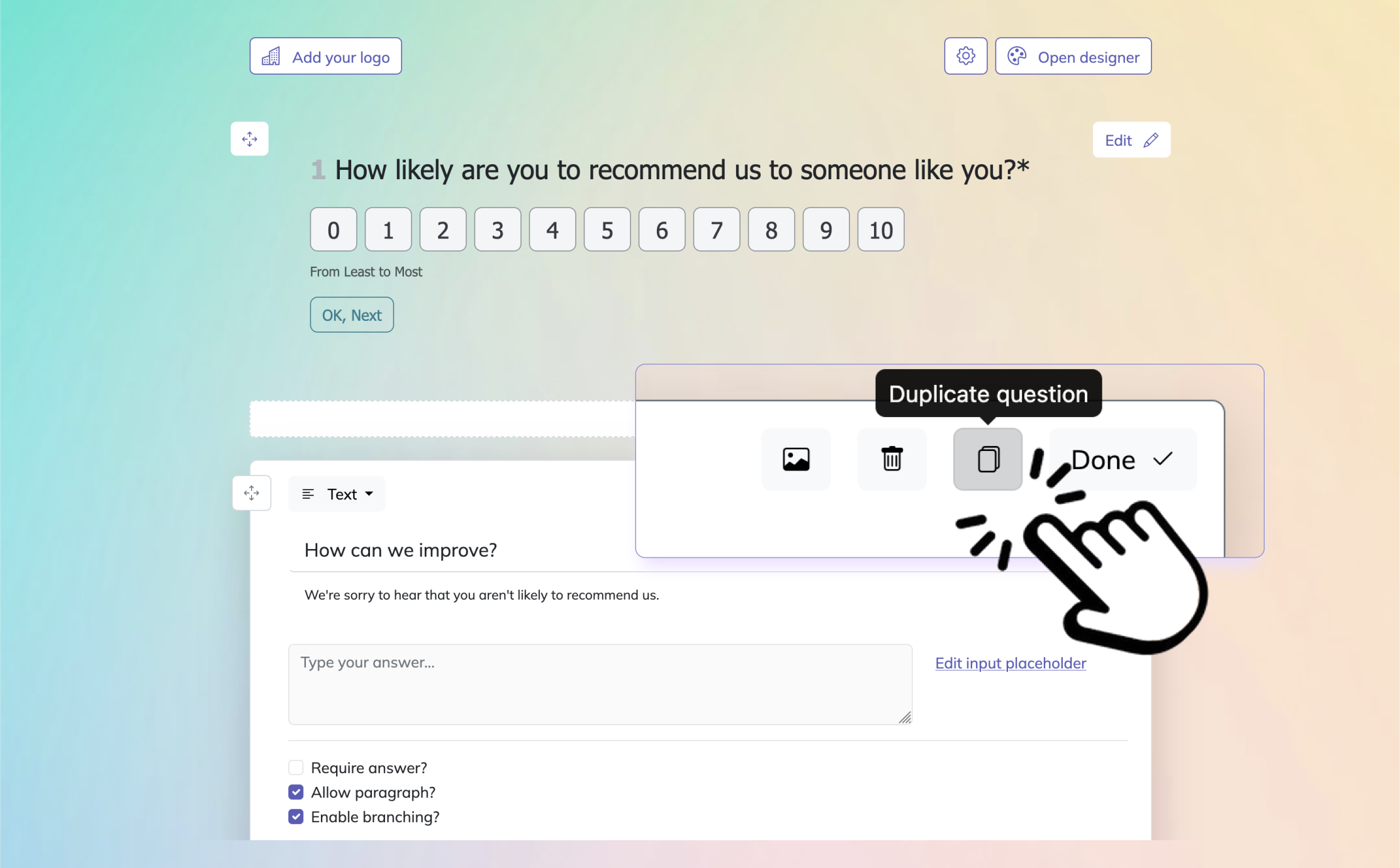
How to create a training feedback survey in HeySurvey
Create a new survey
Start by opening a training feedback survey template from the button below, or create a new survey from scratch with our online survey tool. You do not need an account to begin building, but you will need one to publish and view responses later.Add questions
Click Add Question to include the most useful training feedback items. For example, use Scale questions for session ratings, Choice questions for multiple-choice feedback, and Text questions for open comments. You can mark questions as required, reorder them, and add a description or placeholder to guide respondents.Publish your survey
Review your survey with Preview to check the layout and wording. When everything looks good, click Publish to generate a shareable link. You can then send it to participants and collect feedback in one place.
Post-Training Satisfaction Survey Questions
Sample questions
How satisfied were you with the training overall?
Did the training meet your expectations?
How engaging did you find the training session?
How relevant was the content to your role or goals?
What was the most valuable part of the training for you?
These sample training satisfaction survey questions give you a fast read on how the session landed. They are the go-to format for measuring immediate learner reactions while the experience is still fresh, which means you get clearer answers and fewer vague shrugs.
This type of survey is one of the most useful places to start if you need dependable sample training satisfaction survey questions for your team. Plus, it works well after workshops, onboarding sessions, webinars, compliance training, and internal learning and development programs.
The goal is simple: find out whether people were satisfied, engaged, and convinced the training was worth their time. That makes these training questionnaire questions great for quick pulse checks, even if they should not be your only feedback method.
Here’s the thing, a happy audience does not always mean real learning happened, but it is still a strong clue. Think of it as your first snapshot, not the whole movie.
For stronger results, use a mix of rating-scale items and open-ended prompts in your training questionnaire sample questions, such as:
rating overall satisfaction
scoring relevance to the learner’s role
measuring engagement during the session
asking what felt most useful
inviting one suggestion for improvement
On top of that, these training satisfaction survey examples are easy to reuse across different sessions without making every survey feel copy-pasted into oblivion.
Why & When to Use
Use post-session surveys right after training when you want quick, honest reactions before details fade. They are especially useful for fast feedback on delivery, content fit, and perceived value in any upskill/refresher training survey - new item or standard post-training review.
Research based on the Kirkpatrick model shows post-training surveys should measure relevance, engagement, and satisfaction as immediate reaction indicators, not learning itself (Wiley).
Training Content Relevance and Clarity Questions
Sample questions
How clear and easy to understand was the training content?
Was the information presented at the right level for your experience?
How relevant was the content to your day-to-day work?
Were the examples and case studies useful in explaining key concepts?
Which topics need more explanation, simplification, or detail?
These training questionnaire questions help you spot whether your content actually makes sense to the people taking it. That matters more than it sounds, because training can be interesting, polished, and still leave people thinking, "Cool slides, but what am I supposed to do with this?"
If you are collecting sample training satisfaction survey questions, this set is especially useful for improving course design, not just measuring general reactions. Plus, these training questionnaire sample questions help you separate content that feels engaging from content that is truly useful on the job.
They are especially strong for technical, policy, or process-based sessions where clarity is everything. On top of that, they reveal whether learners felt the material was too basic, too advanced, too fast, or just explained like it was written for a robot.
Use this kind of feedback to review:
language clarity
pacing and flow
usefulness of examples and case studies
role-specific relevance
topics that need more depth or simpler explanations
Why & When to Use
Use these sample training satisfaction survey questions when you want to improve curriculum quality and tighten the learner experience. They work best when you need training satisfaction survey examples that uncover how understandable, well-structured, and appropriately pitched the material really was.
Trainer or Facilitator Feedback Survey Questions
Sample questions
How effectively did the trainer explain the material?
Did the trainer encourage participation and questions?
How knowledgeable did the trainer appear on the topic?
Was the pace of the session appropriate?
What could the trainer do differently to improve future sessions?
These sample training satisfaction survey questions help you measure the human side of training, which can make or break the whole experience. Even when the slides are strong and the material is useful, a trainer who rushes, rambles, or dodges questions can send learning off the rails fast.
If you are building a training questionnaire sample questions list, this section gives you a practical way to evaluate delivery without turning feedback into a personality contest. Here's the thing, the best training questionnaire questions focus on what people actually saw and experienced, not whether someone "seemed nice" or had a heroic coffee order.
To keep feedback useful, ask learners to comment on observable areas like:
communication and clarity
subject expertise
pacing and time management
responsiveness to questions
ability to keep people engaged
Plus, anonymous responses often lead to more honest answers, especially in workplace sessions where people may hesitate to be direct. On top of that, mixing rating-scale items with open-ended training questionnaire questions gives you richer feedback you can actually use.
Why & When to Use
Use these training questionnaire sample questions for instructor-led sessions, workshops, seminars, coaching, and virtual facilitation. They work best when you want training satisfaction survey examples that show how the trainer influenced understanding, participation, and confidence, while keeping feedback focused on behaviors that can be improved.
Meta-analysis found trainee reactions are driven most by instructional style and human interaction, supporting trainer-feedback survey questions on clarity, engagement, and responsiveness (PubMed).
Training Delivery Format and Experience Questions
Sample questions
How effective was the training format for learning this topic?
Was the length of the session appropriate?
How easy was it to participate in the training environment?
Did the training include enough interaction, discussion, or hands-on practice?
What would improve the overall delivery experience?
These sample training satisfaction survey questions help you see whether the format supported learning or quietly got in the way. A great topic can still flop if the webinar platform freezes, the self-paced module drags, or the hybrid setup makes half the room feel like background wallpaper.
If you are building a training questionnaire sample questions list, this section helps you evaluate how the experience felt in real life, not just how the content looked on paper. Here's the thing, strong training questionnaire questions should uncover whether the format matched the topic, the audience, and the way people actually learn.
Useful areas to explore include:
platform reliability and ease of access
session length and pacing
interaction quality in virtual or in-person settings
clarity of structure and flow
opportunities for discussion or hands-on practice
Plus, these training satisfaction survey examples are especially useful for distributed teams, remote onboarding, webinars, and digital courses where small delivery issues can create big frustration.
Why & When to Use
Use these training questionnaire sample questions when you want feedback on in-person, virtual, hybrid, webinar-based, or self-paced learning experiences. They are ideal for measuring access, usability, pacing, timing, and overall delivery quality, especially when content was solid but the format may have made learning harder than it needed to be.
On top of that, these training questionnaire questions help you compare formats over time and spot patterns across teams. If people keep saying the content was helpful but the experience was clunky, your delivery method may need a tune-up, not a total makeover.
Learning Effectiveness and Knowledge Gain Questions
Sample questions
How much did your knowledge of the topic improve after this training?
How confident do you feel applying what you learned?
Which key takeaway from the training stands out most to you?
Did the training improve your understanding of job-related tasks or concepts?
What topics do you still feel unsure about?
These sample training satisfaction survey questions help you look past smiles and into actual learning. A participant can enjoy the session, like the instructor, and still walk away remembering about as much as they remember from last Tuesday's lunch.
If you are building outcome-focused training questionnaire sample questions, this section helps you measure whether people believe they gained useful knowledge and can recall the big ideas. Here's the thing, strong training questionnaire questions do more than capture satisfaction. They also check whether the training moved understanding, confidence, and readiness in the right direction.
Helpful areas to explore include:
self-rated knowledge improvement
confidence applying key lessons
recall of main takeaways
understanding of job-related concepts or tasks
remaining confusion or gaps that need follow-up
Plus, you can pair these training questionnaire sample questions with short knowledge checks if you want a clearer picture of retention, not just reaction.
Why & When to Use
Use these sample training satisfaction survey questions right after training to capture fresh impressions of learning, and again later if you want to measure retention over time. On top of that, they work well when you need training satisfaction survey examples that connect feedback to outcomes, especially for upskill/refresher training survey - new item planning.
Positive feedback is helpful, but it does not always mean real skill improvement. That is why the best training questionnaire questions combine self-assessment with optional knowledge-check framing, so you can see what people liked and what they actually learned.
Application, Behavior Change, and Upskill/Refresher Training Survey Questions
Sample questions
Have you applied anything from the training in your work since completing it?
How confident are you in using the skills covered in the training?
What barriers, if any, have made it difficult to apply what you learned?
Would additional coaching, resources, or refresher training help you use these skills more effectively?
What follow-up support would help you continue improving?
These sample training satisfaction survey questions help you find out whether training actually stuck once real work got involved. Immediate feedback is useful, sure, but a survey sent days or weeks later often tells you much more about real-world value.
If you are building training questionnaire sample questions, this section is where you measure action, not just intention. Here's the thing, the best training questionnaire questions show whether people used the training, felt confident doing it, hit obstacles, or quietly filed the lesson away in the mental junk drawer.
Helpful areas to explore include:
on-the-job application of new skills or knowledge
confidence using the training in real situations
behavior changes since the session ended
barriers such as time, tools, manager support, or unclear processes
whether reinforcement, coaching, or refresher support is needed
These training questionnaire questions work especially well for leadership, sales, safety, software, and operational programs. Plus, they are especially useful for any upskill/refresher training survey effort where the goal is reinforcement, consistency, and better habits over time.
Why & When to Use
Use these sample training satisfaction survey questions after learners have had time to apply the material, usually several days or a few weeks later. Delayed feedback gives you a clearer read on confidence, behavior change, practical usefulness, and whether refresher training is needed.
On top of that, these training satisfaction survey examples help you spot when support is missing. If responses show low confidence, limited application, or repeated barriers, that is your cue to offer coaching, job aids, or an upskill/refresher training survey follow-up before small gaps become big headaches.
Best Practices for Writing and Using Training Feedback Survey Questions
Sample questions
Are your training questionnaire questions short enough that someone can answer them quickly without rereading?
Does each question clearly match your goal, such as satisfaction, learning, application, or trainer feedback?
Are you using a mix of rating-scale, yes/no, and open-ended items in your training questionnaire sample questions?
Are you sending the survey at the right time for the kind of feedback you want?
Have you reviewed results for patterns over time instead of treating one survey like the final boss?
Great training questionnaire questions are easy to answer, easy to analyze, and actually useful once the responses roll in. If you want stronger sample training satisfaction survey questions, start by making every question earn its spot.
Dos
Use these best practices when building sample training satisfaction survey questions:
Keep questions short, specific, and easy to answer.
Match each question type to your goal, whether that is satisfaction, learning, application, or trainer feedback.
Use a balanced mix of rating scales, yes/no items, and open comments.
Send surveys right away for reactions, and later for application or behavior change.
Keep surveys brief so completion rates do not do a disappearing act.
Segment by training type, audience, or format when that context matters.
Review trends across multiple surveys, not just one snapshot.
Don’ts
Avoid these common mistakes in training questionnaire questions:
Do not ask vague questions like “Was the training good?”
Do not cram too many goals into one survey.
Do not use leading or biased wording.
Do not collect feedback and then ignore it.
Do not dismiss negative comments that show recurring issues.
Do not rely only on satisfaction scores.
Do not forget space for comments that explain the ratings.
Why & When to Use
Use these practices anytime you create training questionnaire sample questions or review training satisfaction survey examples. Plus, they help you turn feedback into smarter decisions, not just prettier charts.
Common Mistakes to Avoid in Training Satisfaction Surveys
Sample questions
Are your training questionnaire questions specific enough to show what actually worked and what did not?
Are you sending your survey soon enough that learners still remember the session clearly?
Do your sample training satisfaction survey questions separate trainer, content, and platform feedback?
Have you included at least one comment box in your training questionnaire sample questions?
Are you comparing results across teams, sessions, or time periods instead of looking at one survey alone?
Small survey mistakes can create big reporting headaches. Here’s the thing, even solid training can look confusing on paper when your survey setup is messy.
Why These Mistakes Hurt Results
Poor survey design leads to fuzzy answers, weak patterns, and decisions that miss the mark. Many training questionnaire questions fail because they are too generic, badly timed, or not matched to the audience.
On top of that, if you do not separate what learners are rating, your data becomes a mixed bag. That means your training satisfaction survey examples may look complete, but they still will not tell you what to fix.
5 Mistakes to Watch For
Watch for these common issues in sample training satisfaction survey questions:
Asking too many repetitive questions that make people rush or quit.
Sending the survey too long after training, when details have already floated away.
Mixing trainer, content, and platform issues into one unclear question.
Using only rating scales without comment fields, which is like getting a movie score with no review.
Failing to compare survey results across cohorts or time periods.
Why & When to Use
Use this checklist when reviewing training questionnaire sample questions before launch or when results feel oddly unhelpful. Plus, it helps you clean up your training questionnaire questions so feedback becomes clearer, more actionable, and much easier to trust.
Turn Training Survey Insights Into Action
Sample questions
How will you group responses from your sample training satisfaction survey questions into themes you can actually use?
Which low-scoring training questionnaire questions point to the biggest problems in content, delivery, or trainer effectiveness?
Can you compare your training questionnaire sample questions across teams, roles, or formats to spot meaningful differences?
What changes should you make first based on frequency, learner frustration, and business impact?
How will you update future training satisfaction survey examples after acting on what learners told you?
Good survey data only matters if you do something with it. Here's the thing, collecting feedback is the easy part, but turning training questionnaire questions into better decisions is where the real value shows up.
How to Analyze Responses
Start by grouping answers into practical themes like content, trainer, delivery, learning outcomes, and application barriers. That helps your sample training satisfaction survey questions reveal what is broken, what is working, and what just needs a tiny tune-up.
Next, look for patterns in low ratings and repeated comments. If learners keep mentioning unclear examples, rushed pacing, or no time to practice, your training questionnaire sample questions are waving a giant little flag.
Use comparisons where they help:
By department
By role
By training type
By delivery method
Plus, prioritize issues by frequency and business impact, not just volume. One annoying slide is not ideal, but a skill gap that slows real work is the boss-level problem.
Why & When to Use
Use this process right after reviewing survey results and before planning the next session. On top of that, it helps you improve future training satisfaction survey examples, refine training questionnaire questions, and confirm changes by re-running surveys after updates.
When feedback points to action, you can:
Revise confusing content and cut low-value sections
Coach trainers on pacing, facilitation, or engagement
Adjust format, timing, or session length
Add job aids, office hours, or refresher support
Recheck results to make sure improvements actually landed
Related Surveys
29 Social Media Survey Questions
Explore 25 social media survey questions with practical sample prompts to help gather insights on...
31 Job Satisfaction Survey Questions
Explore **25 job satisfaction survey questions** with sample prompts to improve employee feedback...
29 Quantitative Survey Questions Guide
Explore 25 quantitative survey questions with sample questions, examples, and tips to build effec...