29 Quality Assurance Survey Questions
Explore 25 quality assurance survey questions with sample responses to improve product quality, gather feedback, and strengthen QA processes.
If you want better products, smoother service, and fewer "how did that happen?" moments, a quality survey is a smart place to start. Quality assurance survey questions help you measure consistency, compliance, customer experience, and process performance without guessing.
In this guide, you’ll explore quality survey questions for product teams, service teams, call centers, internal QA programs, and post-resolution feedback. Plus, you’ll see quality assurance examples, product quality survey questions, call center quality assurance survey questions, and practical quality questions you can actually use.
Sample questions
How would you rate the overall quality of the product you received?
Did the product meet your expectations in terms of durability and performance?
Were there any defects, damages, or quality issues when the product arrived?
How consistent is this product compared with previous purchases from us?
What is the one improvement that would most increase your confidence in this product’s quality?
Product Quality Survey Questions
Spot product issues before they become expensive habits.
Why & When to Use
A quality survey for products helps you understand how people actually experience what you sell, not just how it looked in testing or on a spec sheet.
This survey type works best when you want to measure reliability, durability, usability, and consistency across real customer use.
Here’s the thing: even a great product can lose points fast if it arrives damaged, feels flimsy, or performs like it skipped leg day.
Use these quality questions at key moments when feedback is fresh:
after purchase
after onboarding or first use
after repeat orders
after returns or replacements
during product improvement cycles
If you’re searching for product quality survey questions or survey questions about product quality, this is the set to build from.
Plus, the smartest surveys mix rating-scale questions with open-ended quality questions, so you get both trend data and the reasons behind it.
On top of that, segment responses by:
SKU
product line
supplier
batch
That makes it much easier to spot patterns in defects, returns, complaints, and perceived value.
You can also connect this feedback to broader quality assurance examples, especially when you want to improve manufacturing, packaging, or fulfillment consistency.
Sample questions
How satisfied were you with the quality of service you received?
Did our team resolve your issue correctly the first time?
How clearly did our representative explain the next steps or solution?
How professional and knowledgeable did our team appear during the interaction?
What could we improve to provide a higher-quality service experience?
Research shows customer-experienced product quality is multidimensional, and a validated survey scale predicts customer behavior better than older quality measures (source).

How to create a quality assurance survey in HeySurvey
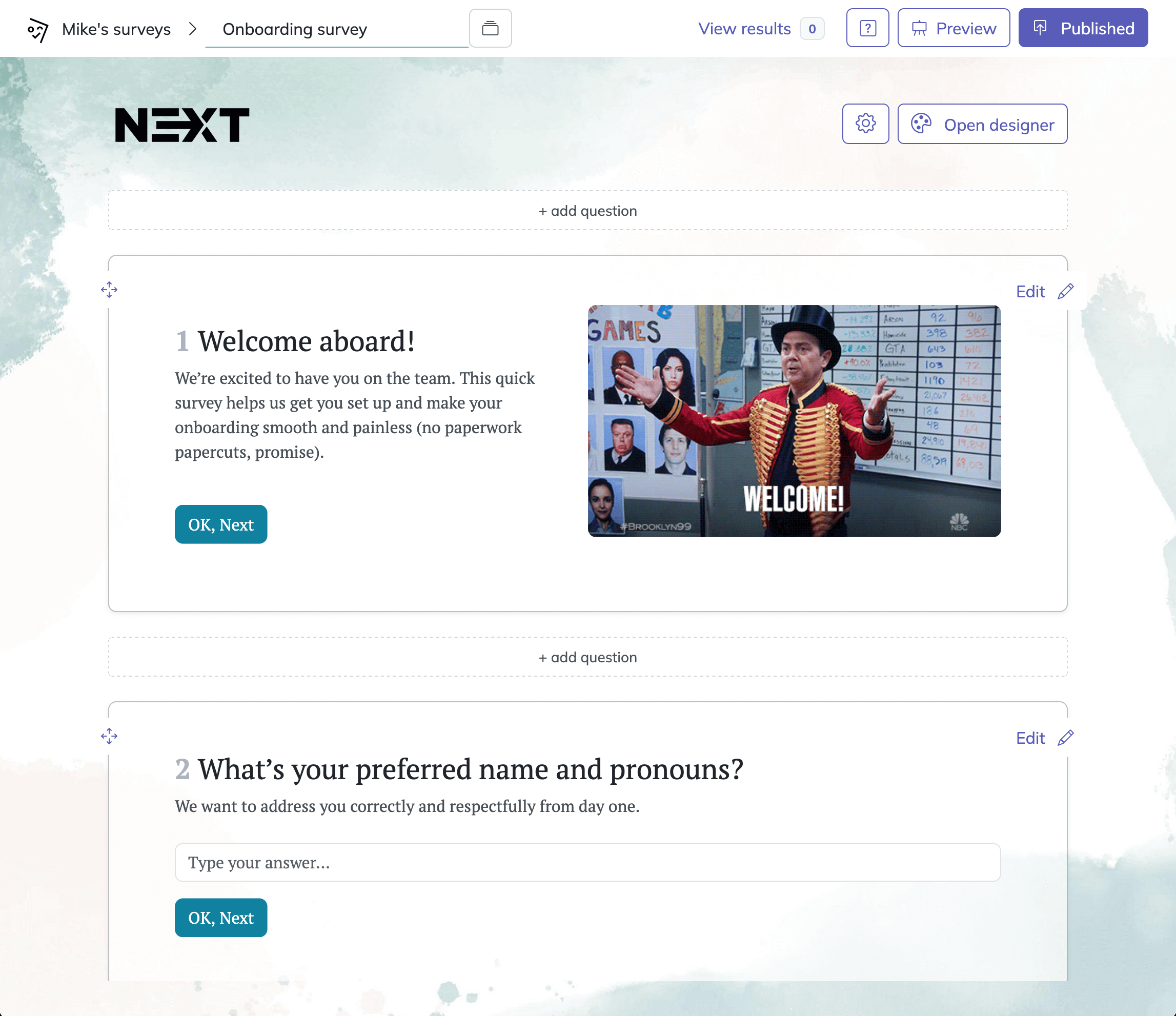
1. Create a new survey
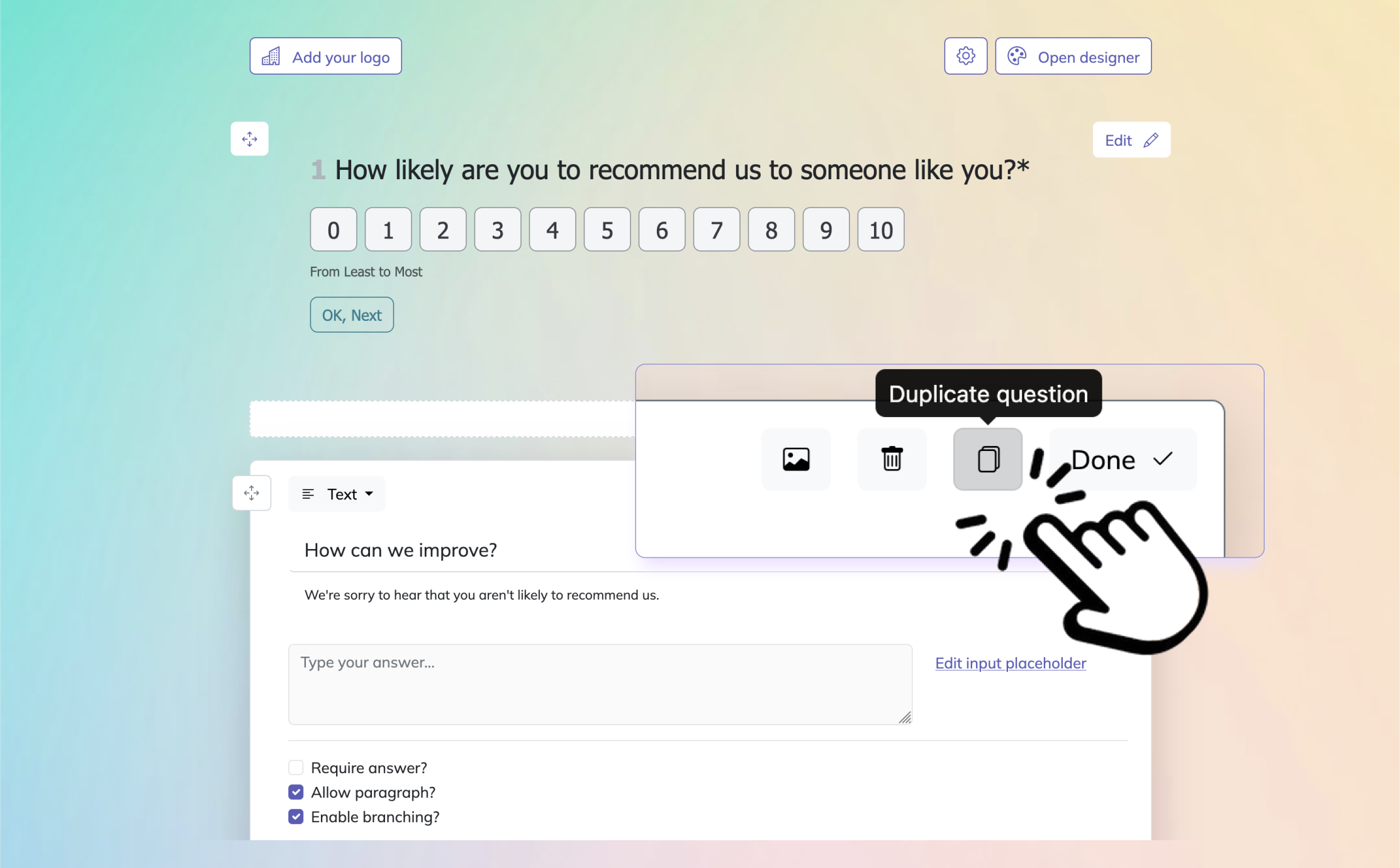
Open HeySurvey and start with a pre-built template or choose an empty sheet to build from scratch. If you’re new, a template is the fastest way to begin. You can do this without an account, but you’ll need one to publish and view responses later.
2. Add questions
Click Add Question to build your QA survey. For quality assurance, use Scale questions for ratings, Choice questions for yes/no checks, and Text questions for comments or issue details. Mark important questions as required so respondents don’t skip them. You can also add descriptions to clarify what each question is checking.
3. Publish survey
Review your survey in Preview mode, make any final design changes, then click Publish to get a shareable link. If needed, you can later check responses in the Results page and track completion, ratings, and written feedback.
Service Quality Assurance Survey Questions
Great service quality is not luck, it is something you can measure and coach.
Why & When to Use
A quality survey for service helps you track whether your team delivers support that is accurate, timely, professional, and consistent from one interaction to the next.
That matters because customers do not judge service quality by effort alone. They judge it by whether the problem got solved, whether it was explained clearly, and whether your team inspired confidence instead of confusion.
Use these quality questions when the experience is still fresh:
after support interactions
after appointments
after installations
after project delivery
after service tickets are resolved
Here’s the thing: first-contact resolution is a big deal, because nobody wants to explain the same issue twice like it is a sad little sequel.
These quality survey questions help you measure the service basics that drive trust:
correct resolution the first time
clear communication about next steps
professionalism and product knowledge
consistency across agents, teams, or locations
Plus, this is where quality assurance examples become useful in real life, not just in a training deck.
Compare customer feedback with internal QA scorecards, coaching notes, and service standards so you can spot gaps between what your team thinks happened and what customers actually felt.
On top of that, this approach works well for department performance survey questions and broader service improvement programs too.
Sample questions
Did the agent listen carefully and understand your concern?
How clearly did the agent communicate the solution or next steps?
Did the agent resolve your issue during the call?
How respectful and empathetic was the agent throughout the conversation?
How would you rate the overall quality of this call experience?
Research consistently identifies first-contact resolution as a key driver of customer satisfaction in service quality measurement and survey design. Source
Call Center Quality Assurance Survey Questions
A strong call is not just fast, it is clear, compliant, human, and actually helpful.
Why & When to Use
A quality survey for call centers helps you measure how well agents handle conversations from start to finish, not just how quickly they get off the phone.
It gives you a clearer view of communication skills, empathy, compliance, accuracy, and issue resolution, which are the things customers remember long after hold music stops haunting their dreams.
Use these call center quality assurance survey questions when you want feedback on high-volume or high-stakes interactions:
after support calls
after outbound campaigns
after escalations
after complaint handling
These quality questions help you evaluate the moments that shape the full call experience:
greeting and first impression
verification and compliance steps
active listening and empathy
accuracy of information shared
clarity of next steps
resolution during the call
Plus, customer feedback works best when paired with internal monitoring.
Survey responses show how the call felt to the customer, while QA reviews show whether the agent followed standards, making both sides useful quality assurance examples for smarter coaching.
Here’s the thing: when you compare both, you can spot coaching opportunities by agent, team, or call type instead of guessing and hoping for a miracle with a headset on.
Sample questions
How clear and easy to follow are the current quality assurance processes?
Where do you most often see errors, delays, or missed checks in the workflow?
Do you have the tools and documentation needed to meet quality standards consistently?
How effective are the current review and approval steps at catching issues early?
What process change would most improve quality and efficiency?
Internal Process Quality Survey Questions
Great quality often depends on what happens behind the scenes, not just what customers see.
Why & When to Use
An internal quality survey helps you spot the hidden friction in workflows before it turns into rework, delays, or audit headaches.
It is especially useful for finding breakdowns in documentation, handoffs, approvals, and quality controls across day-to-day operations.
Use these quality questions when you want input from the people closest to the process:
frontline staff
QA reviewers
team leads
cross-functional partners
These product quality survey questions work well during moments like:
internal audits
SOP reviews
process redesign projects
recurring error investigations
continuous improvement initiatives
Here’s the thing: a strong survey does more than collect complaints.
It helps you uncover root causes, not just isolated mistakes, which makes it a smart choice if you are looking for a quality assurance review example or thinking about q&a quality assurance in a broader operational sense.
Plus, the best responses become more useful when you connect them to KPIs like:
rework volume
error rate
cycle time
audit findings
On top of that, these quality assurance examples can show whether the real problem is unclear instructions, weak review steps, or a handoff that keeps dropping the baton.
Sample questions
How confident are you that current processes meet required compliance standards?
Are quality and compliance expectations clearly documented and communicated?
How often do you encounter situations where policy requirements are unclear?
Do current review procedures catch compliance risks before they become larger issues?
What additional support would help you maintain quality and compliance more consistently?
Employee surveys that include follow-up action help identify process problem areas and evaluate improvement efforts in quality programs (ASQ).
Compliance and Audit Quality Survey Questions
A smart quality survey helps you check whether people are following the rules, not just hoping for the best.
Why & When to Use
A compliance-focused quality survey measures whether standards, policies, regulations, and documentation requirements are actually being followed in day-to-day work.
That makes it useful when quality and compliance need to work as a team, because great work is not just accurate, it also needs to be audit-ready.
Use these quality questions after key moments like:
external or internal audits
regulated customer or patient interactions
training rollouts
policy or procedure updates
recurring documentation issues
These quality assurance examples are especially helpful if your company needs a more structured way to review risk across teams, departments, or locations.
Plus, they give you a clearer view of where people feel confident, where they feel stuck, and where a policy might read like it was written by a robot with a clipboard.
Here’s the thing: quality assurance and compliance assurance are closely related, but they are not identical.
Quality checks whether work is done well, while compliance checks whether it is done according to required rules and standards.
To make your quality survey questions more useful, use consistent rating scales so you can compare results across departments or sites.
On top of that, document patterns in confusion, exceptions, and audit failures, because those trends often point to the real fix faster than one-off comments do.
Sample questions
How efficient is the current quality assurance review process?
How quickly do you receive useful feedback after a quality review?
How consistent are QA evaluations across reviewers or departments?
Does the current QA process help improve performance, or mostly add extra steps?
What change would make the QA process more efficient without lowering standards?
QA Efficiency and Team Performance Survey Questions
The best qa efficiency surveys show whether your QA process actually helps people work better, faster, and with less friction.
Why & When to Use
A strong quality survey does more than track whether reviews happen on time.
It helps you measure whether QA efforts are fast, useful, scalable, and supportive instead of feeling like an administrative side quest.
That makes qa efficiency surveys especially useful when you want to review workload pressure, feedback loops, reviewer consistency, and the bottlenecks that slow teams down.
Use these quality questions when you are evaluating things like:
overloaded QA reviewers
slow feedback after reviews
inconsistent scoring between teams
repeated disputes about evaluations
processes that feel thorough but painfully clunky
Here’s the thing: speed alone is not the goal.
You want a quality assurance process that balances review depth with operational efficiency, so people get clear, actionable feedback without waiting forever or drowning in extra steps.
These quality assurance examples also help you spot whether reviewers are aligned, whether scoring criteria are standardized, and whether calibration sessions are needed to keep evaluations fair.
Plus, if your quality survey questions show that feedback is slow, vague, or inconsistent, that is usually a sign the system needs tuning, not just the people in it.
On top of that, better reviewer alignment means your QA process feels less like roulette and more like a reliable tool for team performance.
Sample questions
Are our survey questions specific enough to produce actionable feedback?
Do our questions measure quality outcomes rather than vague satisfaction alone?
Are we using a consistent rating scale across surveys where comparison matters?
Are we collecting feedback at the right moment in the customer or employee journey?
Do we have a clear plan for acting on the survey responses we collect?
Best Practices for Writing and Using Quality Assurance Survey Questions
Great quality survey questions turn feedback into fixes, not just folders full of responses nobody opens again.
Why & When to Use
This section gives you a practical framework for building better quality survey questions across almost any QA use case.
It is the bridge between raw templates and real improvements, so your quality questions actually help you spot issues, compare results, and take action.
Use this approach when you are writing product quality survey questions, reviewing call center quality assurance survey questions, or improving internal audits and questionnaire assurance qualité workflows.
Here’s the thing: a survey can look polished and still produce mushy feedback.
You want questions that connect to a clear quality standard, arrive at the right moment, and make next steps obvious.
A simple way to stay on track is to follow these dos:
Keep questions clear, specific, and tied to a quality outcome.
Mix rating scales with open-text follow-up questions.
Tailor your quality survey questions to the audience, whether that is customers, agents, auditors, or internal teams.
Keep surveys short enough to protect response quality.
Review results by segment, trend, and root cause.
And avoid these classic faceplants:
Do not ask double-barreled quality questions.
Do not rely only on generic satisfaction scores.
Do not send surveys too late.
Do not collect responses without follow-up ownership.
Do not ignore negative comments that reveal systemic issues.
Sample questions
Are any of our survey questions leading respondents toward a preferred answer?
Are we asking about too many topics in a single survey?
Are our answer options detailed enough to reveal useful quality patterns?
Are we distinguishing between product issues, service issues, and communication issues?
Are we following up on low scores to understand the root problem?
Common Mistakes to Avoid With Quality Survey Questions
A smart quality survey avoids bad data before bad decisions start multiplying like office snacks at 3 p.m.
Why & When to Use
This section helps you catch flawed survey design before it wrecks your QA insights.
Use it before launching any questionnaire assurance qualité process, internal quality survey program, or customer feedback workflow that needs reliable results.
Here’s the thing: weak surveys do not just collect messy data, they quietly point you in the wrong direction.
Plus, better quality questions improve response quality, make trends easier to spot, and help you act with more confidence.
Watch for these common mistakes:
Using vague wording like "Was the experience good?" instead of "Did the product arrive without damage?"
Asking leading questions such as "How satisfied were you with our excellent support team?"
Cramming too many topics into one quality survey, which causes survey fatigue and fuzzy answers
Sending surveys too late, when details are already blurry
Skipping segmentation, so product issues, service issues, and communication issues all get mashed together
Ignoring low scores without follow-up, which leaves root causes hiding in plain sight
On top of that, strong quality assurance examples usually compare weak and strong phrasing.
A weak question might ask, "Was everything acceptable?" while a stronger one asks, "Which part of the service failed to meet expectations?"
That small shift makes your quality survey questions far more useful.
Sample questions
Which survey trends point to the most urgent quality issue?
Which teams, products, or processes are driving the lowest quality scores?
What root causes appear most often in open-ended feedback?
Which corrective actions are most likely to improve quality quickly?
How will we measure whether our changes actually improved quality?
How to Turn Quality Assurance Survey Insights Into Action
A quality survey only earns its keep when you turn feedback into fixes.
Why & When to Use
Collecting responses is only step one.
The real value shows up when you use quality survey insights to improve products, service, processes, and training.
Here’s the thing: even great quality questions are wasted if the results sit in a spreadsheet gathering digital dust.
Use this closing roadmap when you want to turn quality assurance examples and review findings into clear next steps your team can actually follow.
Start by looking for patterns in low scores, repeat complaints, and weak spots across teams, workflows, or product lines.
Plus, open comments often reveal root causes that numeric ratings alone cannot catch.
To operationalize your findings, build a simple action loop:
Collect feedback through a consistent quality survey
Analyze trends, score gaps, and recurring quality questions
Prioritize the issues with the biggest customer or business impact
Act through coaching plans, process updates, and targeted fixes
Measure results using dashboards and recurring QA reviews
Repeat the cycle regularly, because quality improvement is more treadmill than finish line
On top of that, this approach works well for product quality survey questions, service reviews, and even call center quality assurance survey questions.
Strong quality assurance survey questions lead to better decisions, stronger customer experiences, and continuous improvement that actually sticks.
Related Business Survey Surveys
31 Nonresponse vs Voluntary Response Survey Questions
Explore 25 sample questions for nonresponse vs voluntary response survey questions, with clear ex...
32 SWOT Survey Questions to Ask for Better Insights
Explore 25 SWOT survey questions with sample prompts to assess strengths, weaknesses, opportuniti...
31 Sustainability Survey Questions
Explore 25 sustainability survey questions with sample questions, covering ESG, green habits, and...