29 Pulse Survey Questions for Better Employee Feedback
Explore 25 pulse survey questions with sample questions, examples, and tips to measure employee engagement, morale, and workplace feedback.
If you want faster, clearer feedback from your team, pulse surveys are a smart place to start. An employee pulse survey questionnaire is a short, frequent check-in that helps you measure employee sentiment, engagement, and workplace experience in real time.
Plus, this guide will walk you through the most useful question types, when to use them, an employee pulse survey sample, and how to turn answers into action. Because collecting feedback is great, but using it is where the magic happens.
Sample questions
What does an employee pulse survey questionnaire actually measure?
How is a pulse survey different from an annual engagement survey?
When should you use an employee pulse survey sample instead of a longer survey?
What Are Pulse Survey Questions?
Pulse survey questions are short, focused questions you send to employees regularly to understand how work feels right now. A strong employee pulse survey questionnaire helps you spot trends fast, fix issues sooner, and keep feedback tied to real action.
Here’s the thing, pulse surveys are not the same as annual engagement surveys. Annual surveys are broader and deeper, while pulse questions are quicker, more targeted, and built for frequent check-ins.
A good employee pulse survey questionnaire usually asks about one clear topic at a time. That could be engagement, workload, manager support, change readiness, team culture, or retention risk.
Plus, the best pulse survey questions are short enough that people will actually answer them. Nobody wants a “quick survey” that secretly feels like homework.
Why & When to Use
Use pulse survey questions when you need timely feedback and a faster path to action. They work especially well when you want to listen often without overwhelming your team.
Common use cases include:
tracking employee engagement between larger surveys
gathering manager feedback
checking how teams are handling change
understanding workload and stress levels
measuring culture and belonging
spotting early signs of turnover risk
On top of that, an employee pulse survey sample can help you build better questions faster. The goal is simple: ask briefly, learn quickly, and follow up while the feedback is still fresh.
Sample questions
How motivated do you feel to do your best work each day?
Do you feel proud to work for this organization?
How connected do you feel to your team’s goals?
Do you feel your work is meaningful?
How likely are you to recommend this company as a great place to work?
Organizations using pulse surveys report response rates as high as 80–90% when managers consistently communicate results and act on feedback (Frontiers study).
Create a pulse survey in HeySurvey in 3 easy steps
1. Create a new survey
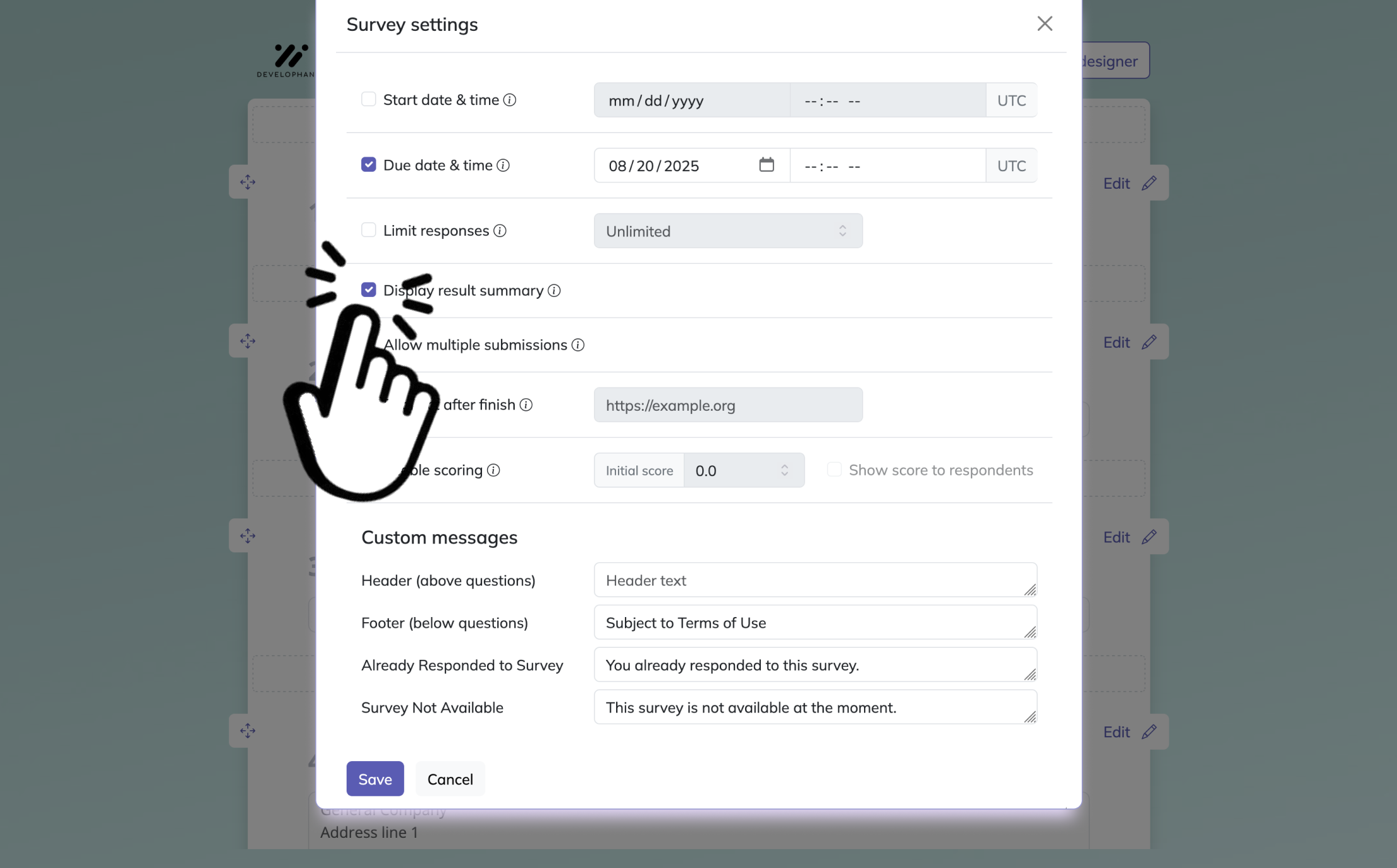
Start by clicking a pulse survey template below, or choose an empty sheet if you want to build from scratch. HeySurvey opens the survey editor right away, so you can name your survey and adjust basic settings before adding content. You can do this without an account, but you’ll need one later to publish and review responses.
2. Add questions
Click Add Question and choose simple formats that work well for pulse surveys, such as Scale, NPS, Emoji Rating, or short Choice questions. Keep it brief: 3–7 questions is usually enough for a quick check-in. You can mark questions as required, add labels, and reorder them if needed. If you want a polished look, use the designer sidebar to adjust colors and branding.
3. Publish survey
Preview your survey to make sure everything looks right, then click Publish to create a shareable link. Once published, you can send the link to your team or embed the survey on your website using our online survey tool.
Employee Engagement Pulse Survey Questions
A strong employee pulse survey questionnaire for engagement helps you track how motivated, committed, enthusiastic, and connected your people feel at work.
Here’s the thing, engagement is often the heart of an employee pulse survey sample because it gives you an early read on whether people are energized or quietly checking out.
Use a simple rating scale, like 1 to 5, so you can track trends over time without making the survey feel heavy. Short and consistent beats clever and complicated every time.
High scores can signal healthy morale, strong leadership, and a sense of purpose. Low scores can point to burnout, weak communication, low trust, or work that feels about as inspiring as soggy toast.
Why & When to Use
Engagement pulse surveys work best when you need a quick read on employee sentiment without waiting for your annual survey. They are especially useful during morale dips, after organizational changes, in quarterly check-ins, or between larger engagement surveys.
Common times to use this part of an employee pulse survey sample include:
after leadership changes or restructuring
when motivation or retention feels shaky
during regular quarterly health checks
between annual engagement survey cycles
Plus, compare results across teams carefully. Look for patterns, not people to blame, because the goal is improvement, not a scoreboard of shame.
Sample questions
How satisfied are you with your overall work experience here?
Do you have the tools and resources needed to do your job well?
How satisfied are you with communication from leadership?
Are you satisfied with your current workload?
How satisfied are you with your opportunities to provide feedback?
Gallup found 12 engagement items predict team performance across 736 studies covering 3.3 million employees, supporting short, consistent pulse-survey questions (source).
Employee Satisfaction Pulse Survey Questions
A smart employee pulse survey questionnaire for satisfaction helps you understand how employees feel about their everyday work experience, not just whether they feel loyal or inspired for the long haul.
Here’s the thing, satisfaction and engagement are close cousins, but they are not the same. Engagement asks if people feel committed and motivated, while satisfaction checks whether work feels manageable, supported, and reasonably friction-free.
That distinction matters in any strong employee pulse survey sample because satisfaction issues often point to quick operational fixes. If people lack tools, feel overloaded, or struggle with unclear updates, you can often improve things faster than you think.
Keep this part short so response rates stay high. On top of that, if you want extra context, add one optional open-text question, but use it sparingly so the survey does not turn into a surprise homework assignment.
Why & When to Use
Use satisfaction questions when you need a fast read on daily experience after changes that affect how work actually gets done.
Common times to use this section of an employee pulse survey sample include:
after policy changes
after compensation reviews
following process or workflow updates
when the same complaints keep popping up
Plus, satisfaction data can help you spot and fix small problems before they grow teeth.
Sample questions
Does your manager communicate expectations clearly?
Do you feel supported by your manager when challenges arise?
Does your manager recognize good work in a meaningful way?
Do you feel comfortable bringing concerns to your manager?
Does your manager help you grow professionally?
Manager Feedback Pulse Survey Questions
A focused employee pulse survey questionnaire about managers helps you measure the day-to-day behaviors that shape trust, clarity, support, and growth on a team.
Here’s the thing, people often do not leave jobs so much as they leave confusing, unsupported, or disconnected management. That makes this kind of employee pulse survey sample especially useful when you want practical fixes instead of vague leadership talk.
Manager feedback questions work best when they cover a few core areas:
communication and clear expectations
support during challenges
recognition for strong work
psychological safety and comfort raising concerns
coaching and professional development
Plus, these questions are highly actionable for people managers because the feedback points to specific habits they can improve. A good employee pulse survey sample here should stay concise, protect anonymity, and make honest answers feel safe.
Why & When to Use
Use manager-focused pulse questions when you want a clearer read on how leadership is experienced at the team level.
Common times to use this section of an employee pulse survey questionnaire include:
after management training
during team restructuring
after a leadership transition
when one team keeps showing higher turnover
On top of that, emphasize confidentiality, and only share manager-level results when group sizes protect employee anonymity. Coaching managers on what to do next matters more than handing over scores and hoping for magic.
Sample questions
Do you feel respected by your coworkers?
Do you feel a sense of belonging at work?
Are company values reflected in everyday decisions?
Do teams collaborate effectively across the organization?
Do you feel safe sharing different perspectives at work?
Gallup research shows managers account for 70% of team engagement variance, making manager-focused pulse questions highly predictive and actionable for improving employee experience. Source
Workplace Culture Pulse Survey Questions
A strong employee pulse survey questionnaire for workplace culture helps you understand how people actually experience your company, not just what ends up on the office wall or in a slide deck.
Here’s the thing, culture shows up in belonging, trust, collaboration, inclusion, and whether company values hold up when real decisions get made. That makes this type of employee pulse survey sample especially useful when you want to spot patterns early, before morale starts doing a disappearing act.
Culture questions work best when they focus on a few areas you can actually improve:
respect between coworkers
belonging and inclusion
trust and psychological safety
collaboration across teams
alignment between stated values and daily behavior
Plus, culture is best tracked through recurring trends, not a one-time snapshot. A smart employee pulse survey sample should stay specific enough to guide action, especially around communication habits, inclusion efforts, and team norms.
Why & When to Use
Use culture-focused pulse questions when you want to measure how connected, supported, and aligned employees feel across the organization.
Common times to use this section of an employee pulse survey questionnaire include:
during rapid company growth
after a merger or acquisition
during remote or hybrid work transitions
when leadership wants to monitor morale and cohesion
On top of that, culture tracking supports retention and strengthens your employer brand because people notice when values feel real, not just nicely laminated.
Sample questions
Do you understand why this change is happening?
Do you feel informed about how this change affects your role?
Do you have confidence in leadership’s handling of this change?
What level of support do you feel during this transition?
Do you believe the change will improve the organization in the long run?
Change Management Pulse Survey Questions
A clear employee pulse survey questionnaire helps you understand how people are reacting when change hits, whether that means a reorganization, merger, new software rollout, policy update, or leadership shake-up.
Here’s the thing, change is rarely stressful just because it exists. It gets stressful when people feel confused, left out, or like someone replaced the map halfway through the trip.
A practical employee pulse survey sample helps you catch those signals early and respond before uncertainty turns into resistance or full-blown change fatigue.
These questions are especially useful for tracking:
clarity about why the change is happening
understanding of role-specific impact
confidence in leadership communication
support levels during the transition
belief in the long-term value of the change
Plus, the best employee pulse survey questionnaire does not happen once and vanish into the mist. You will get better insights if you check sentiment before, during, and after major transitions.
Why & When to Use
Use this part of your employee pulse survey sample when your organization is moving through visible change and you need fast, honest feedback.
It works especially well:
before change, to spot concerns and prepare communication
during rollout, to identify confusion, resistance, and gaps
after implementation, to measure adaptation and trust
On top of that, segmenting results by department or location can reveal where support is strong and where uncertainty is piling up. Leaders should address concerns directly and calmly, not defensively, because ambiguity spreads fast.
Sample questions
How manageable is your current workload?
How often do you feel stressed at work?
Do you feel able to disconnect from work outside normal hours?
Do you have the support you need to maintain your well-being?
How energized do you feel at the end of a typical workweek?
Employee Well-Being and Burnout Pulse Survey Questions
A smart employee pulse survey questionnaire helps you spot stress, workload strain, burnout risk, and work-life balance issues before they start dragging down performance, morale, and retention.
Here’s the thing, people can power through for a while, but nobody does their best work when they are running on fumes and coffee optimism alone.
A thoughtful employee pulse survey sample gives you a clearer picture of whether employees feel supported, stretched too thin, or quietly heading toward burnout.
These questions are especially useful for tracking:
workload manageability
day-to-day stress levels
ability to disconnect after hours
access to support for well-being
energy levels across the workweek
Plus, this part of your employee pulse survey questionnaire should be handled with care. If employees do not trust the process, they will tell you everything is fine while internally waving tiny red flags.
Why & When to Use
Use this part of your employee pulse survey sample during busy seasons, staffing shortages, after layoffs, or when absenteeism and disengagement start creeping up.
It is especially valuable when you need sustainable performance, not just short-term output that burns people out and sends them to the exit.
Keep the survey anonymous and reinforce psychological safety so people can answer honestly.
On top of that, burnout findings should lead to real changes, such as:
workload adjustments
better staffing support
stronger manager check-ins
clearer boundaries around after-hours work
Well-being matters, but do not frame it like a yoga class can fix structural overload. The best employee pulse survey questionnaire turns burnout data into practical action, not just nicer reminders to hydrate.
Sample questions
Is this question specific enough to produce actionable feedback?
Can employees answer this question quickly and clearly?
Does this question avoid leading or biased wording?
Will the results help guide a meaningful decision or action?
Is this question appropriate for a pulse survey rather than a longer annual survey?
Best Practices for Writing and Using Pulse Survey Questions
A strong employee pulse survey questionnaire is not just about asking questions. It is about asking the right ones in the right way so you get honest responses, better participation, and insights you can actually use.
Here’s the thing, even the best employee pulse survey sample can flop if it is too long, too vague, or written like a corporate riddle.
Use these Dos and Don’ts as a practical framework when building your employee pulse survey questionnaire:
Do keep pulse surveys short, usually around 5 to 15 questions.
Do ask one topic at a time so answers stay clear.
Do protect anonymity to encourage honest feedback.
Do use a regular cadence and consistent scale types so trends are easier to track.
Do share results and follow through with visible action.
Don’t ask too many questions or turn a quick pulse into a full novel.
Don’t combine multiple ideas in one question.
Don’t use vague or leading wording that pushes people toward an answer.
Don’t over-survey employees or collect feedback you do not plan to use.
Why & When to Use
This part of your employee pulse survey sample helps when you want a repeatable process, not a one-time guess.
Use it anytime you are designing, reviewing, or improving an employee pulse survey questionnaire so each question stays fast, fair, and useful. Plus, better survey habits mean better decisions, which is kind of the whole point.
Employee Pulse Survey Sample: How to Build a Short, Effective Questionnaire
Sample questions
How motivated do you feel at work this week?
Do you have what you need to do your job effectively?
Does your manager support you when needed?
How manageable is your workload right now?
Do you feel informed about important changes affecting your team?
A smart employee pulse survey sample gives you something practical to model, whether you run surveys weekly, biweekly, monthly, or quarterly.
Here’s the thing, you do not need to cram every possible topic into one employee pulse survey questionnaire. You just need the right mix for the goal in front of you.
If you want a quick morale check, focus on motivation, workload, and manager support.
If you want to track communication, swap in questions about clarity, updates, and team alignment. Plus, that keeps your survey from feeling like homework in disguise.
A strong employee pulse survey questionnaire usually works best when you group questions around one purpose per survey, such as engagement, support, change communication, or workload.
It also helps to balance recurring benchmark questions with rotating topical ones.
Use recurring questions when you want to compare results over time.
Use rotating questions when a new issue, project, or change needs fresh feedback.
Keep the survey short so employees can answer quickly and honestly.
Choose the best question mix based on your business goal, not just what fit on the page.
Why & When to Use
Use this employee pulse survey sample when you want a simple format you can reuse without sounding repetitive.
On top of that, it helps you build an employee pulse survey questionnaire that stays consistent enough to track trends, but fresh enough that people do not answer on autopilot like sleepy robots.

Turn Pulse Survey Insights Into Action
Sample questions
What are the top 3 themes showing up in your employee pulse survey questionnaire results?
Which issues are quick wins, and which need longer-term fixes?
Who owns each action item, and when will employees hear an update?
What did your employee pulse survey sample reveal that you can address right away?
Which results should you monitor over time before making a bigger change?
The real magic starts after the survey closes, because visible follow-through builds trust.
Here’s the thing, an employee pulse survey questionnaire is only useful if you turn responses into decisions people can actually see.
Start by sorting answers into themes like workload, communication, manager support, tools, or recognition.
Then look for patterns across teams, locations, or time periods so you do not overreact to one spicy data point.
Flag quick wins you can fix fast, like unclear updates, missing tools, or meeting overload.
Separate deeper problems, like burnout, weak leadership habits, or broken processes.
Assign one owner to each next step so nothing floats around like office glitter.
Track trends from each employee pulse survey sample to spot what is improving, stalling, or slipping.
Plus, close the feedback loop clearly and often.
Share what you heard, what will change now, and what will not change yet, along with why.
Why & When to Use
Use this approach anytime you want your employee pulse survey questionnaire to lead to action instead of becoming a very expensive suggestion box.
On top of that, it helps you respond to both fast fixes and bigger structural issues while keeping employees informed, which is exactly how an employee pulse survey sample turns from data into momentum.
Related Surveys
29 Social Media Survey Questions
Explore 25 social media survey questions with practical sample prompts to help gather insights on...
31 Job Satisfaction Survey Questions
Explore **25 job satisfaction survey questions** with sample prompts to improve employee feedback...
29 Quantitative Survey Questions Guide
Explore 25 quantitative survey questions with sample questions, examples, and tips to build effec...