29 Post Purchase Survey Questions
Explore 25 sample post purchase survey questions to improve feedback, customer insights, and retention after checkout.
You made the sale, but the real insight starts after checkout.
Post purchase survey questions are the quick, strategic prompts you use after someone buys to understand customer satisfaction, product experience, checkout friction, and retention opportunities.
Here’s the thing: this article will walk you through the main types of post purchase surveys, when to use each one, sample questions you can borrow, and how to turn responses into smart improvements that keep customers coming back for more using an online survey tool.
Customer Satisfaction Survey Questions
Sample questions
How satisfied are you with your overall purchase experience?
How easy was it to complete your order today?
Did our product meet your expectations?
How would you rate the value for money of your purchase?
What is one thing we could do to improve your experience?
A quick pulse on customer happiness
Why & When to Use
Customer satisfaction surveys help you measure how customers feel right after buying, or shortly after they receive the product or service.
They work especially well for ecommerce brands, SaaS companies, subscription businesses, and service providers that want a fast read on the full experience.
Here’s the thing: satisfaction with the buying process is not always the same as satisfaction with the product itself.
A customer might love your product but hate a clunky checkout, or breeze through checkout and then feel underwhelmed when the item arrives. Yes, customers contain multitudes.
Use this survey right after checkout if you want feedback on the purchase experience.
Use it after delivery, onboarding, or service completion if you want feedback on the full journey.
A smart customer satisfaction survey should stay short, simple, and easy to finish.
A mix of question types usually works best:
Rating-scale questions help you spot trends fast.
Open-ended questions show you why customers feel the way they do.
Plus, this data helps you uncover experience gaps across key moments like:
checkout flow
shipping and delivery
product quality
overall value for money
On top of that, shorter surveys usually get more responses, which means more useful insight and less digital tumbleweed.
Research consistently finds shorter post-purchase surveys improve response and completion rates, increasing feedback usefulness for customer satisfaction measurement (source).
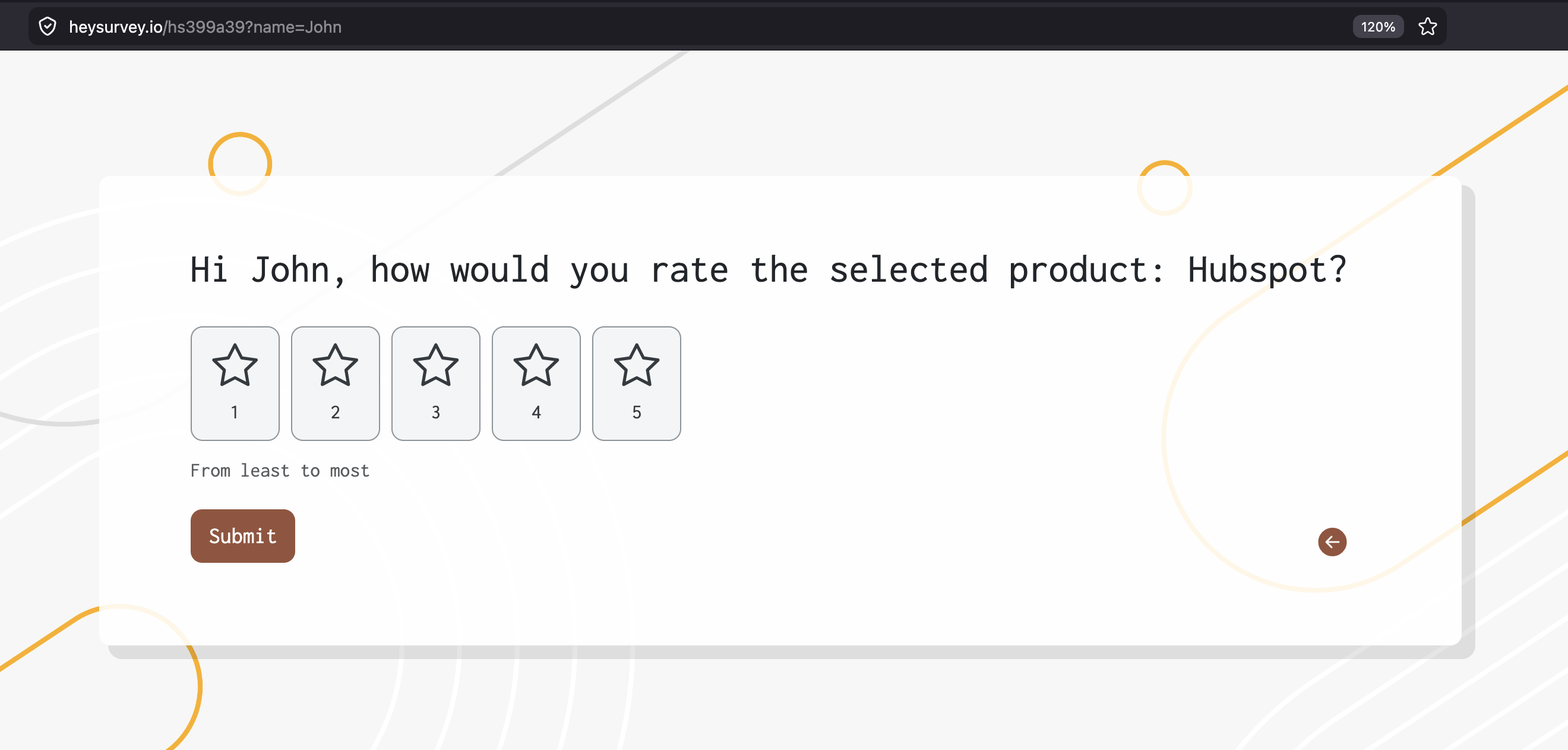
How to create a post-purchase survey in HeySurvey
1. Create a new survey
Start by opening a post-purchase survey template with the button below, or create a survey from scratch if you prefer. HeySurvey lets you begin without an account, so you can explore the editor first. Once your survey opens, you can rename it and adjust basic settings like your logo, survey dates, and branding. For post-purchase feedback, a simple one-question-per-page layout usually works best.
2. Add questions
Click Add Question to include the questions you want to ask customers after they buy. Good post-purchase survey questions often use Choice, Scale, or NPS questions, such as “How satisfied were you with your purchase?” or “How likely are you to recommend us?” You can also add a short Text question for open feedback. Mark important questions as required if you want every respondent to answer them.
3. Publish your survey
Before sharing, preview the survey to check how it looks on desktop and mobile. When everything is ready, click Publish to create your shareable link. If you have an account, you can also view responses, track results, and update the survey later.
Net Promoter Score (NPS) Survey Questions
Sample questions
On a scale of 0 to 10, how likely are you to recommend us to a friend or colleague?
What is the main reason for your score?
What nearly stopped you from giving a higher score?
What did we do particularly well during your purchase experience?
What could we improve to make you more likely to recommend us?
A simple score with big loyalty clues
Why & When to Use
NPS-style post purchase survey questions help you measure loyalty, not just satisfaction.
Here’s the thing: they show how likely your customers are to recommend you, which makes NPS especially useful when you want a benchmarkable metric tied to advocacy.
This survey works best after customers have had enough time to actually use the product or experience the service.
If you ask too early, you may get a score based on first impressions alone, and that is a bit like judging a movie by the popcorn.
In plain language, NPS responses usually fall into three groups:
Promoters are happy customers who are very likely to recommend you.
Passives are reasonably satisfied, but not excited enough to rave about you.
Detractors are disappointed customers who are less likely to recommend you.
Plus, the score alone only tells you what happened, not why it happened.
That is why your follow-up question matters so much.
A strong NPS survey should always ask what drove the rating, then review comments by score group so patterns are easier to spot.
On top of that, NPS is most useful when you act on it:
Look at promoter feedback to see what to keep doing.
Review passive responses for missed opportunities.
Study detractor comments to find friction points and fix them fast.
Bain found the “likelihood to recommend” question strongly correlates with repurchases and referrals, making NPS useful for post-purchase loyalty measurement (source).
Product Experience Survey Questions
Sample questions
Did the product match the description on our website?
How satisfied are you with the quality of the product?
Was the product easy to use or set up?
Which feature or aspect of the product do you value most?
What, if anything, disappointed you about the product?
The fastest way to spot expectation gaps
Why & When to Use
Product experience survey questions help you learn whether what you sold actually lived up to what your customer expected.
They work especially well for physical products, digital products, and subscription boxes, where satisfaction depends on real use, not just a smooth checkout.
Here’s the thing: this survey is best sent after delivery and after the customer has had enough time to try the product.
If you ask too soon, you may get opinions based on packaging excitement alone, and yes, the unboxing glow is real.
These questions also help you separate product feedback from purchase-process feedback.
That matters because a customer might love the checkout experience but still feel let down by the item itself.
Use responses to improve the parts of the experience that shape expectations and product reality:
Product pages, especially descriptions, specs, and images.
Packaging, instructions, and setup guidance.
Quality control issues that affect consistency.
Plus, these surveys can reveal expectation gaps caused by unclear imagery, vague copy, or descriptions that sound better than the product feels in real life.
On top of that, segment answers by product category or SKU.
That makes it easier to spot whether one item is underperforming, one feature keeps confusing people, or one product page is quietly causing chaos.
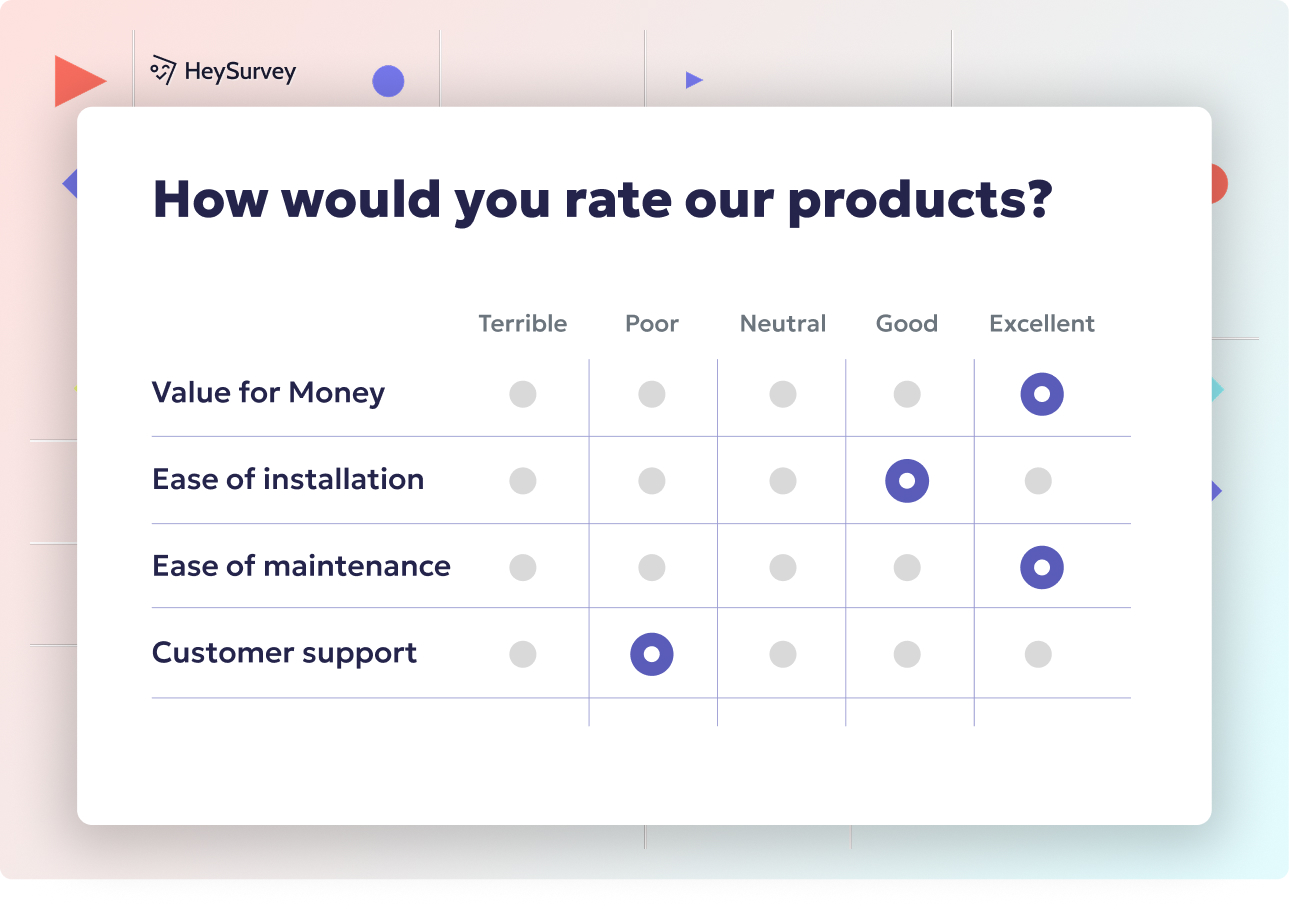
Checkout and Purchase Experience Survey Questions
Sample questions
How easy was it to find the product you wanted?
Did you experience any issues during checkout?
Were the shipping options clear and satisfactory?
Did you feel confident entering payment information on our site?
What almost prevented you from completing your purchase?
The quickest way to catch checkout friction before it costs you more sales
Why & When to Use
Checkout and purchase experience survey questions help you uncover friction in the buying journey before and during checkout.
They are especially useful when you want to improve conversion quality, reduce abandonment in future visits, and make payment and shipping selection feel smoother.
Here’s the thing: analytics can show you where people drop off, but they usually cannot tell you why.
A survey fills in that gap and helps you spot the hidden stuff, like hesitation, confusion, or a trust wobble right before the finish line.
Send this survey immediately after order completion, while the experience is still fresh in your customer’s mind.
It is also extra helpful after a site redesign, pricing update, or any checkout change, because even small tweaks can create big "wait, what?" moments.
Focus your questions and analysis on the areas that shape purchase confidence most:
Clarity of product discovery and navigation.
Speed and smoothness of checkout steps.
Trust in payment security and form design.
Shipping options, costs, and delivery expectations.
Plus, look for recurring themes in responses.
Those patterns help you prioritize UX and conversion improvements faster, so you fix the stuff that actually nudges more shoppers across the finish line.
Sending checkout surveys immediately after purchase captures fresher, more predictive feedback than later surveys, improving detection of friction that affects satisfaction and future behavior (source)
Delivery and Fulfillment Survey Questions
Sample questions
Did your order arrive on time?
Was the packaging in good condition when your order arrived?
Was your order accurate and complete?
How satisfied are you with the delivery experience?
What could we improve about shipping or fulfillment?
What happens after checkout often becomes the part your customer remembers most
Why & When to Use
Delivery and fulfillment survey questions help you measure the part of the customer experience that starts after the purchase is already done.
For ecommerce and subscription brands, this stage carries a lot of emotional weight, because people often judge your whole brand by the moment the box lands on the doorstep.
Here’s the thing: a smooth checkout can win the order, but sloppy fulfillment can steal the applause.
Send this survey shortly after confirmed delivery, while the details are still fresh and before a small annoyance turns into a very public one-star masterpiece.
Use responses to connect feedback to the operational areas that shape fulfillment quality most:
Carrier performance and delivery timing.
Warehouse picking, packing, and order accuracy.
Packaging quality, protection, and presentation.
Whether delivery expectations matched the real experience.
Plus, separate internal issues from carrier-related issues during analysis.
That helps you avoid blaming your warehouse for a carrier delay, or blaming the carrier when the wrong item left your shelf in the first place.
On top of that, fixing repeat fulfillment complaints can support retention and protect search visibility by reducing negative reviews that mention shipping, damage, or missing items.
Customer Effort Survey Questions
Sample questions
How easy was it to complete your purchase from start to finish?
How easy was it to find the information you needed before buying?
How easy was it to set up or start using your purchase?
How easy was it to get help when you needed it?
What part of the experience felt harder than it should have been?
Easy experiences earn repeat business
Why & When to Use
Customer effort survey questions help you measure how easy or frustrating it felt for someone to buy, receive, set up, use, or get help with a purchase.
They are especially useful if your brand is focused on reducing friction, improving retention, and making life easier for customers instead of making them work for every small win. Nobody wants a product that feels like homework.
Here’s the thing: low-effort experiences often lead to stronger loyalty and more repeat purchases, because people remember when your brand saved them time and energy.
Send this survey after a key post-purchase interaction, such as onboarding, setup, delivery, or a support conversation, while the details are still fresh.
Use responses to spot friction across the full journey, not just at checkout:
Product pages and pre-purchase information.
Device-specific issues on mobile or desktop.
Setup, onboarding, or first-use confusion.
Support access, response time, and resolution path.
Differences by product type or customer segment.
Plus, effort-based questions often uncover practical fixes with fast ROI, like clearer instructions, better FAQs, or fewer support steps.
On top of that, comparing effort scores by device type, product category, or audience segment helps you find exactly where the bumps are hiding.
Best Practices for Post Purchase Surveys
Sample questions
Was this survey quick and easy to complete?
Did any question feel unclear or repetitive?
Would you prefer to answer this survey by email, SMS, or on-site?
How many questions felt reasonable for this type of survey?
Is there anything we should have asked but did not?
Great surveys respect your customer’s time
Why & When to Use
Use this section as your playbook for building better post purchase surveys, no matter which survey type you send.
Here’s the thing: even smart questions can flop if the timing is off, the survey is too long, or the wording feels like it was written by a committee with no snacks.
If you want higher completion rates and more reliable responses, keep your survey tight, relevant, and easy to answer.
Focus on a few core habits that make a big difference:
Send the survey while the experience is still fresh and relevant.
Keep it short and centered on one clear objective.
Use simple language and ask only one idea per question.
Mix score-based questions with open-ended comments.
Segment feedback by product, customer type, and purchase channel.
Follow up by acting on what people tell you.
Plus, a clear Dos and Don'ts approach keeps your survey from becoming cluttered or confusing.
Do:
Keep surveys short.
Match timing to the customer journey.
Review both ratings and written comments.
Ask only for information you do not already have.
Don't:
Cram too many questions into one survey.
Combine multiple topics in a single question.
Send every survey at the same moment regardless of context.
Ignore negative feedback or repeated patterns.
On top of that, the best survey is not just collected. It actually changes something.
How to Analyze Post Purchase Survey Responses
Sample questions
Which customer segment reports the lowest satisfaction?
What complaint appears most often in open-ended responses?
At what stage of the post purchase journey do issues happen most?
Which products or channels generate the strongest positive feedback?
Which survey findings point to the fastest improvement opportunities?
Good analysis turns feedback into clear next steps
Why & When to Use
Use this section when you are ready to move from collecting responses to actually learning from them.
It works best after you understand your survey types, because once answers start rolling in, you need a simple way to spot patterns without turning into a spreadsheet wizard overnight.
Start by grouping feedback into a few repeatable themes so the mess becomes manageable.
Shipping
Product quality
Customer support
Pricing
Usability
Here’s the thing: one angry comment can feel dramatic, but repeated issues are what deserve your attention.
Look for patterns that show up again and again across ratings, written comments, products, or customer segments.
Plus, compare score-based answers with open-text feedback so you get both the headline and the backstory.
For example, a low satisfaction score tells you something is wrong, while written comments reveal whether the real culprit is late delivery, confusing setup, or support that moved at the speed of a sleepy turtle.
On top of that, rank issues by two things: how often they appear and how much they affect your business.
Focus first on problems that hit revenue, retention, or customer trust.
That way, you are not just reacting faster. You are fixing the things that matter most.
Turn Survey Insights Into Action
Sample questions
What is the single biggest issue customers mention after purchase?
Which improvement would most quickly improve customer satisfaction?
What feedback trend should be escalated to product or operations teams?
Which positive responses can be used to strengthen messaging or testimonials?
How will we measure whether changes made from survey feedback actually worked?
Action is where survey value finally pays rent
Why & When to Use
Use this closing section when you want to turn post purchase survey questions into better retention, stronger reviews, more referrals, and higher customer lifetime value.
Here’s the thing: surveys do not create results by themselves, no matter how pretty the dashboard looks.
The real win comes when you pick one clear goal, launch a simple survey, review feedback on a regular schedule, and assign someone to own each improvement.
Plus, this works best when teams share responsibility instead of tossing feedback around like a hot potato.
Marketing can use positive responses in messaging and testimonials.
Ecommerce can improve checkout, delivery communication, or product page clarity.
Product can fix recurring quality or usability issues.
Support can reduce friction in common complaint areas.
Fulfillment can address packing, shipping speed, or damaged orders.
A simple framework keeps everything moving:
Collect feedback
Categorize responses
Prioritize what matters most
Fix the issue
Re-measure results
On top of that, track whether changes actually improve satisfaction, repeat purchases, review quality, or referral behavior.
That is the whole game: not just collecting data, but using it to make the next customer experience better than the last.
Related Surveys
29 Social Media Survey Questions
Explore 25 social media survey questions with practical sample prompts to help gather insights on...
31 Job Satisfaction Survey Questions
Explore **25 job satisfaction survey questions** with sample prompts to improve employee feedback...
29 Quantitative Survey Questions Guide
Explore 25 quantitative survey questions with sample questions, examples, and tips to build effec...