31 Open Ended Survey Questions
Explore 25 open ended survey questions with sample questions, tips, and examples to improve responses and gather deeper insights.
Open ended survey questions let you answer in your own words, unlike closed-ended formats that box you into fixed choices. They turn surveys into real conversations, which is where the good stuff usually shows up.
In this guide, you’ll see the main types of survey questions open ended formats handle best, plus sample questionnaire open ended questions, open question questionnaire examples, and open ended questions for surveys examples you can actually use. On top of that, you’ll get sample open ended survey questions, best practices, and a simple open ended questionnaire template because staring at a blank page is nobody’s hobby.
Sample questions
What was the main reason for your satisfaction or dissatisfaction with your recent experience?
What could we have done better to meet your expectations?
What stood out most about your experience with our product or service?
If you could change one thing about your experience, what would it be?
What nearly stopped you from completing your purchase or using our service?
Customer Satisfaction Open Ended Survey Questions
These questions reveal the story behind the score.
Why & When to Use
Customer satisfaction surveys work best when you go beyond the rating and ask why someone feels the way they do. That is exactly where sample questionnaire open ended questions shine.
This is one of the most common use cases for open question questionnaire examples because it helps you uncover churn risk, delight drivers, and unmet expectations before they quietly turn into bigger problems.
You’ll get especially useful answers after key moments like:
a purchase
a customer support interaction
onboarding
a renewal
an NPS or CSAT follow-up
Here’s the thing: a score of 6 or 9 tells you how a customer feels, but not what caused it. Pairing ratings with open ended questions for surveys examples gives you the context you need to actually improve something.
Plus, once responses start coming in, look for repeated phrases tied to:
service quality
product performance
pricing
trust
On top of that, tag replies by themes like speed, communication, ease of use, and value. That makes sample open ended survey questions far easier to analyze, and way less like wrestling a spreadsheet before coffee.
Sample questions
What problem were you hoping this product would solve for you?
Which feature do you use the most, and why?
What feels confusing, frustrating, or harder than it should be?
What feature or improvement would make this product significantly more valuable to you?
If you stopped using this product tomorrow, what would you miss most?
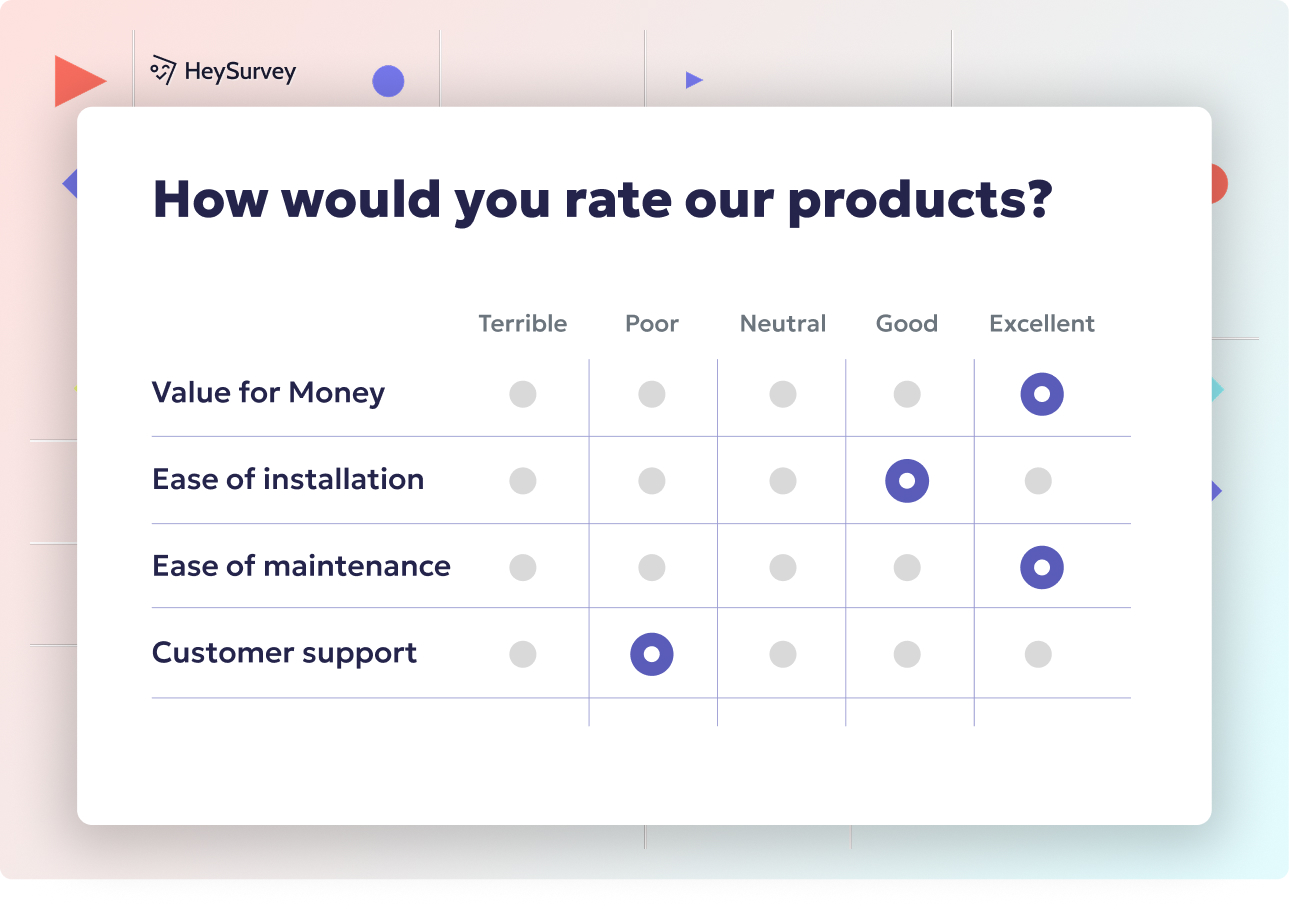
Research shows pairing closed-ended satisfaction ratings with open-ended comments reveals actionable drivers of satisfaction and complaints that numeric scores alone miss (ScienceDirect).
Create an open-ended survey in 3 easy steps
1. Create a new survey
Start by opening a template below this guide, or choose an empty sheet if you want to build from scratch. You can use HeySurvey without an account while you edit, but you’ll need to sign in before you can publish and view responses. Give your survey a name in the editor so it’s easy to find later. If you’re looking for an online survey maker, this is a simple place to start.
2. Add questions
Click Add Question and select Text for each open-ended question. Use single-line mode for short answers, or paragraph mode for longer feedback. Add a question title, optional description, and a placeholder if you want to guide respondents. If needed, mark the question as required so people must answer before continuing.
3. Publish survey
Review your survey with Preview to see it as respondents will. When everything looks right, click Publish to generate a shareable link. You can then send the survey by link, embed it on your website, or share it in email.
Product Feedback Open Ended Survey Questions
Product feedback turns opinions into practical next steps.
Why & When to Use
Product-focused sample questionnaire open ended questions help you uncover what users actually experience, not just what your team assumes they experience.
That makes them perfect for spotting usability issues, uncovering desired features, and understanding why people adopt a product, ignore parts of it, or quietly abandon it.
This is why open question questionnaire examples are so useful for product improvement across SaaS tools, mobile apps, physical products, beta tests, feature launches, and ongoing research.
Here’s the thing: broad questions help you explore the big picture, while targeted feature questions help you zoom in on specific workflows, tools, or release changes.
Use broad open ended questions for surveys examples when you want to learn what users hoped to achieve, what they value most, and what gets in their way.
Then use narrower questions when you need feedback on one feature, one screen, or one product moment. Plus, that keeps your survey from turning into a junk drawer of random opinions.
As answers come in, compare themes by:
user segment
plan type
lifecycle stage
On top of that, separate feature requests from root-cause pain points.
A request like "add a dashboard" may sound clear, but the deeper issue might be poor visibility, slow reporting, or confusing navigation. That is where questionnaire sample open ended insights become genuinely useful.
Sample questions
What challenge led you to start looking for a solution like this?
How are you currently solving this problem today?
What matters most to you when comparing options in this category?
What concerns or doubts do you have before choosing a provider or product like this?
How would you describe your ideal solution in your own words?
Open-ended survey questions can elicit respondents’ first-order concerns without constraining them to preset choices, making them valuable for uncovering unexpected product feedback (source).
Market Research and Audience Insight Questions
Real buyer language is marketing gold.
Why & When to Use
Market research sample questionnaire open ended questions help you understand what drives people to search, compare, hesitate, and finally buy.
They uncover customer motivations, decision criteria, alternatives considered, and the exact words real buyers use when talking about their problem.
That matters more than you might think, because open question questionnaire examples often reveal the gap between what your brand says and what your audience actually cares about.
Use these sample open ended survey questions before launching a product, entering a new market, repositioning your messaging, or tightening up buyer personas.
Plus, responses can show you purchase triggers, competitor patterns, and the difference between emotional motivations and functional needs. People rarely buy with spreadsheets alone, even if they pretend they do.
These open ended questions for surveys examples are especially useful when you want better discovery data, not just prettier charts.
As you review answers, look for patterns like:
phrases customers repeat
objections that slow decisions
alternatives they compare you against
segments with different priorities or pain points
On top of that, save respondents’ exact wording for SEO copy, ad messaging, landing pages, and sales content.
That is where a smart open ended questionnaire template becomes more than research, because it helps you segment audiences and speak like someone who actually listened.
Sample questions
What is one thing that would most improve your experience at work?
What helps you do your best work here?
What gets in the way of your productivity or motivation?
How would you describe communication within your team or the company overall?
What is one suggestion you have for leadership or management?
Employee Feedback and Engagement Questions
Honest employee feedback helps you fix the stuff dashboards miss.
Why & When to Use
Employee-focused sample questionnaire open ended questions give you the kind of insight ratings alone cannot.
They help you spot morale issues, communication gaps, leadership concerns, and practical ideas for improvement before small frustrations turn into full-blown eye rolls.
Use these open question questionnaire examples in engagement surveys, onboarding check-ins, manager feedback forms, training reviews, and exit surveys.
They also work well when you want clearer context around trends that pop up in closed-answer surveys.
Here’s the thing, better answers depend on trust.
If people are unsure about anonymity or worry their comments will be used against them, your open ended questions for surveys examples will collect safe, vague responses instead of useful ones.
Keep the tone neutral, explain confidentiality clearly, and create psychological safety so employees feel comfortable being candid.
On top of that, avoid prompts that are too broad, because questions like "Any thoughts?" usually earn replies that are about as helpful as a shrug.
A stronger questionnaire sample open ended approach is to ask focused questions tied to real experiences, blockers, support, and communication.
As you review responses, group themes by:
department
tenure
job role
manager or team
stage in the employee journey
Plus, this makes your sample open ended survey questions far more actionable, and it can turn a basic open ended questionnaire template into a real improvement tool.
Sample questions
What was the most valuable part of the event or training for you?
What topics or segments felt least useful or relevant?
What questions do you still have after attending?
How could the event or training be improved for future participants?
What would you like to see covered in a future session?
Open-ended survey questions yield insights into how respondents understand questions and arrive at answers, beyond their substantive responses (source).
Event and Training Feedback Questions
Great event feedback turns polite applause into better sessions next time.
Why & When to Use
This set of sample questionnaire open ended questions works especially well for webinars, conferences, workshops, courses, and internal training sessions.
It gives you practical insight into what people actually learned, what felt unclear, and what should change before the next round.
These open question questionnaire examples are useful when you want more than attendance numbers or star ratings.
They help you understand content relevance, speaker quality, pacing, delivery format, and timing, so your next session is not just louder but smarter.
Here’s the thing, the best feedback usually comes fast.
Send your open ended questions for surveys examples soon after the event while details are still fresh, because waiting too long can turn useful insight into fuzzy "it was good" comments.
This is a strong questionnaire sample open ended category because the feedback is immediately usable.
You can apply responses right away to improve agendas, slides, handouts, exercises, and follow-up resources.
As you review answers, look for patterns around:
pacing and session length
speaker clarity and energy
content usefulness and relevance
format, such as live, virtual, or hybrid
questions that still need follow-up
Plus, these sample open ended survey questions can help you shape a better open ended questionnaire template for future events that people actually want to finish.
Sample questions
What brought you to our website today?
What information were you hoping to find but couldn’t easily locate?
What almost stopped you from contacting us or signing up?
What is your biggest priority in finding a solution like this?
Is there anything that would make you feel more confident moving forward with us?
Lead Generation and Website Experience Questions
Smart website feedback helps you catch buyer intent before it slips out the side door.
Why & When to Use
These sample questionnaire open ended questions are ideal when you want to understand why people visit, hesitate, and convert on your website.
They reveal visitor intent, hidden objections, and those tiny friction points that quietly wreck forms, landing pages, and sign-ups.
These open question questionnaire examples work especially well for post-demo requests, abandoned carts, lead forms, pricing-page surveys, and contact inquiries.
Plus, they help you spot content gaps fast, like missing pricing details, weak trust signals, or a CTA that sounds fancy but says very little.
Use these open ended questions for surveys examples when you need more than click data.
Analytics can tell you where people dropped off, but not what they were thinking while doing it, which is where the gold usually hides.
This is also where an open ended questionnaire template becomes useful for lead qualification and conversion research.
Keep questions short and clear so people actually answer them instead of treating your form like a pop quiz they did not study for.
As responses come in, look for patterns around:
buyer intent and urgency
objections before contact or sign-up
missing information on key pages
trust concerns, pricing confusion, or weak offers
ways to improve landing page copy, FAQs, and CTAs
On top of that, a strong questionnaire sample open ended approach can turn scattered comments into sharper messaging and better leads.
Sample questions
What made you give that rating?
How would you describe the biggest issue in your own words?
What could we change to make this experience easier for you?
Why did you choose that answer?
How could this product, service, or process work better for your needs?
Best Practices for Writing Open Ended Survey Questions
Great open-ended questions feel easy to answer and useful to analyze.
Why & When to Use
These sample questionnaire open ended questions work best when you want detail, context, and real human language instead of one-click answers.
Use them when a rating alone is not enough, especially if you need follow-up insight after a scale, yes-no item, or multiple-choice response.
Here’s the thing, strong open question questionnaire examples improve response quality because they are specific, neutral, and easy to understand.
They also help you decide when to use types of survey questions open ended versus closed-ended, since not every survey needs a wall of text and a heroic amount of patience.
Dos
Use clear, neutral wording like “What made that experience frustrating?” instead of “What did you dislike about our confusing checkout?”
Ask one thing at a time. A weak prompt is “What did you think of the price and quality?” A stronger one is “What did you think of the price?”
Match the question to your goal, audience, and timing.
Place sample open ended survey questions after a rating question when you want deeper explanation.
Keep the total number manageable so people do not tap out halfway through.
Use simple prompts like what, why, and how.
Test your wording before launch.
Don’ts
Do not lead people toward your preferred answer.
Do not make every item open-ended. Closed-ended questions are better when you need fast comparison or cleaner data.
Do not rely on vague prompts like “Any other thoughts?” as your main method.
Do not combine topics, ask for fuzzy memories, or skip analysis planning.
Do not ignore tone, privacy, or sensitivity, because even the best open ended questionnaire template cannot save an awkward question.
Sample questions
What is the main reason you are completing this survey today?
Can you describe your experience in your own words?
What worked well for you, and why?
What could have been better, and why?
What should we improve first based on your experience?
Open Ended Questionnaire Template Ideas
A simple template saves time, but smart customization saves your survey.
Why & When to Use
Sometimes you do not just want isolated prompts. You want a reusable structure you can plug into different surveys without starting from a blank page and staring at it like it owes you money.
That is where an open ended questionnaire template helps.
It gives you a practical starting point if you are searching for sample questionnaire open ended questions, questionnaire sample open ended formats, or flexible open question questionnaire examples.
Here’s the thing, the best templates are built around one goal only.
If your goal is customer feedback, product research, employee input, or event follow-up, your template should match that purpose instead of copying generic wording word-for-word.
A simple 3 to 5 question format usually works best for open ended questions for surveys examples because it keeps responses focused and easier to review.
Use a structure like this:
Start with context, such as why the person is responding now.
Move to the full experience in their own words.
Ask what worked well.
Ask what did not work well.
End with the top improvement priority.
Plus, you can adapt the same sample open ended survey questions by audience, survey goal, and stage of the customer or employee journey, which makes your open ended questionnaire template far more useful than a one-size-fits-all list.
Sample questions
Which feedback themes appear most often across responses?
Which comments point to high-impact problems or opportunities?
What quick fixes can be implemented immediately?
What longer-term improvements require further research or resourcing?
How will we communicate changes back to respondents or stakeholders?
Turning Open Ended Survey Responses Into Action
Great feedback is only useful when you actually do something with it.
Why & When to Use
Collecting responses is the easy part. The real value of sample questionnaire open ended questions shows up when you turn messy comments into clear next steps.
Here’s the thing, raw answers can look chaotic at first, but patterns usually appear faster than you think.
When you review open question questionnaire examples or open ended questions for surveys examples, your goal is not to admire the wording like it belongs in a museum. Your goal is to spot what repeats, what matters, and what deserves action.
A simple process keeps you from drowning in comments:
Categorize responses into themes like pricing, support, product issues, or wins.
Quantify recurring themes so you can see what shows up most often.
Prioritize items based on impact, urgency, and effort.
Assign owners so improvements do not float around homeless in a spreadsheet.
Review outcomes later to see what changed.
Plus, tools like dashboards, tagging systems, and quote extraction can make sample open ended survey questions far more useful without getting overly technical.
On top of that, separate quick fixes from bigger projects. Some issues need an immediate tweak, while others need research, budget, or team buy-in.
Use open ended questionnaire template ideas and open ended questions for surveys examples as your starting point, then refine based on what your responses actually reveal.
Conclusion: Use Open Ended Survey Questions to Get Better Insights
Sample questions
What are people really trying to tell you beyond the score they selected?
Are your survey questions clear enough to invite useful, honest answers?
How often do you review open ended responses for patterns and trends?
Who on your team needs to see these insights to make better decisions?
What changes can you make right now based on what respondents are saying?
Why & When to Use
Use open ended survey questions when you want the story behind the score, not just the score itself.
The real gold is in the why.
Here’s the thing, ratings tell you what happened, but open responses help you understand why people felt that way in the first place. That extra context can reveal friction, confusion, unmet needs, and opportunities you would otherwise miss.
The best results usually come from getting the basics right first. Choose the right survey type, ask clear and focused questions, and make it easy for people to answer without feeling like they just got assigned homework.
Keep these principles in play:
match the question to the survey goal
keep wording simple and specific
avoid leading or overly broad prompts
review responses for repeated themes
turn insights into actions your team can actually use
Plus, do not let great feedback sit in a spreadsheet collecting dust bunnies. Review themes regularly, share the most useful insights with decision-makers, and use what you learn to improve customer experiences, employee experiences, messaging, and business outcomes.
When you do that consistently, open ended survey questions become more than a research tool. They become a smart habit for making better decisions.
Related Surveys
29 Social Media Survey Questions
Explore 25 social media survey questions with practical sample prompts to help gather insights on...
31 Job Satisfaction Survey Questions
Explore **25 job satisfaction survey questions** with sample prompts to improve employee feedback...
29 Quantitative Survey Questions Guide
Explore 25 quantitative survey questions with sample questions, examples, and tips to build effec...