29 NPS Survey Questions
Explore 25 sample NPS survey questions to improve customer feedback, measure loyalty, and build stronger surveys for better insights.
Want a faster read on customer loyalty without guesswork? Net Promoter Score, or NPS, measures how likely people are to recommend you, and the right questions can turn a shrug into useful insight.
Smart NPS questions get smarter answers.
In this guide, you’ll see practical survey types, when to use each, and an nps questions sample your marketing, CX, and product teams can adapt. Plus, we’ll cover customer satisfaction nps survey questions that help you spot friction, improve retention, and keep more customers from quietly ghosting you, all with the help of an online survey tool.
Standard Relationship NPS Survey Questions
Sample questions
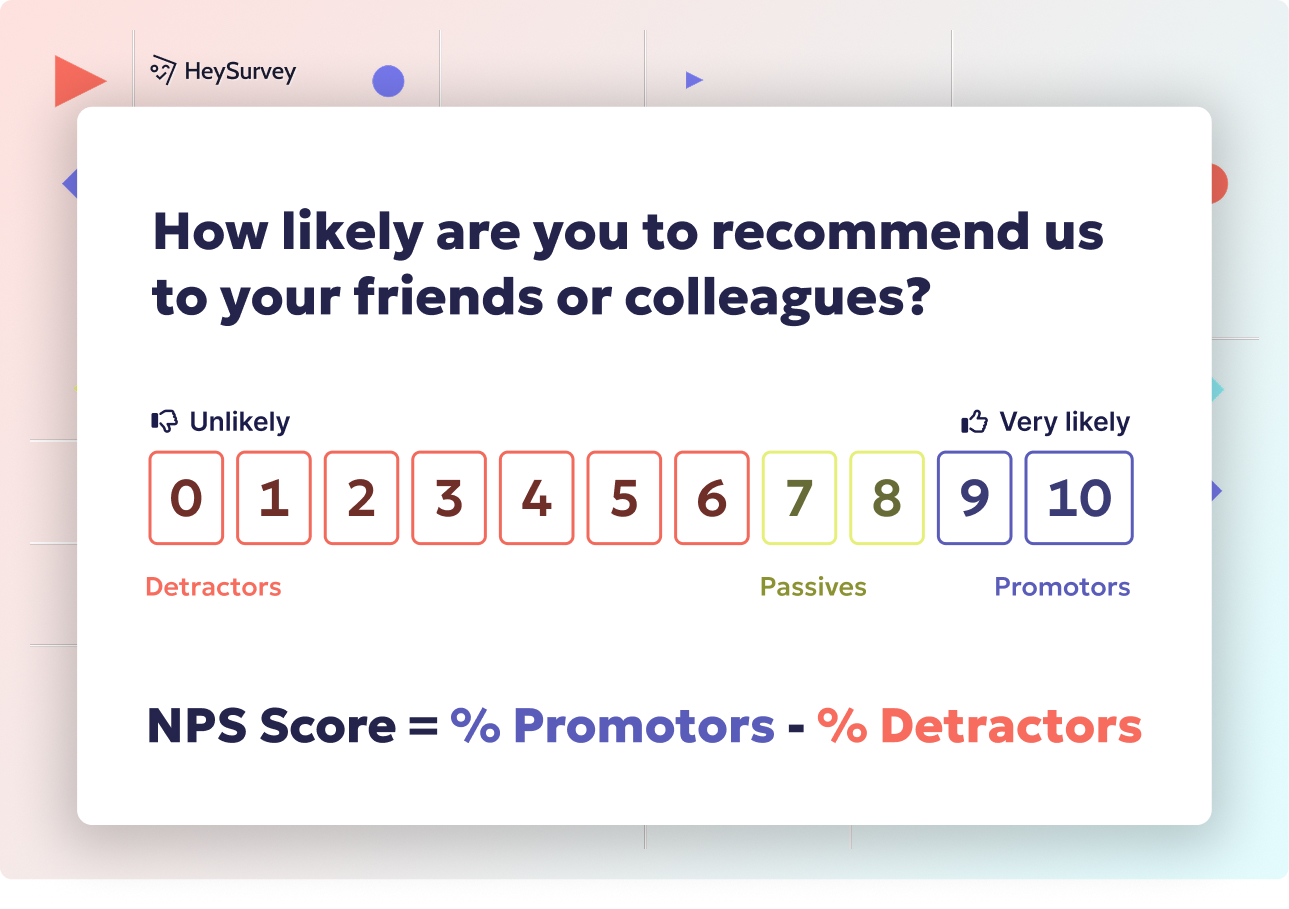
On a scale of 0 to 10, how likely are you to recommend our company to a friend or colleague?
What is the primary reason for your score?
What is one thing we could do to improve your experience?
What do you value most about our product or service?
How well does our company meet your expectations overall?
This is your classic loyalty pulse check.
Why & When to Use
This is the standard relationship NPS format, and it is the one most people mean when they talk about an nps questions sample.
The first question is the actual NPS question, while the rest give you the story behind the number.
Use this format when you want a high-level read on how loyal customers feel toward your brand, company, or service, not just one support ticket, delivery, or feature.
It works especially well for:
ongoing pulse checks
quarterly customer experience reviews
benchmarking loyalty over time
segmenting responses into promoters, passives, and detractors
Here’s the thing: if you only ask the score question, you get a number, but not much direction.
When you add a few short follow-ups, your customer satisfaction nps survey questions become much more useful for spotting trends, friction points, and what keeps people coming back.
Plus, this format makes trend tracking easier because you can compare results month to month or quarter to quarter without changing the core structure.
Keep it short, though.
Five questions is usually plenty, because customers are far more likely to finish a quick survey than a surprise pop quiz nobody studied for.
Bain research found the “likely to recommend” question best predicted customer behavior in 11 of 14 industry studies, supporting standard relationship NPS surveys (source)
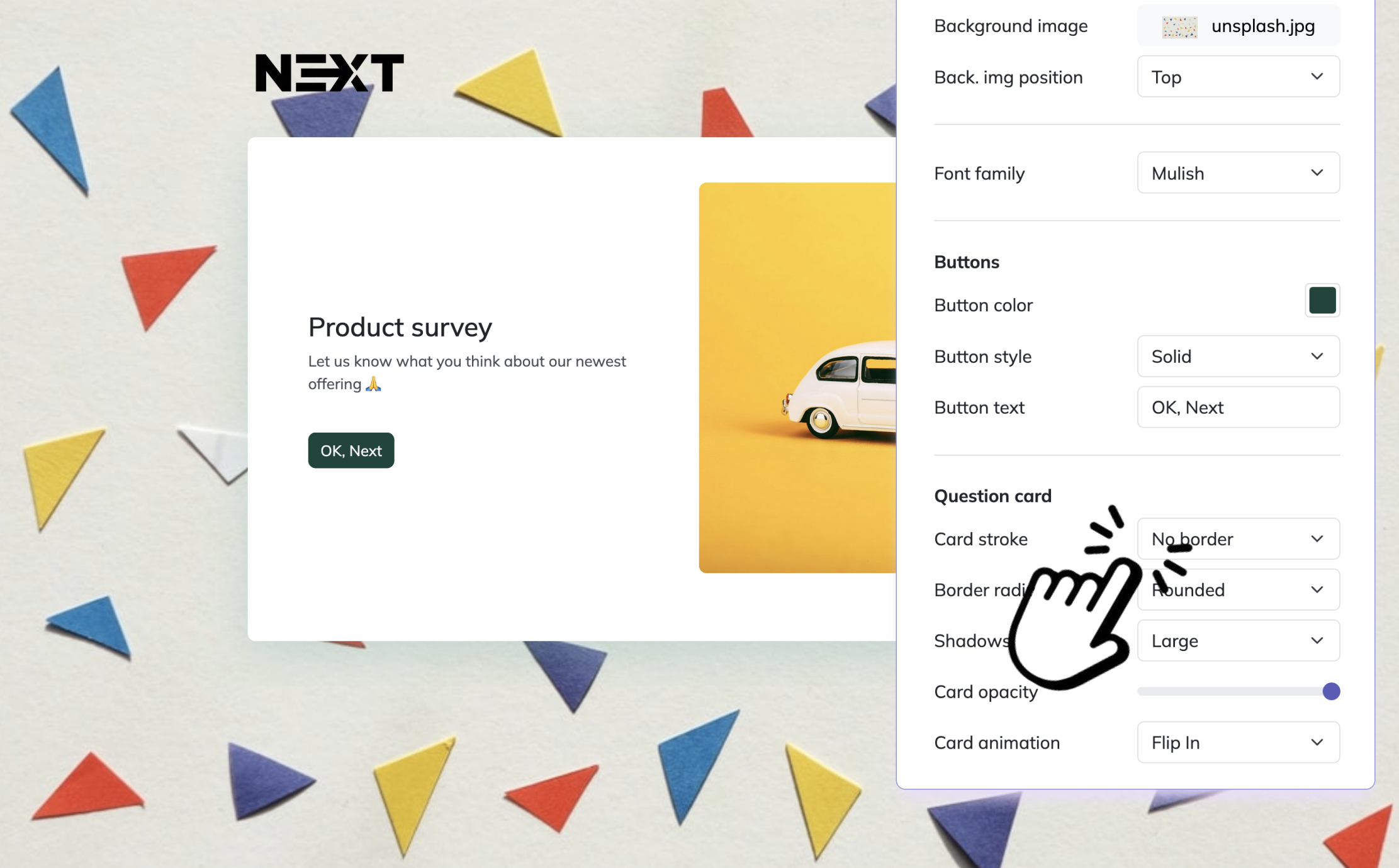
Creating an NPS survey in HeySurvey is quick and simple.
1. Create a new survey
Start by clicking a template below these instructions, or open a new survey from scratch. If you already have an account, you can sign in first; if not, you can still begin building without one. Give your survey a clear name so you can find it later.
2. Add questions
Click Add Question and choose the NPS question type. HeySurvey will automatically create the standard 0–10 rating scale used for Net Promoter Score surveys, making it easy to build with an online survey maker. You can customize the endpoint labels, add a short description, and include a follow-up question if you want to learn why respondents gave that score.
3. Publish your survey
When your survey looks ready, preview it to check the flow and design. Then click Publish to create a shareable link. Once published, you can send the survey to respondents and view your NPS score and response breakdown in the results page.
Transactional NPS Survey Questions
Sample questions
Based on your recent experience, how likely are you to recommend us to others?
What part of this recent interaction influenced your score the most?
How satisfied were you with the speed of this experience?
Was anything confusing, frustrating, or harder than expected?
What could we improve before your next interaction with us?
This is your moment-by-moment loyalty snapshot.
Why & When to Use
Transactional NPS is different from a relationship survey because it measures loyalty after one specific interaction, not your brand overall.
That makes this nps questions sample ideal when you want feedback tied to a purchase, support ticket, onboarding session, delivery, or another key touchpoint.
Here’s the thing: timing matters a lot.
You should send customer satisfaction nps survey questions as close to the event as possible, while the experience is still fresh in your customer’s mind.
If you wait too long, people forget details, mix experiences together, or answer based on their overall brand opinion instead of that one moment.
Use this format when you want to spot friction in individual steps of the customer journey, especially if one team owns that touchpoint.
It works especially well for:
post-purchase surveys
customer support follow-ups
onboarding check-ins
delivery or installation feedback
appointment or service completion reviews
Plus, transactional surveys help you find exactly where things feel smooth, slow, confusing, or frustrating.
On top of that, they help teams avoid mixing relationship loyalty data with event-specific feedback, which keeps your reporting cleaner and your next steps smarter.
Short version: ask fast, ask clearly, and ask while the memory is still warm, not stone-cold like forgotten office coffee.
Transactional NPS surveys are most accurate and actionable when sent shortly after a specific interaction, while the experience is still fresh in customers’ minds (source).
Customer Satisfaction NPS Survey Questions
Sample questions
How likely are you to recommend our business based on your overall satisfaction?
Overall, how satisfied are you with your experience with us?
Did our product or service meet your expectations?
What aspect of your experience contributed most to your satisfaction level?
What could we change to improve your satisfaction in the future?
This hybrid set gives you loyalty signal plus satisfaction context.
Why & When to Use
A lot of people search for customer satisfaction nps survey questions, but here’s the thing: NPS and customer satisfaction are close cousins, not twins.
NPS measures likelihood to recommend, CSAT measures how satisfied someone feels, and CES measures how easy the experience was.
That means this nps questions sample works best as a blended approach, not as a metric mash-up with mystery seasoning.
Use it when you want broader advocacy insight and practical feedback about service quality, product fit, or whether expectations were actually met.
It’s especially useful for:
quarterly feedback surveys
post-service experience reviews
account health check-ins
subscription or renewal touchpoints
customer journey improvement projects
Plus, combining the NPS rating with satisfaction follow-ups helps you understand not just whether people would recommend you, but why they feel good, bad, or lukewarm.
On top of that, you should not treat satisfaction-only questions as a replacement for the actual NPS question if you want true NPS reporting.
Keep customer satisfaction nps survey questions short when you need fast insight.
If you add too many extras, response rates can droop a little, like a sad office plant.
Best practice: pair one real NPS question with one to three satisfaction follow-ups when you need context, and keep it lean when speed matters.
B2B NPS Survey Questions
Sample questions
How likely are you to recommend our company to another business?
What has had the biggest impact on your score so far?
How well does our solution support your business goals?
How would you rate your experience with our account management or support team?
What would increase the value you receive from working with us?
B2B feedback works best when you measure both the relationship and the real-world results.
Why & When to Use
B2B surveys need a slightly smarter setup than consumer ones because buying decisions often take longer, involve more people, and come with onboarding, support, and account management layered on top.
That is exactly why this nps questions sample is useful when you want more than a quick thumbs-up or thumbs-down.
Use these customer satisfaction nps survey questions for SaaS companies, agencies, enterprise services, and account-based customer programs where one contact rarely tells the whole story.
Here’s the thing, in B2B you should capture both relationship strength and operational experience, because a client may love your team but still struggle with adoption or delivery.
It also helps to survey different personas across the same account, such as:
admins who manage setup
decision-makers who approve budget
daily users who live with the product
Plus, segmenting responses by company size, lifecycle stage, or contract tier makes your customer satisfaction nps survey questions much more useful.
On top of that, do not stop at one response and call it insight.
Look for account-level trends across teams, because one happy champion can hide a bigger mess faster than a cat under a couch.
B2B NPS programs are most useful when they combine relational and transactional surveys to capture both long-term loyalty and specific touchpoint feedback (Source).
SaaS and Product-Led NPS Survey Questions
Sample questions
How likely are you to recommend our product to a colleague or peer?
What is the main reason for your score today?
Which feature or capability delivers the most value to you?
What has been the biggest challenge in using our product?
What is one improvement that would make you more likely to recommend us?
For SaaS teams, the best feedback shows not just what users say, but what they actually do.
Why & When to Use
SaaS and product-led companies often use nps questions sample formats like this to spot retention risk, test product-market fit signals, and understand how customers feel about the product experience over time.
That makes these customer satisfaction nps survey questions especially useful when you want feedback that connects to real usage, not just opinions floating in the void.
Use these questions after key moments such as:
onboarding milestones
recurring usage periods
major feature adoption
renewal windows
trial-to-paid conversion stages
Here’s the thing, this version works best when you tie responses to lifecycle stages like trial, activation, adoption, and renewal.
Plus, when possible, connect survey answers to product behavior like login frequency, feature usage, or time to value, because that gives your nps questions sample far more diagnostic power.
Open-text responses are often where the gold is hiding.
They can reveal roadmap priorities, onboarding gaps, confusing workflows, and unmet expectations before churn starts packing its bags.
On top of that, focus on user outcomes, not just feature requests.
If users ask for a shiny new button, dig deeper and learn what job they are trying to get done with your product.
Employee-to-Customer Experience NPS Survey Questions
Sample questions
How likely are you to recommend us based on your experience with our team?
How helpful and professional was the staff you interacted with?
Did our team resolve your issue or request effectively?
What did our team do especially well during your experience?
What could our team do better next time?
Great service turns ordinary moments into loyalty-building ones.
Why & When to Use
Sometimes your NPS score has less to do with the product itself and more to do with the humans behind the curtain. If your team is the part customers remember most, these nps questions sample prompts can tell you exactly how that experience shapes loyalty.
This section is all about customer-facing team impact, not internal employee NPS.
That means these customer satisfaction nps survey questions help you connect service quality, responsiveness, professionalism, and issue resolution to the score customers give you.
Use this format when your business depends heavily on support or personal interaction, such as:
service businesses
support-heavy brands
hospitality teams
healthcare practices
high-touch customer success teams
Here’s the thing, when customers say they would or would not recommend you, the reason is often hiding inside a conversation, appointment, or support exchange.
Plus, these questions can uncover whether training gaps, thin staffing, or inconsistent service standards are nudging loyalty in the wrong direction. No crystal ball needed, just better listening.
Use this type of nps questions sample after moments like:
support cases
consultations
service appointments
onboarding calls
account review meetings
On top of that, look for patterns across locations, teams, or reps so you can turn feedback into coaching that actually sticks.
NPS Survey Question Best Practices
Sample questions
Is our core NPS question clear and easy to answer?
Are we sending this survey at the right moment in the customer journey?
Are we asking only the follow-up questions we truly need?
Are we segmenting responses by customer type, stage, or recent experience?
Do we have a clear plan to act on detractor, passive, and promoter feedback?
Even the best survey questions can flop if the setup is messy.
Why & When to Use
A strong nps questions sample list is not enough on its own.
If wording is fuzzy, timing is off, the wrong audience gets the survey, or the form feels too long, your customer satisfaction nps survey questions can produce data that looks useful but points you in the wrong direction.
Here’s the thing, this section is your operating manual for making any NPS survey more accurate, more consistent, and a lot more actionable.
Use these best practices when you want cleaner benchmarking, better response quality, and feedback your team can actually do something with.
Do this:
Keep the main NPS question standard if you want reliable comparisons over time.
Use one to three follow-up questions, max.
Send surveys at the right moment, such as after a key interaction or at a consistent relationship touchpoint.
Segment responses by customer type, lifecycle stage, or recent experience.
Close the loop with detractors, passives, and promoters.
Don’t do this:
Overload the survey or bury people in extra questions.
Ask leading questions that nudge the answer.
Mix transactional and relationship scores without clearly labeling them.
Ignore open-ended feedback.
Collect responses with no action plan attached, because that is just digital hoarding in a nicer outfit.
Plus, keep language plain, make surveys mobile-friendly, stick to a steady cadence, and avoid changing wording too often if benchmarking matters.
Common Mistakes When Writing NPS Survey Questions
Sample questions
Are any of our questions leading customers toward a positive answer?
Are we asking multiple things in one question?
Are our follow-up questions too broad to be useful?
Are we collecting feedback from the wrong audience or at the wrong time?
Are we making it hard to identify what action to take from responses?
Small wording mistakes can quietly wreck good feedback.
Why & When to Use
Teams often damage data quality without realizing it.
A weak nps questions sample can sound harmless, but vague, biased, or overly long wording can distort answers, lower completion rates, and make your customer satisfaction nps survey questions much less useful.
Here’s the thing, this section works as a practical checkpoint before you launch any NPS campaign.
Use it when you want to catch preventable mistakes early and make sure your survey leads to decisions, not just spreadsheets with feelings.
Common mistakes to watch for:
Leading wording, like “How much did you love your experience with us?”
Double-barreled questions, like “Was our service fast and friendly?”
Too many follow-ups that make the survey feel like homework.
Broad prompts, like “Tell us your thoughts,” which sound nice but give mushy answers.
Sending surveys too often, or to the wrong audience at the wrong moment.
Mixing loyalty with satisfaction instead of separating them clearly.
Weak vs. strong phrasing matters too.
Weak: “How satisfied and likely to recommend are you?”
Strong: “How likely are you to recommend us to a friend or colleague?”
Weak follow-up: “Any feedback?”
Strong follow-up: “What is the main reason for your score?”
On top of that, better survey design helps you get clearer responses and clearer next steps, which is a pretty great trade.
Turning NPS Survey Insights Into Action
Sample questions
What themes appear most often in detractor feedback?
Which promoter comments reveal our strongest competitive advantages?
What quick wins can we implement based on passive feedback?
Which teams should own the most common issues surfaced in responses?
How will we measure whether changes improve future NPS results?
The score matters, but the next move matters more.
Why & When to Use
The real value of any nps questions sample shows up after the survey closes.
Your customer satisfaction nps survey questions should help you spot patterns, prioritize fixes, and follow up with customers in ways that improve retention, referrals, and the overall experience.
Here’s the thing, this final section is the bridge between collecting feedback and actually doing something useful with it.
Use it when you want to turn comments into action plans instead of letting responses sit in a dashboard looking busy and mysterious.
A practical action framework looks like this:
Collect responses from the right customer moments.
Categorize open-text feedback into themes like pricing, support, onboarding, product bugs, or ease of use.
Prioritize issues based on frequency, business impact, and how fast you can fix them.
Assign ownership to the right teams, such as product, support, success, or marketing.
Follow up with customers when it makes sense, especially detractors and high-value passives.
Measure future results to see whether changes improve NPS and customer sentiment.
Plus, promoter comments can sharpen marketing, detractor themes can guide support and product fixes, and passive feedback often hides your easiest wins.
Best takeaway: the best nps questions sample is not the one that gets you a score, but the one that leads to clear action.
Related Surveys
29 Social Media Survey Questions
Explore 25 social media survey questions with practical sample prompts to help gather insights on...
31 Job Satisfaction Survey Questions
Explore **25 job satisfaction survey questions** with sample prompts to improve employee feedback...
29 Quantitative Survey Questions Guide
Explore 25 quantitative survey questions with sample questions, examples, and tips to build effec...