29 Customer Survey Questions to Ask for Better Feedback
Discover 25 customer survey questions with sample questions to improve feedback, boost insights, and create better customer experiences.
Customer survey questions are the prompts you use to understand satisfaction, loyalty, product experience, and what your customers actually need, not just what they politely nod at. The right questions reveal the real story.
In this guide, you’ll find the most useful customer survey questions to ask, when to use each survey type, and sample survey questions for customers you can adapt fast. Plus, if you need customer product survey questions, an example of customer product survey questionnaire, or a customer product survey questionnaire example, you’re in the right place. If you’re ready to create your own, an online survey maker can help you build it quickly.
Customer Satisfaction Survey Questions
Sample questions
How satisfied were you with your overall experience with our company?
How well did our product or service meet your expectations?
How satisfied were you with the speed and quality of service you received?
What part of your experience were you most satisfied with?
What could we have done better to improve your experience?
Customer satisfaction surveys help you spot quick wins fast.
Why & When to Use
If you want reliable customer survey questions to ask right away, satisfaction surveys are usually the best place to start.
They help you measure how happy your customers feel after a purchase, a support interaction, onboarding, or any service experience that leaves an impression.
Here’s the thing, timing matters almost as much as the questions.
Use these customer surveys questions:
Right after a transaction
After a customer support issue is resolved
After delivery
At key account milestones
Shorter surveys often get better response rates, because nobody wakes up hoping to complete a 27-question masterpiece.
Use rating-scale questions when you want clear numbers you can track over time, like satisfaction scores across different teams, products, or touchpoints.
Use open-ended customer product survey questions when you want context, emotion, and specific details about what worked or what flopped a little.
Plus, the sweet spot is mixing both types.
A quick scale question shows you what happened, while an open text box helps explain why it happened.
This approach works especially well if you need sample survey questions for customers, customer product survey questions, or an example of customer product survey questionnaire that feels practical instead of stiff.
Research using the ACSI framework shows customer satisfaction surveys should include both overall satisfaction and expectation-meeting questions to better predict loyalty outcomes (source).
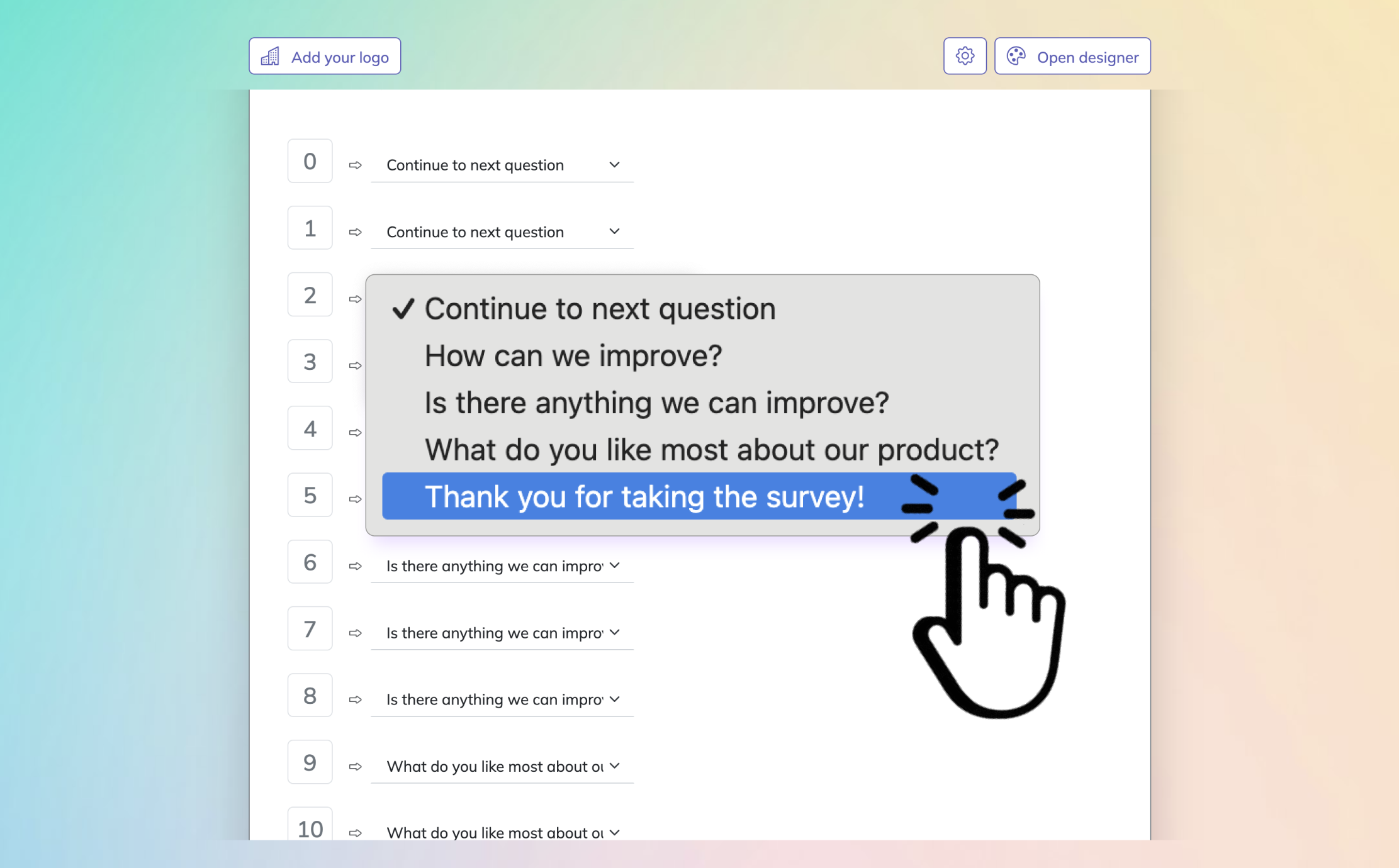
How to create customer survey questions in HeySurvey
1. Create a new survey
Open HeySurvey and start with a template using the button below, or choose a blank survey if you want to build from scratch. No account is needed to begin. Once the survey opens, you can give it a clear internal name and adjust basic settings like branding, dates, and response limits.
2. Add questions
Click Add Question to create your customer survey. For feedback surveys, use Choice questions for multiple options, Scale or NPS questions for satisfaction ratings, and Text questions for open comments. You can mark questions as required, add answer options, and include helpful descriptions so respondents know what to answer. If needed, rearrange questions by dragging them into the right order.
3. Publish survey
Before sharing, click Preview to see how the survey looks. When everything is ready, click Publish to generate your shareable link. After publishing, you can send the survey to customers, embed it on your website, or copy the link into email campaigns.
Net Promoter Score (NPS) Survey Questions
Sample questions
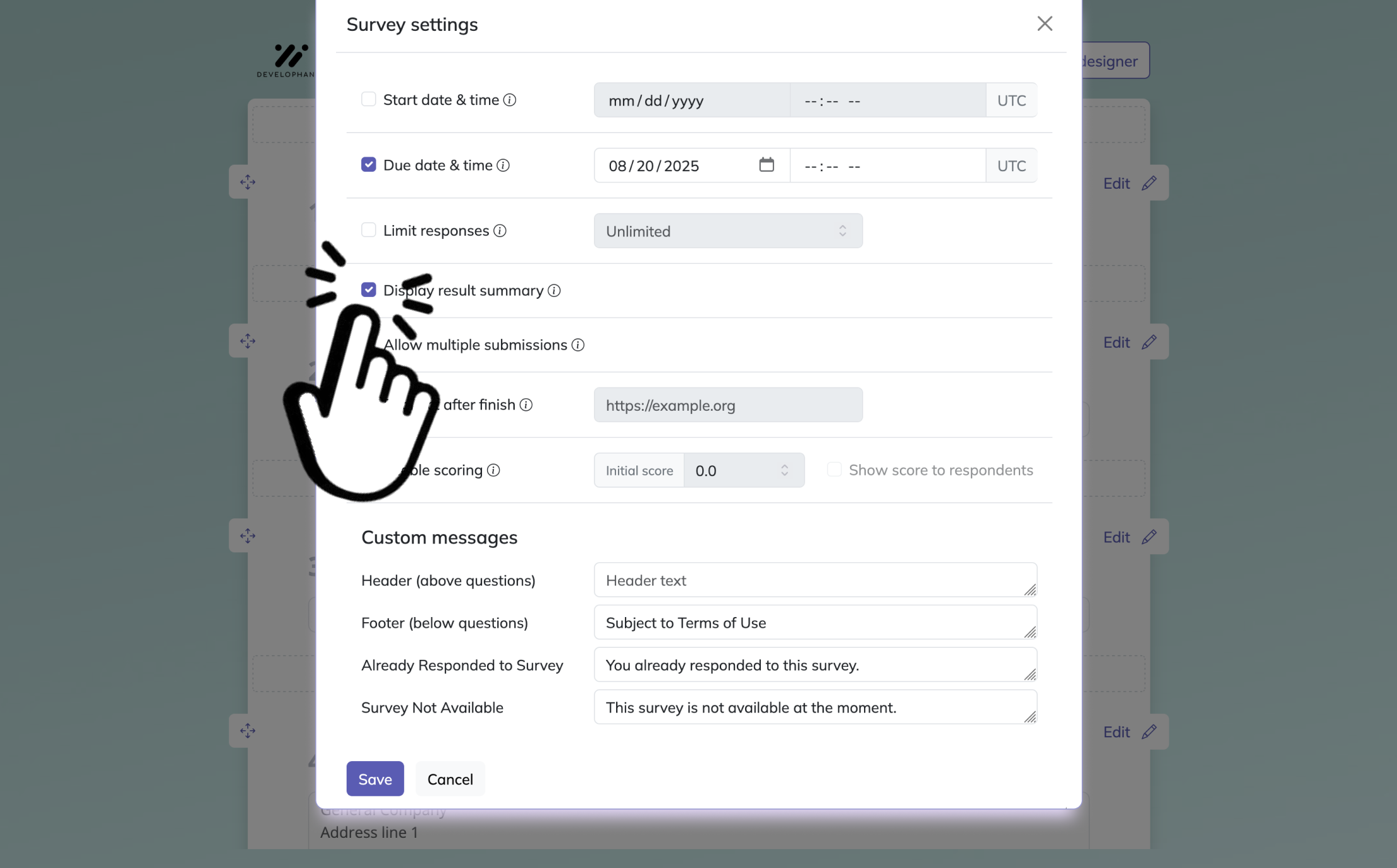
On a scale of 0 to 10, how likely are you to recommend us to a friend or colleague?
What is the primary reason for your score?
What is one thing we could improve to earn a higher rating from you?
What do you value most about our product or service?
How likely are you to continue buying from us in the future?
NPS helps you measure loyalty, not just a single moment of satisfaction.
Why & When to Use
Net Promoter Score, or NPS, is one of the most useful customer survey questions to ask when you want to understand long-term loyalty and word-of-mouth potential.
Instead of measuring one isolated touchpoint, it shows how likely customers are to stick with you, buy again, and recommend your brand to others.
Here’s the thing, NPS groups people into three buckets: promoters who score 9 to 10, passives who score 7 to 8, and detractors who score 0 to 6.
That breakdown gives you a fast read on brand sentiment, but the real gold usually comes from the follow-up question asking why they chose that score.
Use this style of customer product survey questions when you want to track trends over time, especially in:
Subscription businesses
SaaS companies
Retail loyalty programs
Recurring service relationships
Periodic brand health checks
Plus, this is a strong example of customer product survey questionnaire design when your goal is benchmarking, not just reacting to one event.
Do not send NPS after every tiny interaction, unless you want your customers to roll their eyes in perfect unison.
On top of that, the best customer product survey questions turn the score into action, so you can improve retention, messaging, and the overall experience.
NPS research found “likelihood to recommend” best predicted growth across industries, making it a powerful customer survey question for loyalty tracking (source).
Customer Effort Score (CES) Survey Questions
Sample questions
How easy was it to resolve your issue today?
How easy was it to complete your purchase or task?
The company made it easy for me to get the help I needed. Do you agree?
What, if anything, made this process difficult?
What could we change to make this experience easier?
CES shows you how hard your customers had to work, and that matters more than most teams think.
Why & When to Use
Customer Effort Score measures how easy it was for your customer to complete a task, solve a problem, or get value from your product or service.
That makes it one of the smartest customer survey questions to ask when you want to fix friction fast, not just collect polite feedback.
Here’s the thing, people remember hassle.
If checkout feels clunky, support takes too long, or onboarding feels like assembling furniture without instructions, effort goes up and satisfaction usually drops.
Use these customer product survey questions right after a specific interaction, because CES works best in the moment instead of as a broad brand sentiment check.
It is especially useful for:
Customer support conversations
Return or refund processes
Checkout and payment flows
Onboarding steps
Account setup experiences
Self-service help centers
Plus, lower effort often leads to stronger retention and less churn, which is why service teams and e-commerce brands love this format.
This is also a practical example of customer product survey questionnaire design when you need to improve one journey at a time.
On top of that, a strong example of customer product survey questionnaire strategy pairs a rating question with an open-ended follow-up, so you learn what slowed people down and what to simplify next.
Customer Product Survey Questions
Sample questions
How satisfied are you with the product overall?
Which features do you use most often?
Which feature or function do you find least useful?
Did the product perform as you expected? Why or why not?
What improvements or new features would make this product more valuable to you?
Customer product survey questions help you turn opinions into practical product decisions.
Why & When to Use
Use customer product survey questions when you want to understand product quality, usability, feature value, and whether your product feels worth the price.
Here’s the thing, if you only ask whether customers are "happy," you miss the good stuff.
These are some of the most useful customer survey questions to ask after:
Product delivery for a physical item
A free trial or onboarding period for software
Repeated usage over time
A major product update or feature release
For physical products, you might learn that packaging was confusing, the item felt lower quality than expected, or setup took too long.
For software products, you might find that one feature gets constant use while another just sits there like a treadmill in February.
Plus, this section fits common search intent around an example of customer product survey questionnaire, a customer product survey questionnaire example, and practical customer surveys questions you can actually use.
Keep your wording simple and direct.
On top of that, strong customer product survey questions should explore expectations, usability, and feature gaps, because that feedback can shape your roadmap, packaging, pricing, and quality control.
A solid example of customer product survey questionnaire design avoids jargon, asks about real usage, and makes it easy for customers to tell you what feels useful, confusing, or missing.
Effective product surveys ask about satisfaction, feature usage, least-useful functionality, expectations, and improvements to generate actionable roadmap decisions. Source
Customer Service Survey Questions
Sample questions
How satisfied were you with the support you received?
Was your issue resolved during this interaction?
How knowledgeable was the representative who helped you?
How clear and professional was our communication?
What could our support team do to serve you better next time?
Customer service surveys show you whether the problem was the person, the process, or both.
Why & When to Use
Use customer service survey questions when you want to evaluate support quality, agent helpfulness, issue resolution, and how clearly your team communicates.
These customer survey questions to ask work best when you send them fast, while the interaction is still fresh and the details have not wandered off for coffee.
The best time to send customer product survey questions is not actually about products here, but the same rule applies to customer surveys questions in general: timing matters.
Send your survey right after:
A support ticket closes
A live chat ends
A phone call finishes
An in-person service interaction wraps up
Here’s the thing, strong customer service feedback helps you measure both agent performance and process effectiveness.
If someone gives a low score, it does not always mean the representative dropped the ball.
On top of that, poor ratings often reveal broken workflows, slow approvals, weak documentation, or confusing handoffs between teams.
That is why sample survey questions for customers should uncover whether the issue was solved, how the interaction felt, and where the service process got stuck.
A smart example of customer product survey questionnaire structure can inspire this format too: keep questions short, specific, and easy to answer across email, chat, phone, and in-person support.
Customer Retention and Loyalty Survey Questions
Sample questions
How likely are you to purchase from us again?
What is the main reason you continue choosing our company?
Have you considered switching to a competitor? Why or why not?
What would make you more likely to stay with us long term?
Which rewards, benefits, or improvements would increase your loyalty?
Retention surveys help you learn not just whether customers are happy, but whether they plan to stick around.
Why & When to Use
Use these customer survey questions to ask when you want to understand why customers stay, leave, renew, or keep buying over time.
Here’s the thing, satisfaction and retention intent are cousins, not twins.
A customer can say they are satisfied and still quietly drift to a competitor like a cat slipping through an open door.
These customer product survey questions are especially useful for:
Subscription renewals
Repeat-purchase analysis
Churn reduction efforts
Loyalty program reviews
Annual account reviews
On top of that, this type of example of customer product survey questionnaire helps you look beyond one transaction and understand long-term behavior.
That makes it a smart choice for brands that want more than polite applause.
Plus, segment responses by new customers versus long-term customers, because loyalty drivers often change with time.
New customers may care more about onboarding and value, while loyal customers may care more about consistency, rewards, and trust.
Watch open-ended answers closely for churn warning signs like price concerns, better competitor options, weak product fit, or fading engagement.
A strong customer product survey questionnaire example should not just collect feedback.
It should help you connect insights to retention campaigns, renewal outreach, and loyalty offers that give customers a real reason to stay.
Post-Purchase Feedback Survey Questions
Sample questions
How easy was it to complete your purchase?
Did you find all the information you needed before buying?
How satisfied were you with shipping, delivery, or order fulfillment?
What nearly stopped you from completing your purchase?
What could improve the buying experience for future customers?
Post-purchase surveys catch fresh reactions while the experience is still warm, not buried under twenty other receipts.
Why & When to Use
Use these customer survey questions to ask when you want fast feedback on the buying journey, from checkout clicks to delivery knocks.
Here’s the thing, post-purchase feedback works best when the details are still fresh in your customer’s mind.
That means sending customer product survey questions shortly after checkout, after shipping confirmation, or soon after the order arrives.
This type of example of customer product survey questionnaire is especially useful for:
E-commerce stores
Retail brands
Direct-to-consumer companies
Subscription product orders
Limited-time campaign purchases
Plus, these customer product survey questions help you spot friction that can quietly hurt conversions.
You can uncover issues like clunky checkout steps, confusing payment options, weak product details, or delivery problems that leave a bad first impression.
On top of that, a smart customer product survey questionnaire example separates website experience from product satisfaction when needed.
If someone loved the product but hated the checkout, you need to know that.
A strong example of customer product survey questionnaire can also reveal what nearly blocked the sale, like surprise shipping costs, unclear sizing, payment errors, or slow fulfillment.
That insight helps you fix leaks before more carts perform their dramatic little exits.
Best Practices for Writing and Using Customer Survey Questions
Sample questions
Is each question focused on one clear topic?
Are we asking for feedback at the right moment in the customer journey?
Do our answer choices make it easy for customers to respond honestly?
Are we including at least one open-ended question for context?
Have we removed any leading, vague, or repetitive questions?
Great surveys are less about asking more and more about asking smarter.
Why & When to Use
Even the best customer survey questions to ask can flop if they are biased, too long, or sent at the wrong time.
Here’s the thing, this section gives you a practical framework to check before sending any example of customer product survey questionnaire.
Use it when you are building new customer product survey questions, cleaning up old ones, or improving a customer product survey questionnaire example that is not getting useful replies.
A strong set of customer surveys questions should feel easy, relevant, and fair.
Dos
Use these best practices before launching any sample survey questions for customers:
Keep surveys short and tied to the specific interaction.
Use simple, neutral language that does not push customers toward an answer.
Match the question type to your goal, like rating scales for trends and open text for detail.
Include a mix of scaled and open-ended customer product survey questions.
Test timing and survey length to improve response quality.
Segment responses by customer type, product, or channel.
Don’ts
Watch for common mistakes that quietly wreck good feedback:
Do not ask two things in one question.
Do not use leading, vague, or emotionally loaded wording.
Do not send every example of customer product survey questionnaire to every customer.
Do not make every question required.
Do not collect feedback without a plan to review it.
Do not rely only on scores without reading comments, because numbers can be helpful but comments spill the tea.
Turn Customer Survey Insights Into Action
Sample questions
What patterns appear most often in customer feedback?
Which issues have the biggest impact on satisfaction, loyalty, or churn?
What quick fixes can we implement immediately?
Which teams need to act on these survey findings?
How will we measure whether our changes improved the customer experience?
The best feedback is feedback you actually use.
Why & When to Use
Collecting feedback only matters if it leads to better products, smoother service, sharper messaging, or a less annoying customer experience.
Here’s the thing, this is the practical next step after choosing the right customer survey questions to ask and building an example of customer product survey questionnaire that gets real answers.
Use this section when your customer product survey questions have started bringing in useful responses and you need to decide what happens next.
On top of that, it helps you turn a pile of comments, scores, and trends into clear actions instead of a spreadsheet that quietly gathers dust.
Start by grouping feedback into themes so patterns are easier to spot:
Product
Service
Pricing
User experience
Delivery
Plus, once themes are clear, prioritize them by two things:
How often the issue appears
How much it affects satisfaction, loyalty, or churn
That helps you separate small annoyances from problems that actually cost you customers.
Then assign owners across the right teams, fix quick wins fast, and track whether changes improve results in future customer surveys questions.
If appropriate, close the loop with customers and let them know you listened, because nothing says “we value your input” quite like proving it.
In the end, the smartest customer product survey questionnaire example does not just collect opinions. It helps you make decisions.
Related Surveys
29 Social Media Survey Questions
Explore 25 social media survey questions with practical sample prompts to help gather insights on...
31 Job Satisfaction Survey Questions
Explore **25 job satisfaction survey questions** with sample prompts to improve employee feedback...
29 Quantitative Survey Questions Guide
Explore 25 quantitative survey questions with sample questions, examples, and tips to build effec...