29 Customer Satisfaction Survey Questions
Explore 25 customer satisfaction survey questions with practical sample questions to improve feedback, measure service quality, and understand customer needs.
Customer satisfaction surveys are short feedback tools that help you see what your customers love, where they get stuck, and what needs fixing fast. When your customer csat survey questions are clear and well-timed, you get better responses, sharper insights, stronger retention, and a smoother customer experience.
Here’s the thing, great customer satisfaction survey questions do more than collect opinions. They help you choose the right satisfaction surveys questions, explore main survey types, review sample customers satisfaction survey questions, follow best practices, and actually act on what your customers tell you, because guessing is a terrible business strategy.
CSAT Survey Questions
Sample questions
How satisfied were you with your recent experience?
How satisfied were you with the quality of the product or service you received?
How satisfied were you with the speed of service?
How well did we meet your expectations today?
Overall, how satisfied are you with your recent interaction with our company?
Fast feedback wins.
These customer csat survey questions are built to measure immediate satisfaction after one specific moment, not your customer’s whole relationship with your brand.
Plus, they are quick to answer, easy to score, and perfect when you want clean signals instead of a novel in the comment box.
A simple 1 to 5 or 1 to 10 rating scale works well for these satisfaction surveys questions, especially if you want to compare results over time.
Here’s the thing, an overall satisfaction survey question helps you spot whether that single interaction felt smooth, frustrating, or somewhere in the mildly awkward middle.
Why & When to Use
Use CSAT when you want to measure satisfaction with a product, service, support chat, delivery, onboarding step, or another specific touchpoint.
These customers satisfaction survey questions work best right after the interaction, while the experience is still fresh and before memory does its usual disappearing act.
CSAT is often the best starting point for businesses creating online customer satisfaction survey questions because it is simple, fast, and easy to act on.
Use this survey type after moments like:
post-purchase
post-support
post-onboarding
post-delivery
On top of that, CSAT is different from loyalty or effort metrics.
It tells you how satisfied someone felt right now, while broader metrics look at long-term loyalty or how hard the experience was.
Research shows customer satisfaction measures are most predictive when collected at precisely timed moments after an interaction, supporting immediate post-touchpoint CSAT questions. Source
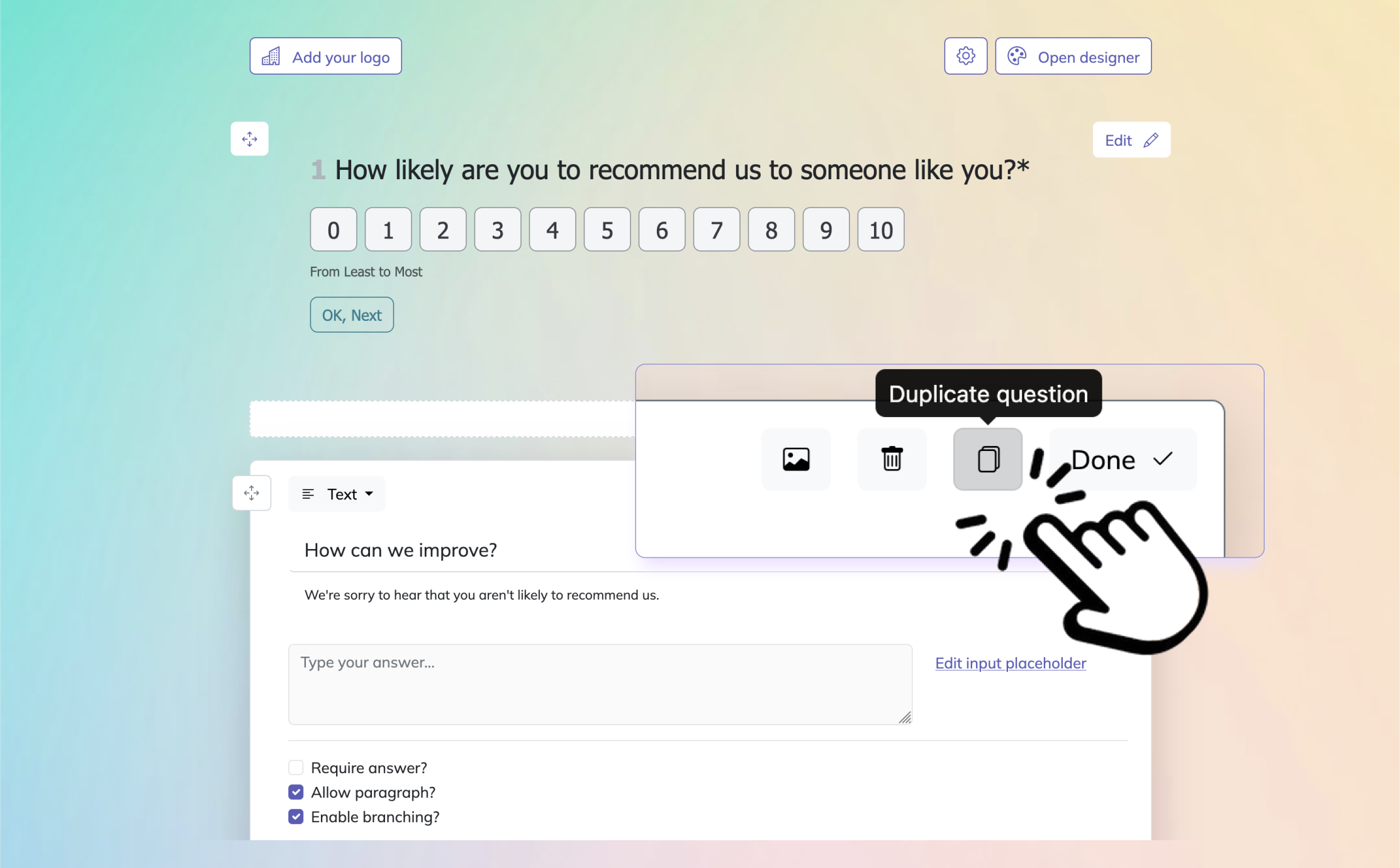
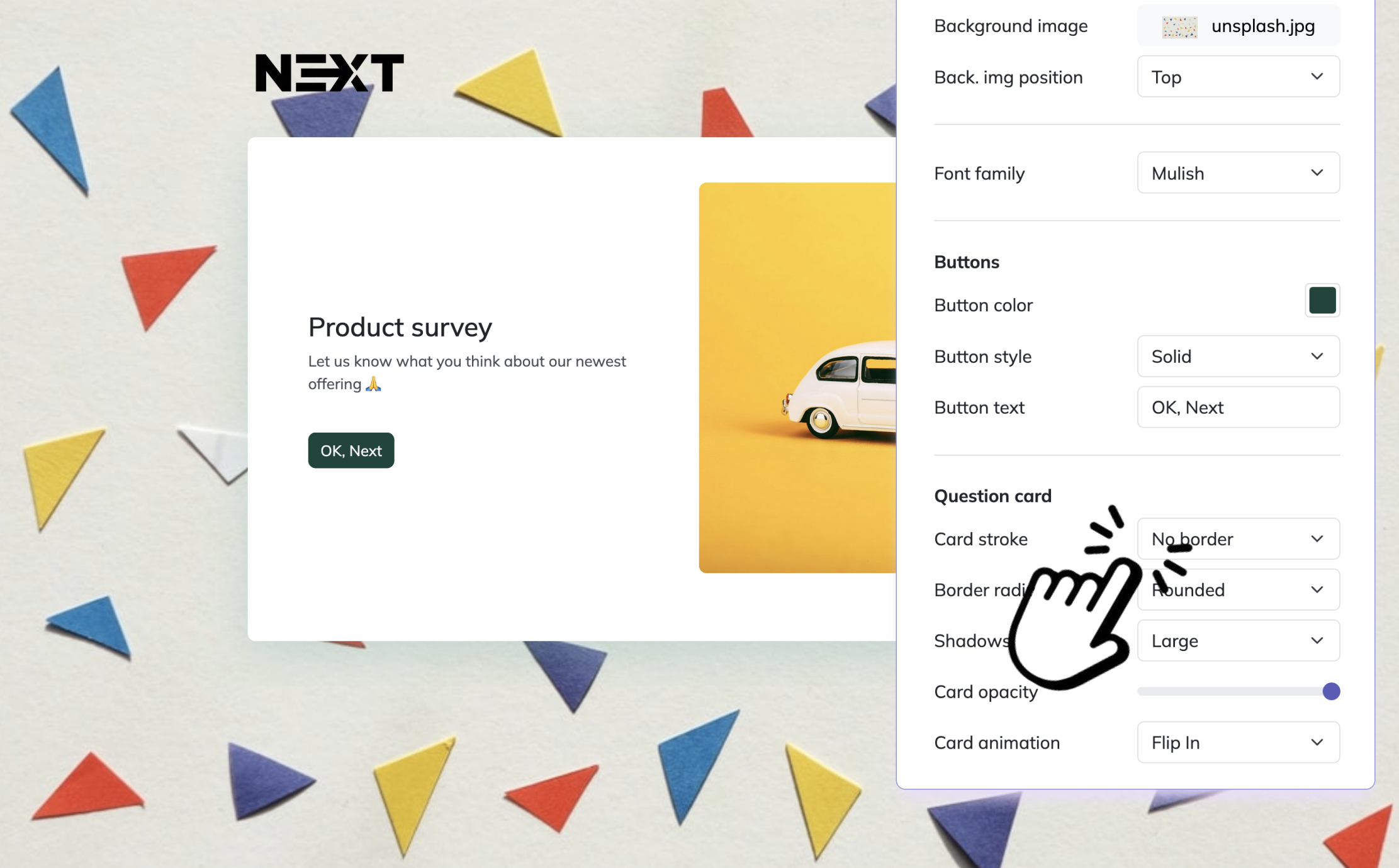
Create a customer satisfaction survey in HeySurvey in 3 easy steps
Create a new survey
Start from a customer satisfaction template by clicking the button below, or open a blank survey if you want to build it yourself. HeySurvey works in your browser, so you can begin right away without an account. If you plan to publish later, you’ll need to sign in first.Add questions
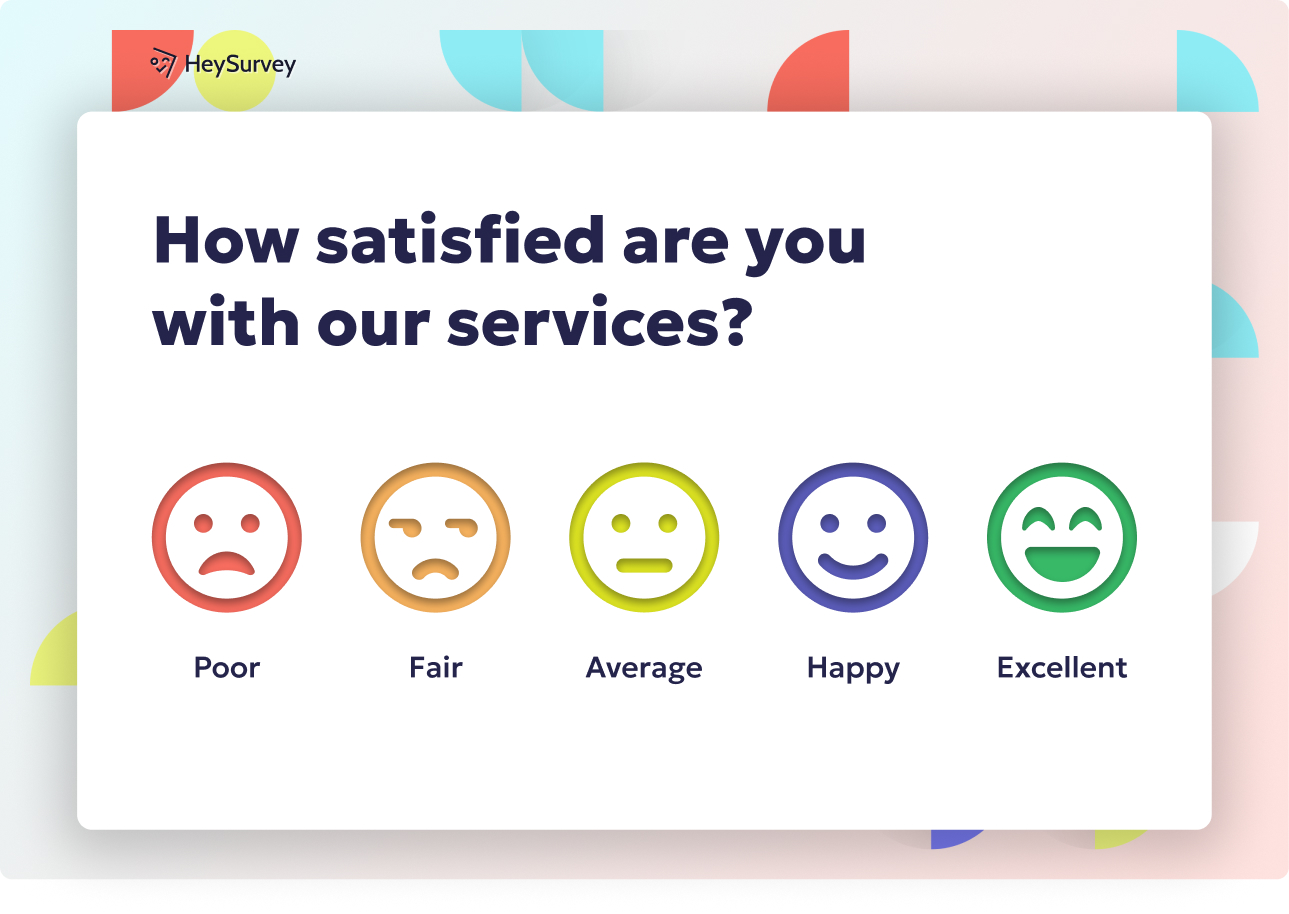
Use simple question types that fit satisfaction surveys best, such as Scale, NPS, Choice, or Text. Add questions like “How satisfied are you with our service?”, “How likely are you to recommend us?”, and “What could we improve?” Mark important questions as required, and reorder them if needed.Publish survey
Review your survey in Preview to see how it looks for respondents. Then click Publish to create a shareable link. After publishing, you can send the survey to customers by email, embed it on your website, or copy the link and share it anywhere.
Net Promoter Score (NPS) Survey Questions
Sample questions
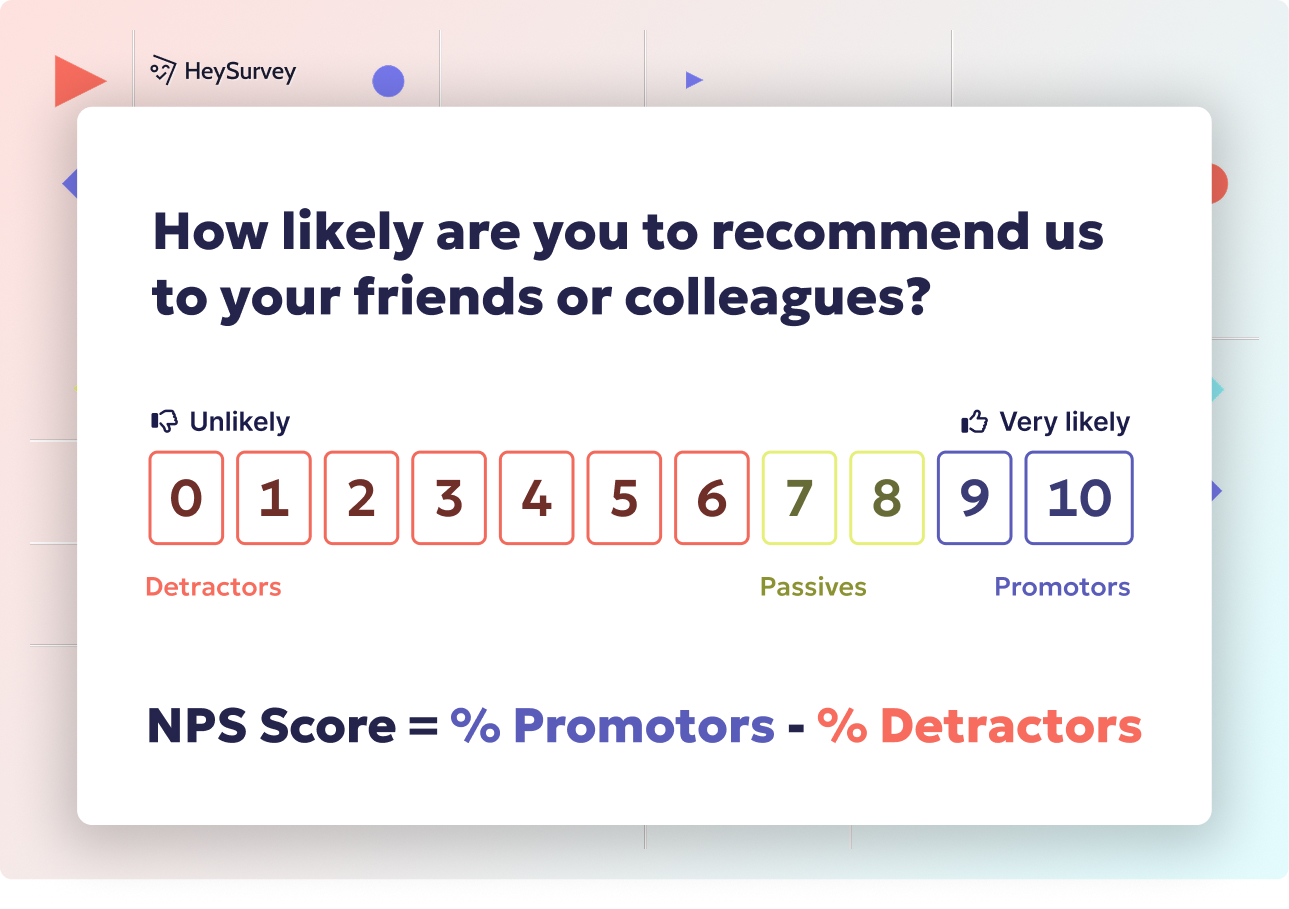
How likely are you to recommend our company to a friend or colleague?
What is the primary reason for your score?
What could we do to improve your experience?
What do you value most about our product or service?
What nearly stopped you from recommending us?
Loyalty shows up in the recommendation.
Unlike customer csat survey questions that measure one recent interaction, NPS looks at the bigger relationship and asks whether you have earned enough trust to be recommended.
Here’s the thing, that makes it one of the most useful satisfaction surveys questions formats when you want to understand long-term sentiment instead of a single good or bad Tuesday.
A typical NPS setup uses a 0 to 10 scale, then groups responses into:
Promoters, who score 9 or 10 and are likely to recommend you
Passives, who score 7 or 8 and feel mostly fine but not wildly enthusiastic
Detractors, who score 0 to 6 and may be unhappy or at risk of leaving
Plus, the score alone only tells part of the story, so pair the rating with one open-ended follow-up to collect customer satisfaction survey answers examples you can actually use.
Why & When to Use
Use NPS when you want to measure loyalty, advocacy, and overall brand sentiment over time.
These customers satisfaction survey questions fit best in periodic relationship surveys, post-onboarding milestones, subscription checkpoints, and account reviews.
On top of that, NPS is not the same as online customer satisfaction survey questions built around one support ticket, delivery, or purchase.
It works best when you want the long view, because loyalty is a marathon, not a speed date.
Research suggests NPS should be paired with follow-up questions, because the recommendation score alone gives limited diagnostic insight into loyalty and future behavior. Source
Customer Effort Score (CES) Survey Questions
Sample questions
How easy was it to resolve your issue today?
How easy was it to complete your purchase or request?
The company made it easy for me to get the help I needed. Do you agree?
How much effort did you personally have to put in to solve your problem?
What made this process easier or harder than expected?
Easy wins customers, hard work loses them.
Customer Effort Score measures how easy or difficult it felt for you to complete a task, which makes it different from broader customer csat survey questions or general customers satisfaction survey questions.
Here’s the thing, people often forgive a small hiccup, but they remember a clunky process that made them jump through hoops like a circus intern.
CES usually uses simple scales such as:
Very easy to very difficult
Strongly agree to strongly disagree
Low effort to high effort
Plus, these satisfaction surveys questions are especially useful for service and operations teams because they point straight at friction in support workflows and digital journeys.
They also uncover pain points that a standard overall satisfaction survey question might miss, especially when the problem is not the outcome but how annoying the process felt.
Why & When to Use
Use CES after support cases, returns, account updates, bookings, checkout flows, and issue resolution moments.
On top of that, it works well in online customer satisfaction survey questions where you want to improve self-service tools, help centers, forms, chat, or handoffs between teams.
Effort has a big impact on repeat business and churn, so if customers have to work too hard, they may leave even if the final result was technically fine.
That is why customer csat survey questions and survey question examples for customers satisfaction survey often get stronger when you add one ease-focused question too.
Product and Service Quality Survey Questions
Sample questions
How satisfied are you with the quality of our product or service?
How well does our product or service meet your needs?
How reliable has our product or service been?
How would you rate the value for money of our offering?
What is one thing we could improve about the product or service?
Quality is the promise you actually keep.
These customer csat survey questions focus on the core offering itself, not just whether your support team was friendly or your checkout page behaved for once.
That makes them different from broader customers satisfaction survey questions, because they help you learn whether the product works well, the service is delivered consistently, and the value feels worth the price.
These satisfaction surveys questions can be adapted across industries, including SaaS platforms, ecommerce products, home services, agencies, and B2B vendors.
Plus, they work especially well when you add follow-up prompts that ask for specifics about defects, missing features, delays, or inconsistent service, because vague feedback is about as helpful as a chocolate teapot.
You can also use these as survey question examples for customers satisfaction survey programs that need clearer insight into product performance versus service experience.
Why & When to Use
Use these after product use, free trials, completed service delivery, repeat purchases, onboarding milestones, or regular account check-ins.
They help you spot:
Quality gaps in the product or service
Reliability issues and recurring defects
Missing features or weak deliverables
Value perception problems tied to pricing
Here’s the thing, when reviewing customer satisfaction survey answers examples, separate quality feedback from support and price so your team knows what actually needs fixing.
ACSI research shows customer satisfaction is driven more by perceived quality than price/value, making quality, reliability, and value-for-money questions especially predictive. Source
Customer Service and Support Survey Questions
Sample questions
How satisfied were you with the support you received?
Did our team resolve your issue completely?
How would you rate the knowledge and professionalism of the representative?
How satisfied were you with the response time?
What could our support team have done better?
Great support turns a problem into proof you can be trusted.
These customer csat survey questions focus on the service experience after a customer needs help, especially how helpful, professional, responsive, and effective your team was.
Unlike broader customers satisfaction survey questions, these satisfaction surveys questions zoom in on the actual interaction, not the product itself or the price tag.
That makes them useful for B2C support teams, SaaS help centers, ecommerce service desks, and internal IT teams handling employee requests.
Plus, this is one of the most common places readers look for it customer satisfaction survey questions examples, because both external support and internal service desks need clear feedback on how issues are handled.
A strong set of online customer satisfaction survey questions should balance how the agent performed with how well the support process worked, because even the nicest rep cannot outrun a clunky system forever.
Why & When to Use
Use this survey right after live chat, phone support, email support, or help desk ticket closure, while the interaction is still fresh in your customer’s mind.
It helps you measure:
Agent helpfulness and professionalism
Response speed and follow-up quality
Whether the issue was fully resolved
Process friction across support channels
On top of that, these survey question examples for customers satisfaction survey programs are especially helpful when you want cleaner insight into support quality, resolution strength, and service desk performance.
Website and Online Experience Survey Questions
Sample questions
How easy was it to find what you were looking for on our website?
How satisfied were you with the checkout or booking process?
How clear and helpful was the information on our site?
Did you encounter any problems while using our website?
What is one improvement that would make our online experience better?
A smooth online experience quietly removes friction before it costs you the sale.
These customer csat survey questions help you understand how people experience your site from the first click to the final action.
Unlike broader customers satisfaction survey questions, these satisfaction surveys questions focus on navigation, usability, content clarity, checkout flow, and the overall digital experience.
That makes them especially useful if you are looking for online customer satisfaction survey questions for websites, customer portals, ecommerce stores, mobile experiences, or self-service help centers.
Here’s the thing, even small annoyances can tank conversions fast, because confusing menus, clunky forms, weak trust signals, or pages that feel slow can send people running like the tab owes them money.
These survey question examples for customers satisfaction survey programs work best when you want practical feedback tied to real friction points, such as finding information, completing a purchase, or using a resource without getting lost.
Why & When to Use
Use these customer csat survey questions when you want to spot what is helping people move forward and what is getting in their way online.
They are especially valuable:
After a purchase, booking, or sign-up
After someone uses a help article, portal, or resource center
In periodic website experience surveys
When you want an overall satisfaction survey question focused on digital journeys
Plus, these it customer satisfaction survey questions examples can also inspire internal portal and self-service feedback, especially when ease, clarity, and task completion matter most.
Best Practices for Writing Customer Satisfaction Survey Questions
Sample questions
Is each question short enough to answer in a few seconds?
Does every question focus on only one idea?
Are you using the same rating scale from start to finish?
Have you included one open-ended follow-up for helpful context?
Are you sending the survey close to the customer experience you want to measure?
Better survey design gives you cleaner feedback and fewer guess-what-they-meant moments.
When you write customer csat survey questions well, you make life easier for both your customers and your team.
Here’s the thing, strong customers satisfaction survey questions are practical, not fancy, and the best satisfaction surveys questions usually feel almost boring in the best possible way.
Why & When to Use
Use these best practices whenever you are building survey question examples for customers satisfaction survey planning, refreshing old forms, or trying to improve response quality.
Focus on real-world survey design:
Keep questions short, specific, and easy to answer
Ask about one topic per question
Match the survey type to the touchpoint
Use consistent rating scales throughout
Include at least one open-ended follow-up
Send surveys soon after the experience
Segment customer csat survey questions by journey stage, channel, or customer type when useful
Just as important, avoid the traps that quietly wreck your data:
Do not ask leading or biased questions
Do not overload people with too many questions
Do not combine multiple ideas in one item
Do not use vague words like good or bad without context
Do not ask for feedback you will ignore
Do not rely only on scores without comments
Plus, poor wording can hurt data reliability and completion rates fast, because confusing questions make people click away like their coffee just arrived.
How to Turn Survey Results Into Action
Sample questions
Which survey responses point to the biggest customer pain points?
Which low-scoring touchpoints have the highest business impact?
What themes appear repeatedly in open-ended feedback?
Which issues can be fixed quickly, and which require long-term changes?
How will we close the loop with customers after making improvements?
The best feedback is the kind you actually use.
Customer csat survey questions only create value when you turn responses into clear next steps.
Here’s the thing, this is the bridge between customer satisfaction survey answers examples and real decisions your team can act on without staring at dashboards like they hold ancient secrets.
Why & When to Use
Use this approach after collecting customers satisfaction survey questions data from post-purchase, support, onboarding, or online customer satisfaction survey questions.
Start by grouping satisfaction surveys questions in ways that reveal patterns:
By theme, such as speed, product quality, support, or billing
By score, especially low ratings and sudden drops
By journey stage, like signup, delivery, renewal, or support resolution
Plus, prioritize what to fix based on what matters most:
Frequency, or how often the issue appears
Severity, or how frustrating the issue is
Business impact, such as revenue, churn, retention, or support costs
Effort, or whether it is a quick win or a longer project
On top of that, share findings with the teams who can act on them, not just the people who love spreadsheets.
Close the loop, too:
Tell customers what changed
Tell internal teams what to monitor next
Re-run the overall satisfaction survey question set to measure improvement
In the end, the best survey question examples for customers satisfaction survey work lead to measurable action, not just a very organized pile of opinions.
How to Turn Customer Satisfaction Survey Insights Into Action
Sample questions
What are the top three themes appearing in customer feedback?
Which customer segments report the lowest satisfaction scores?
Which issues have the biggest effect on churn, retention, or repeat purchase?
What quick fixes can be implemented immediately?
How will we tell customers their feedback led to changes?
Survey insights only start paying rent when you turn them into clear, prioritized action.
Why & When to Use
Use this step after every survey cycle, whether your program runs all year or in short campaign bursts.
Here’s the thing: survey data does not create value by sitting in a dashboard looking important.
You need to turn responses into improvements people can actually feel, and fast.
Start by grouping feedback into themes so patterns are easier to spot.
For example:
Product
Service
Pricing
Communication
Process
Then prioritize what to fix based on three simple factors:
Impact on satisfaction, churn, retention, or repeat purchase
Frequency of the issue across responses
Ease and speed of implementation
Plus, look for quick wins you can ship now, not just giant projects that need six meetings and a heroic spreadsheet.
Once priorities are clear, assign each action to an owner, set a deadline, and decide how you will measure whether the fix worked.
On top of that, share findings across support, product, marketing, and leadership teams so improvements do not get stuck in one corner of the business.
Closing the loop matters too.
Tell internal teams what changed, and tell customers their feedback helped shape it, because nothing says "we listened" quite like proving it.
Related Surveys
29 Social Media Survey Questions
Explore 25 social media survey questions with practical sample prompts to help gather insights on...
31 Job Satisfaction Survey Questions
Explore **25 job satisfaction survey questions** with sample prompts to improve employee feedback...
29 Quantitative Survey Questions Guide
Explore 25 quantitative survey questions with sample questions, examples, and tips to build effec...