27 Character Survey Questions for Better Insights
Explore 25 sample keyword character survey questions designed to improve research, boost insights, and support effective survey creation.
Character survey questions are prompts you use to explore how a person or fictional character thinks, feels, chooses, and changes, which makes them wildly useful for writers, teachers, game designers, roleplayers, and researchers.
They turn vague personalities into clear, usable patterns.
In this guide, you’ll see the main types of character survey questions, when to use each one, sample prompts to spark better answers, and practical ways to apply what you learn so your characters feel consistent, believable, and a lot less like cardboard with shoes.
Sample questions
What does your character want more than anything right now, and why?
Which personal rule would your character never break, even under pressure?
How does your character act differently around friends, strangers, and authority figures?
What habit, fear, or flaw keeps getting in their way?
Which relationship has shaped your character the most?
What Are Character Survey Questions?
Character survey questions are structured prompts that help you understand who a character really is.
You use them to dig into a character’s background, personality, goals, relationships, values, habits, and growth over time.
In plain English, they give you a clear way to ask better questions, so your character feels like a person and not a coat rack with opinions.
A character questionnaire can be short and simple, or detailed enough to build a full personality map.
Plus, character development questions help you uncover how someone thinks, reacts, changes, and clashes with the world around them.
You’ll also see these called personality questions for characters or character profile questions, especially when you want more organized, easy-to-scan answers.
These prompts are not just for novelists, either.
You can use them for:
fictional character creation
classroom character-building exercises
roleplay and tabletop games
team-building activities
audience engagement, quizzes, or fan content
Why & When to Use
Use character survey questions when you want sharper insights and fewer fuzzy details.
Here’s the thing: they work best when you need consistency, deeper motivation, stronger backstory, or quicker brainstorming without staring at the screen like it insulted you.
Sample questions
How would this character describe themselves in three honest words?
What situation makes this character feel most confident?
What personality flaw causes the most trouble in their life?
How does this character behave when meeting strangers?
What emotion does this character try hardest to hide?
Narrative-identity research finds that structured prompts about key scenes and life chapters reveal goals, traits, and meaning-making more effectively than vague self-description alone (source).
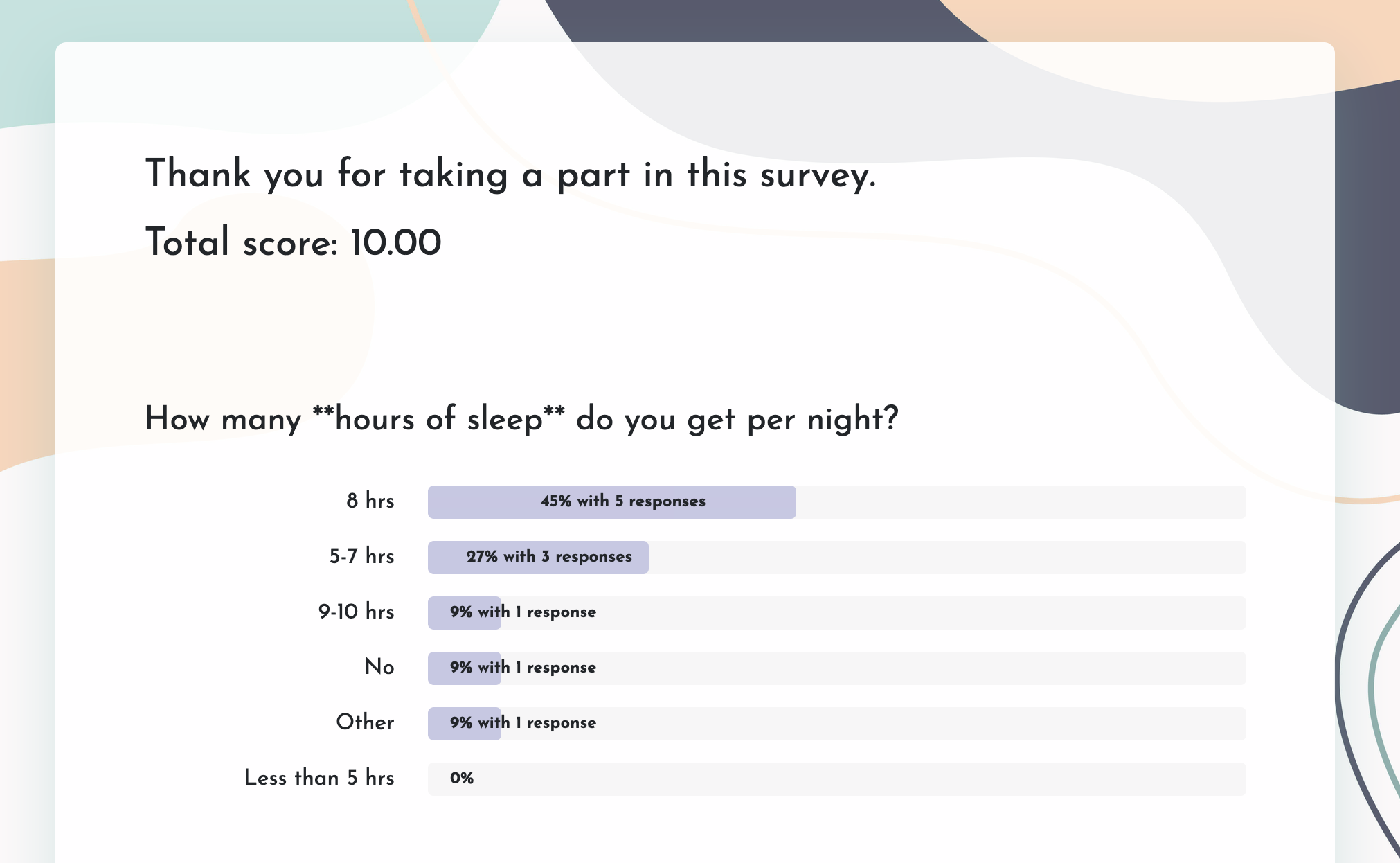
Creating a character survey in HeySurvey is quick and easy. You can start from a template using the button below, or begin with a blank survey if you want full control using our online survey tool.
1. Create a new survey
Open HeySurvey and choose a character survey template, or click to start a new survey from scratch. Give your survey a clear name so you can find it later. If needed, add your logo or adjust basic settings before moving on.
2. Add questions
Click Add Question to build your character survey. Use Choice questions for traits, Scale or Emoji Rating for personality ratings, and Text questions for open-ended answers. You can mark questions as required, add images, and reorder them to match the flow of your survey.
3. Publish survey
When your questions are ready, click Preview to check how it looks. If everything is correct, press Publish to create your shareable link. After publishing, you can send the survey to participants and view their responses in HeySurvey.
Personality Character Survey Questions
Personality-focused questions help you pin down how your character naturally moves through the world.
These prompts are perfect for defining default behavior, emotional habits, personal strengths, social style, flaws, and the kind of voice your character brings to every scene.
If you are creating a character from scratch, this is a smart place to start.
Plus, these questions are especially useful when a character feels flat, when dialogue sounds too similar across your cast, or when your game or story needs each person to feel clearly distinct.
Here’s the thing: personality gets more believable when you tie traits to actions, not just labels.
Saying a character is "kind" or "arrogant" is fine, but showing how they interrupt, comfort, avoid, joke, or deflect is where the magic sneaks in.
On top of that, contradictions make people feel real.
A character can be brave in public and deeply insecure alone, which is a lot more interesting than a neat little personality sticker.
Try pairing each answer with a scene that reveals it:
how they react under pressure
how they talk to strangers
how they hide discomfort
how they act when they feel powerful
That way, you are not just collecting answers.
You are building personality your reader can actually see, hear, and occasionally side-eye.
Why & When to Use
Use personality character survey questions when you want clearer voices, stronger behavior patterns, and characters who do not all sound like they were raised by the same keyboard.
Sample questions
What childhood experience shaped this character the most?
What kind of family environment did this character grow up in?
What is a memory this character has never fully moved past?
What belief about the world did this character learn early in life?
What part of their past would this character rather keep hidden?
Personality questionnaires based on the Big Five can meaningfully predict socially important behaviors like alcohol use and grade point average (PubMed).
Background and Life History Survey Questions
Backstory works best when it still has fingerprints on the present.
Background questions help you build depth by uncovering the experiences that made your character who they are.
That includes family dynamics, education, culture, early losses, defining memories, and the quiet lessons they picked up before they knew they were learning them.
Here’s the thing: not every detail from the past deserves a spotlight.
You want the moments that still affect how your character chooses, trusts, avoids, loves, lies, or panics when life gets messy.
This section is especially useful when a character’s current behavior needs believable roots.
Plus, it helps when you want a more detailed profile before drafting, so you are not inventing their entire childhood in chapter twelve like a raccoon digging through leftovers.
As you answer, focus on past events that still shape the present.
A harsh parent might explain perfectionism.
A sudden move might explain attachment issues.
An early success might fuel confidence, pressure, or both.
On top of that, avoid loading your character up with backstory that never matters.
Link the past to present fears, goals, and relationships, and suddenly your character starts feeling less like a sketch and more like someone with history under their skin.
Why & When to Use
Use background and life history survey questions when you want your character’s present-day behavior to feel earned, layered, and connected to something deeper than "because the plot said so."
Sample questions
What does this character want more than anything right now?
Why is that goal so important to them personally?
What fear could stop this character from pursuing their goal?
What line would this character refuse to cross to succeed?
How would this character react if their goal became impossible?
Motivation and Goal Survey Questions
Strong motivation turns a character from active on the page into hard to ignore.
Motivation questions help you figure out what your character wants, why they want it, and what they are willing to risk to make it happen.
That matters because goals drive plot, shape conflict, and keep behavior from feeling random when pressure starts rising.
Here’s the thing: a surface goal is not always the real engine.
Your character may say they want a promotion, revenge, or a second chance, but underneath that they might really want safety, respect, love, or proof that they matter.
When you separate the visible goal from the deeper emotional need, your character starts making choices that feel more human.
Plus, it helps to show both external and internal motivation.
External motivation is what they are trying to do in the world.
Internal motivation is what that goal means to them emotionally.
Strong motivation raises the stakes because failure costs more than just a missed opportunity.
On top of that, motivation is gold for character arcs.
If you know what your character wants, what fear blocks them, and what line they will not cross, you can build turning points that actually land instead of wobbling around like a shopping cart with one bad wheel.
Why & When to Use
Use motivation and goal survey questions when you want stronger plotting, sharper conflict, and a character arc that holds together from beginning to end.
Sample questions
Who does this character trust most, and why?
What type of person brings out the worst in this character?
How does this character show affection or loyalty?
What relationship in their life feels unfinished or unresolved?
How does this character respond when they feel betrayed?
Readers infer and track characters’ goals to build narrative coherence, making goal-focused character questions especially useful for stronger story construction (source).
Relationship and Social Dynamic Survey Questions
Relationships reveal who your character is when other people get close enough to matter.
Relationship questions help you uncover how your character connects with friends, family, rivals, mentors, and romantic interests.
That matters because people rarely act exactly the same with everyone, and your character should not either.
Here’s the thing: the way someone behaves with a parent, best friend, ex, or enemy can expose very different sides of their personality.
A confident leader might turn awkward around a mentor, while a sweet romantic might become fiercely defensive around a sibling.
Plus, this category is especially useful when you are building ensemble casts, messy conflict webs, and interactions that feel emotionally believable instead of scripted.
Try mapping how your character handles different kinds of closeness and pressure.
Notice who gets their honesty, and who only gets the polished version.
Identify trust patterns, attachment style, and conflict habits.
Show both supportive relationships and strained ones.
Include at least one bond that feels safe and one that feels like a lit match near a curtain.
On top of that, unresolved relationships can quietly power a whole story.
If your character has old loyalty, buried resentment, or betrayal sitting under the surface, dialogue gets sharper fast, and in a good way.
Why & When to Use
Use relationship and social dynamic survey questions when you want richer character chemistry, stronger ensemble scenes, and conflict that grows naturally from who your characters are around each other.
Sample questions
What principle would this character defend no matter the cost?
What action would this character consider unforgivable?
When has this character compromised their values?
Does this character believe people can truly change?
What does this character think matters more: honesty, loyalty, justice, or survival?
Values, Morality, and Belief Survey Questions
Values shape what your character does when the easy choice and the right choice are not the same.
Values-driven survey questions help you define your character’s ethics, worldview, decision-making, and inner conflict.
Here’s the thing: a character’s beliefs are interesting on paper, but they become unforgettable when those beliefs get tested in messy, high-stakes moments.
That makes this category especially useful for leadership roles, moral dilemmas, antagonist design, and any plot where choices actually cost something.
A loyal hero who lies to protect a friend is suddenly more layered, and an antagonist with a sincere moral code gets a lot more chilling. Villains with principles are weirdly efficient at stealing scenes.
Plus, you will get better results if you test values under pressure instead of only asking what your character believes in theory.
Compare what your character says matters with what they actually do.
Put their beliefs in conflict with fear, love, ambition, or survival.
Look for the moment they bent their code, even a little.
Use moral tension to create scenes that feel sharp, revealing, and emotionally sticky.
On top of that, value conflicts often produce the most memorable character moments.
Why & When to Use
Use values, morality, and belief survey questions when you want stronger ethical stakes, clearer decision-making, and inner conflict that feels honest instead of conveniently dramatic.
Sample questions
What false belief is holding this character back?
What is this character most afraid to admit about themselves?
What challenge would force this character to change?
What does healing or success look like for this character?
By the end of the story, what should this character understand that they do not understand now?
Growth, Conflict, and Character Arc Survey Questions
Character growth gets real when change costs something.
Growth-focused survey questions help you find your character’s internal conflict, emotional wounds, limiting beliefs, and potential transformation.
Here’s the thing: an arc is not just about what happens to your character, but about what shifts inside them because of it.
This section is especially useful when you are planning story arcs, midpoint turns, climactic choices, and endings that actually feel earned.
A strong arc starts with contrast, so get clear on who your character is at the beginning versus who they are by the end.
Define the flaw, fear, wound, or false belief shaping their early choices.
Decide what truth they need to learn, resist, or tragically reject.
Tie growth to meaningful decisions, not random self-awareness that drops from the sky like a motivational pigeon.
Track whether the character improves, regresses, or fails to change at all.
Plus, not every arc needs to be uplifting to be satisfying.
Some characters heal, some harden, and some almost change but miss the chance, which can be painfully great for drama.
Why & When to Use
Use growth, conflict, and character arc survey questions when you want to shape transformation with intention.
On top of that, they are perfect for mapping emotional progression, testing turning points, and making sure the ending reflects the character’s choices instead of just the plot.
Sample questions
Which survey questions will actually help you write this character better right now?
What answer reveals a real pressure point instead of just a fun fact?
How can you turn a survey answer into conflict, dialogue, or a scene?
Which answers feel too neat, and what contradiction would make them more human?
What should you revise as the character changes during the draft?
Best Practices for Writing and Using Character Survey Questions
The best character surveys stay useful, not just impressive.
Here’s the thing: a great survey is not the one with the most questions.
It is the one that helps you uncover choices, pressure points, and change potential you can actually use on the page.
Dos
Use questions that fit the character’s role, genre, and job in the story.
A side character in a comedy needs a different set of prompts than a tragic protagonist carrying your whole third act on their emotionally exhausted back.
Ask open-ended questions that invite specific, revealing answers.
Focus on tension, contradiction, stakes, and vulnerable truths.
Connect answers to scenes, conflict, dialogue, and plot decisions.
Revise answers as the character develops and surprises you.
Plus, choose question sets based on your goal.
If you are fixing flat dialogue, use voice-focused prompts, and if you are shaping an arc, use questions about fear, desire, and change.
Don'ts
Do not collect backstory that never affects the story.
Do not lean on generic labels like "brave" or "kind" unless you can show what those traits cost under pressure.
Do not make every answer polished, consistent, or predictable.
Do not ignore contradiction when contradiction feels more human.
Do not treat survey answers like law if the draft reveals something better.
On top of that, balance depth with usability, because a survey should help you write, not become the hobby that replaces writing.
Why & When to Use
Use these best practices when your character work starts feeling bloated, vague, or weirdly decorative.
They help you stay intentional, pick the right prompts for the job, and build surveys that lead to stronger scenes instead of a beautiful pile of unused personality trivia.
Sample questions
How can you turn one survey answer into a flaw, secret, or story problem?
Which repeated answers point to a defining trait you should actually use in scenes?
What can an avoided question reveal about fear, shame, or hidden motivation?
How do survey answers improve dialogue without making it sound overly explained?
Which answer could become a plot twist, relationship rupture, or turning point?
How to Turn Character Survey Answers Into Stronger Characters
Your survey becomes powerful when the answers start causing trouble.
Here’s the thing: interesting character notes are nice, but useful character choices are better.
If your character says they hate being controlled, do not leave that sitting in a document like a forgotten sandwich in the fridge. Put that trait under pressure in a scene, and now you have conflict, dialogue, and momentum.
One answer can do a lot of heavy lifting.
A fear can become a flaw that sabotages good decisions.
A private belief can become a secret that strains a relationship.
A past wound can create an overreaction in dialogue.
A confident self-image can set up a sharp, satisfying plot twist.
Plus, look for patterns across answers.
If your character keeps avoiding blame, chasing approval, or masking pain with jokes, that repeated behavior is probably a defining trait, not random trivia.
On top of that, pay attention to the questions your character seems unable to answer cleanly.
Hesitation, vagueness, or discomfort often points to the most story-rich material, because that is where fear, denial, and change like to hide.
Why & When to Use
Use this approach when you want survey answers to improve actual pages, not just your planning notes.
Strong character survey questions matter only when the answers shape action, tension, choices, and change that readers can feel.
Related Surveys
29 Social Media Survey Questions
Explore 25 social media survey questions with practical sample prompts to help gather insights on...
31 Job Satisfaction Survey Questions
Explore **25 job satisfaction survey questions** with sample prompts to improve employee feedback...
29 Quantitative Survey Questions Guide
Explore 25 quantitative survey questions with sample questions, examples, and tips to build effec...