31 Brand Perception Survey Questions for Better Insights
Explore 25 brand perception survey questions to measure awareness, trust, and loyalty, uncover customer insights, and strengthen how your brand is seen.
Your brand is what people think it is, not just what you want it to be. A brand perception survey helps you spot the difference, without relying on your team’s crystal ball.
The question sets below form a modular brand perception survey template, so you can choose questions that match your research goals rather than ask everything.
You’ll explore awareness (who knows you), associations (what comes to mind), perceived quality, trust, value, and preference (who chooses you). Plus, you can use the association questions as a brand imagery questionnaire to explore the impressions your brand creates with an online survey maker.
1. Brand Awareness and Recall Survey Questions
Sample questions
“When you think of [product category], which brands come to mind?” Open-ended; ask before displaying brand names.
“Which of the following brands have you heard of?” Randomize the brand list and include “None of these.”
“Before today, how familiar were you with [brand]?” Use a five-point scale from “Not at all familiar” to “Extremely familiar.”
“Where, if anywhere, have you encountered [brand] in the past three months?” Allow multiple selections, with “Other” and “I don’t recall.”
Start your brand perception survey template with these distinctions:
Unaided recall measures which brands you remember without prompts.
Aided awareness measures which brands you recognize from a list.
Familiarity measures how well you feel you know a brand.
Keep unaided brand awareness survey questions ahead of names, logos, or descriptions. Otherwise, you’re handing out answers before the quiz.
Include customers and noncustomers across your target market. Remember, awareness measures visibility, not approval; your brand imagery questionnaire can explore what those impressions actually mean.
Why & When to Use
Use this brand perception survey module before a launch, during market expansion, or when evaluating awareness-building campaigns.
Plus, repeat the same questions with consistent wording and comparable audiences over time to track awareness and recall. This gives your brand perception survey template a useful baseline before you explore deeper perceptions.
Brand users were approximately 2.5 times more likely than nonusers to recall advertising unprompted, highlighting why awareness surveys should include both groups. Source
Create a brand perception survey in HeySurvey
1. Create a new survey
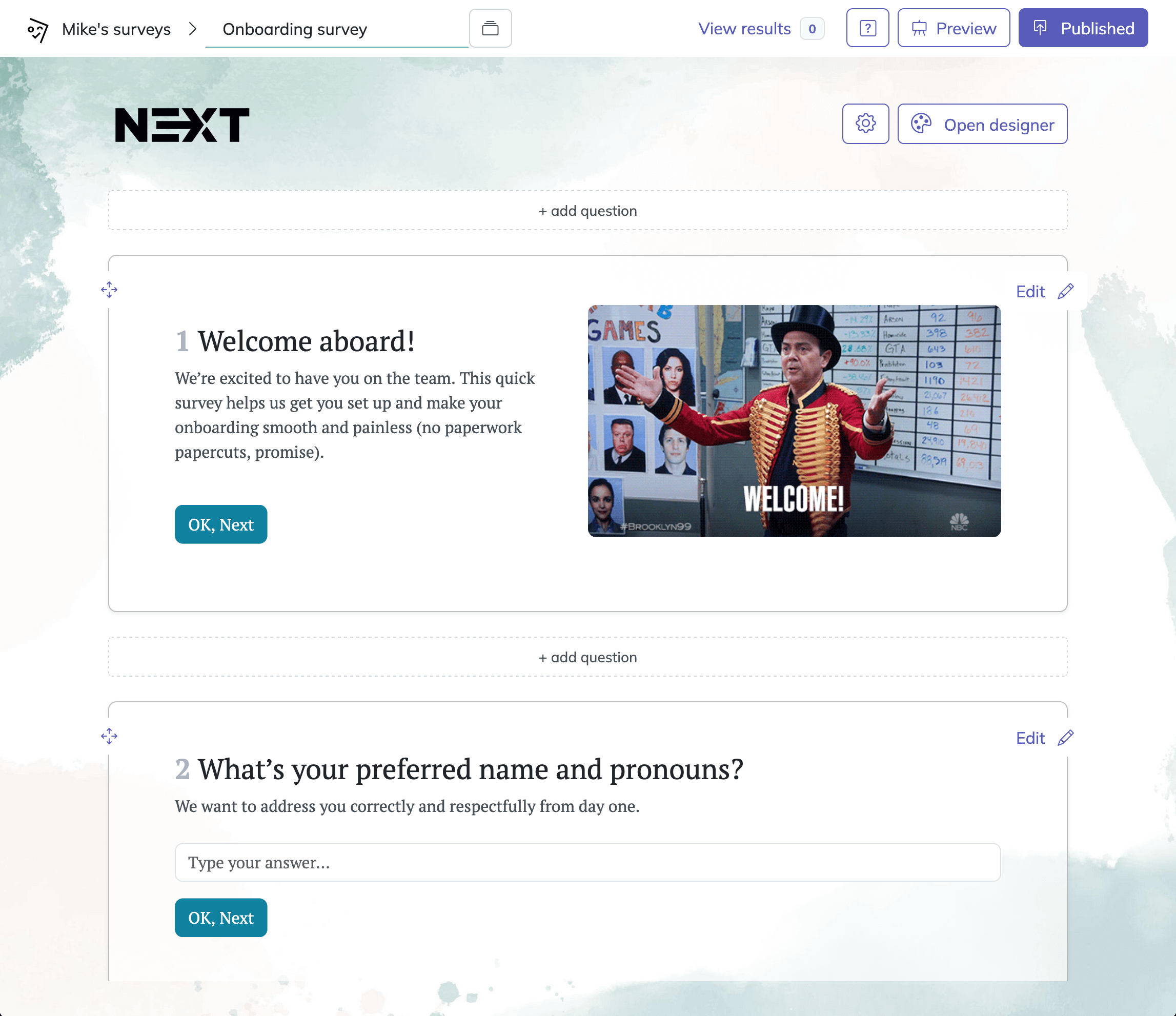
Click the button below to open a brand perception survey template. You can start editing without an account. In the Survey Editor, give your survey a clear name and adapt the template to your brand and audience. You can also start from scratch or enter your questions as text with our online survey tool.
2. Add and customize questions
Ask focused questions about brand awareness, reputation, trust, and customer associations. For example: “How familiar are you with our brand?” or “Which words best describe our brand?” Click Add Question to create or edit questions. Use Choice for brand associations, Scale for ratings such as trust or quality, and Text for open-ended feedback. Mark essential questions as required, and use the Designer Sidebar to adjust colors, fonts, and layout.
3. Publish your survey
Click Preview to check how the survey looks and works for respondents. Make any final changes, then click Publish. You’ll need an account to publish and view responses. Once published, copy the shareable link and send it to your audience.
2. Brand Imagery and Association Survey Questions
Sample questions
“What three words come to mind when you think of [brand]?” Use an open-ended response.
“Which of these characteristics, if any, do you associate with [brand]?” Randomize the attribute list; include “None” and “Not familiar enough to answer.”
“How would you describe [brand] on the following scale?” Use separate seven-point scales for relevant opposing attributes, such as “Traditional–Innovative.”
“Compared with other brands in [category], how distinctive does [brand] seem?” Use a five-point scale from “Not at all distinctive” to “Extremely distinctive,” plus “Not sure.”
Your brand imagery questionnaire uncovers the personality, associations, and positioning people connect with your brand. Think of it as a mirror, not a wish list.
Build this module into your brand perception survey template with these guidelines:
Ask open-ended questions before showing attributes, so you capture associations without planting ideas.
Choose category-relevant attributes rather than assuming every brand should seem luxurious, youthful, or innovative.
Separate intended identity from reported associations when reviewing your brand perception survey results.
Why & When to Use
Use this brand imagery questionnaire before repositioning, refreshing messaging, or checking whether a campaign communicates your intended associations.
Plus, compare responses across target segments to spot inconsistent or unexpected imagery. These brand perception survey questions help you see where your intended positioning matches respondents’ impressions and where it differs. Explore these brand image survey questions for more ways to measure how people perceive your brand.
Pew Research finds closed-ended questions can prime subsequent open-ended responses, supporting asking unaided brand associations before presenting attributes (source).
3. Perceived Quality and Performance Survey Questions
Sample questions
“Based on what you know about [brand], how would you rate its overall quality?” Use a five-point scale from “Very low” to “Very high,” plus “Not sure.”
“Compared with other brands in [category], how would you rate [brand]’s quality?” Use a five-point scale from “Much lower” to “Much higher,” plus “Not enough knowledge to compare.”
“How consistently has [brand] met your expectations?” Use a five-point scale from “Never” to “Always”; ask recent users only.
“Which aspect of [brand] most needs improvement?” Use an open-ended response; allow “None” and “Not sure.”
Your brand perception survey should separate perceived quality from customer-reported performance. A great reputation is encouraging, but it cannot test a toaster.
Add this module to your brand perception survey template alongside your brand imagery questionnaire:
Screen for usage and recency before asking experience-based questions.
Tailor follow-up attributes to your category, such as durability, reliability, or service responsiveness.
This brand evaluation survey module helps you spot gaps between what people expect and what customers report experiencing.
Why & When to Use
Use these brand perception survey questions to investigate quality concerns, evaluate product improvements, or compare perceived performance with competitors.
Plus, compare customers with familiar noncustomers to explore whether weaker ratings suggest experience problems, communication problems, or both.
4. Brand Trust and Reputation Survey Questions
Sample questions
“How much do you trust [brand]?” Use a five-point scale from “Not at all” to “Completely,” plus “Not familiar enough to answer.”
“How confident are you that [brand] will deliver on its promises?” Use a five-point scale from “Not at all confident” to “Extremely confident,” plus “Not sure.”
“How transparent do you believe [brand] is about its business practices?” Use a five-point scale from “Not at all transparent” to “Extremely transparent,” plus “Not sure.”
“What, if anything, has influenced your trust in [brand]?” Use an open-ended response.
Your brand perception survey should measure trust, transparency, and promise fulfillment separately. Trust deserves its own questions, not a group hug.
Add this module to your brand perception survey template alongside your brand imagery questionnaire:
Keep wording neutral rather than assuming your brand is ethical, responsible, or trustworthy.
Include category-specific attributes, such as data privacy or product safety, only when relevant.
Treat reported influences as respondents’ explanations, not proof of what caused a trust change.
Why & When to Use
Use these brand perception survey questions during reputation monitoring, after a service failure, or when evaluating confidence in your brand’s claims.
Plus, establish a baseline before trouble arises so later brand perception surveys offer a meaningful comparison.
Two consumer studies validated distinct brand-trust dimensions—reliability and intentions—supporting multidimensional survey measurement. (researchgate.net) Source
5. Perceived Value and Price Positioning Survey Questions
Sample questions
“Based on what you know about [brand] and its prices, how would you rate its value for money?” Use a five-point scale from “Very poor” to “Very good,” plus “Not enough information.”
“Compared with similar brands, how would you describe [brand]’s prices?” Use a five-point scale from “Much lower” to “Much higher,” plus “Not sure.”
“How well do [brand]’s benefits justify its price?” Use a five-point scale from “Not at all” to “Completely,” plus “Not enough information.”
“What would most improve the value [brand] offers you?” Use an open-ended response.
Your brand perception survey should separate price perception from value perception. An expensive brand can still feel worth every penny, without a discount code riding to the rescue.
Add these questions to your brand perception survey template alongside your brand imagery questionnaire:
Ask only respondents who know your pricing, or give everyone the same neutral price information first.
Review answers alongside quality and benefit perceptions before assuming lower prices are the solution.
Segment results by customer status and relevant purchasing needs.
Why & When to Use
Use these brand perception survey questions to evaluate premium positioning, investigate price objections, or review perceptions after pricing changes.
Here’s the thing: they measure perceived value, not an optimal price or precise willingness to pay.
6. Brand Preference and Purchase Consideration Survey Questions
Sample questions
“Which brands would you consider the next time you buy [product category]?” Use a randomized multiple-selection list with “Other” and “None.”
“If you were choosing today, which brand would be your first choice?” Use single selection with “No preference” and “Would not purchase.”
“How likely are you to choose [brand] for your next [category] purchase?” Use a five-point likelihood scale, plus “Not planning a purchase.”
“What is the main reason you would choose [brand] over another brand?” Ask an open-ended question only of respondents who selected or would consider it.
“What is the main reason you would not consider [brand]?” Ask an open-ended question only of respondents who excluded it.
Your brand perception survey should separate consideration, first choice, and purchase intention. Making the shortlist is not the same as winning the shopping cart.
In your brand perception survey template:
Define the category and a realistic purchase situation.
Ask which brand respondents currently buy to compare preference with behavior.
Review answers alongside earlier brand imagery questionnaire findings without assuming causation.
Why & When to Use
Use these brand perception survey questions to identify competitive alternatives, uncover purchase barriers, and see whether stronger perceptions accompany greater consideration.
Plus, repeat them alongside awareness and trust measures in your brand tracking survey, remembering that stated purchase intention is not a sales forecast.
7. Brand Perception Survey Best Practices: Dos and Don’ts
Sample questions
“How familiar are you with [brand]?” Include “Not at all familiar.”
“How would you rate [brand]’s product quality?” Include “Not familiar enough to rate.”
Your brand perception survey should support a clear decision, not collect answers that gather digital dust.
Dos
Define the decision: positioning, messaging, product quality, reputation, or value communication.
Specify your market, category relevance, customer status, and familiarity or usage requirements.
Keep only relevant modules in your brand perception survey template.
Use neutral, single-topic wording, clearly labeled scales, and appropriate “Not sure” or “Not applicable” options.
Ask unaided recall first, broad perceptions next, and detailed brand imagery questionnaire attributes afterward.
Pilot comprehension, completion time, routing, and answer coverage.
Keep core tracking questions, scales, audiences, and collection methods consistent.
Report sample sizes, field dates, respondent composition, and uncertainty.
Don’ts
Lead respondents with praise or turn your questionnaire on branding into a sales pitch.
Combine attributes: ask about affordability and reliability separately.
Require nonusers to rate experiences they have never had.
Confuse recognition with approval.
Generalize customer-only findings to the entire market.
Overinterpret small differences without considering sample size, sampling method, and audience changes.
Why & When to Use
Use these checks before launching brand perception surveys or updating your brand perception template.
Plus, revisit them before comparing results across waves, so questionnaire changes do not masquerade as perception shifts.
8. Turn Brand Perception Survey Insights Into Action
Sample questions
Which three words describe [brand]?
How likely are you to consider [brand] for your next purchase?
Your brand perception survey should turn findings into decisions, not become a spreadsheet trophy.
Build a Brand Perception Scorecard
Summarize awareness, associations, quality, trust, value, and consideration from your brand perception survey template.
Define each metric and denominator, distinguishing all eligible respondents from brand-aware respondents.
Compare priority segments and competitors only when respondent bases and question wording support fair comparisons.
Code open-ended brand imagery questionnaire responses into clear themes, retaining representative wording.
Prioritize Changes and Assign Ownership
Identify gaps between intended positioning and actual perceptions, then prioritize by prevalence, strategic importance, and supporting customer evidence.
Connect findings to specific actions: investigate service failures, clarify benefits, strengthen evidence behind claims, or revise positioning.
Assign each action an owner, target outcome, and review date.
Treat relationships between perceptions and preference as hypotheses to investigate, not proof of causation.
Measure Progress With Follow-Up Surveys
Establish a baseline, then choose a repeat-survey cadence suited to your category and planned changes.
Plus, reuse consistent brand perception survey questions and comparable samples, pairing trends with behavioral evidence such as repeat purchases or complaint patterns.
Why & When to Use
Use this process after your initial survey and during follow-up reviews.
Brand perception surveys create value when you use findings to make decisions, then measure what changes.
Turn Brand Perception Survey Insights Into Action
The real win happens after the survey closes.
Why & When to Use
A questionnaire on brand awareness and brand perception only becomes valuable when you use the results to make sharper decisions.
This closing step matters when you are working with brand imge survey questions examples, reviewing a brand evaluation questionnaire, or using a branding survey questionnaire to guide marketing, customer experience, training, positioning, or rebranding survey questions.
Here’s the thing, data by itself is just a very confident spreadsheet.
Use a simple action framework to turn insights into movement:
Identify patterns across awareness, image, trust, and loyalty.
Prioritize the issues that affect growth, retention, or conversion most.
Assign owners to each problem or opportunity.
Implement changes in messaging, service, onboarding, or brand presentation.
Re-measure with a brand perceptions survey to track progress over time.
Plus, sort open-text feedback into themes like pricing confusion, weak differentiation, poor service, or unclear values.
On top of that, connect those themes to business metrics such as churn, repeat purchase rate, lead quality, or customer satisfaction so your branding survey questions sample leads somewhere useful.
Some fixes will be quick, like clearer messaging or better staff scripts.
Others will take longer, like repositioning the brand or making bigger changes through a branding survey questionnaire sample.
The best brand imge survey questions examples are not the ones that create more data.
They are the ones that help you make better decisions, faster.
Related Brand Survey Surveys
31 Brand Positioning Survey Questions for Better Insights
Explore 25 brand positioning survey questions to uncover how customers perceive your brand, under...
31 Ad Testing Survey Questions for Effective Campaigns
Explore 25 ad testing survey questions to evaluate creative, messaging, and audience response, an...
31 Rebranding Survey Questions
Explore 25 sample rebranding survey questions to refine your brand strategy, gather customer insi...