29 Chatbot Survey Questions
Explore 25 chatbot survey questions with sample questions, examples, and tips to improve user feedback, surveys, and customer engagement.
If you want faster customer feedback, chatbot survey questions are a smart place to start. They help you capture in-the-moment insights across support, sales, onboarding, and product experiences, while the interaction is still fresh in your customer’s mind.
In this guide, you’ll see practical live chat survey questions, live chat post survey questions, and chatbot questions you can actually use. Plus, you’ll learn which chat survey questions fit each goal, how a chatbot questionnaire or chatbot survey should flow, and how to turn responses into real improvements, not just another dusty spreadsheet.
Customer Satisfaction Chatbot Survey Questions
Sample questions
How satisfied are you with your chatbot support experience today?
Did the chatbot help solve your issue?
How easy was it to get the answer you needed?
How would you rate the speed of the chat support you received?
What is one thing we could improve about this chatbot experience?
Quick satisfaction checks help you measure how people feel right after a chatbot or live chat interaction, when the experience is still fresh and the details have not wandered off for coffee.
Why & When to Use
Use these live chat post survey questions after support chats, automated help flows, or issue-resolution moments. They are built to capture immediate satisfaction, not broad customer opinions about your brand or every chatbot question you have ever asked.
Here’s the thing, general chatbot customer feedback looks at the bigger picture over time, while live chat survey questions focus on how that specific interaction felt in the moment. That makes them especially useful when you want fast, clear signals about support quality.
Keep your customer satisfaction chatbot survey short and easy to answer.
Use mostly rating-scale live chat survey questions for speed.
Add one open-ended question to uncover context and catch issues numbers miss.
Show how feedback improves chatbot responses, routing, and support workflows.
Trigger follow-up logic for low scores so you can ask what went wrong or offer human help.
Plus, short chat survey questions usually get better completion rates because people have just finished the conversation and want to move on with their day. Fair enough, nobody wants a surprise pop quiz after getting password help.
SurveyMonkey analysis of 100,000 surveys found shorter questionnaires improve completion rates, supporting brief post-chat CSAT surveys with mostly rating-scale questions (source)
Create a chatbot survey in HeySurvey in 3 easy steps
1. Create a new survey
Start by opening HeySurvey, the online survey tool, and choosing a template with the button below, or begin from an empty sheet if you want to build from scratch. In the Survey Editor, give your survey a clear name and, if needed, add your logo or adjust the basic settings. You can keep the default one-question-per-page layout for a simple chatbot-style flow.
2. Add questions
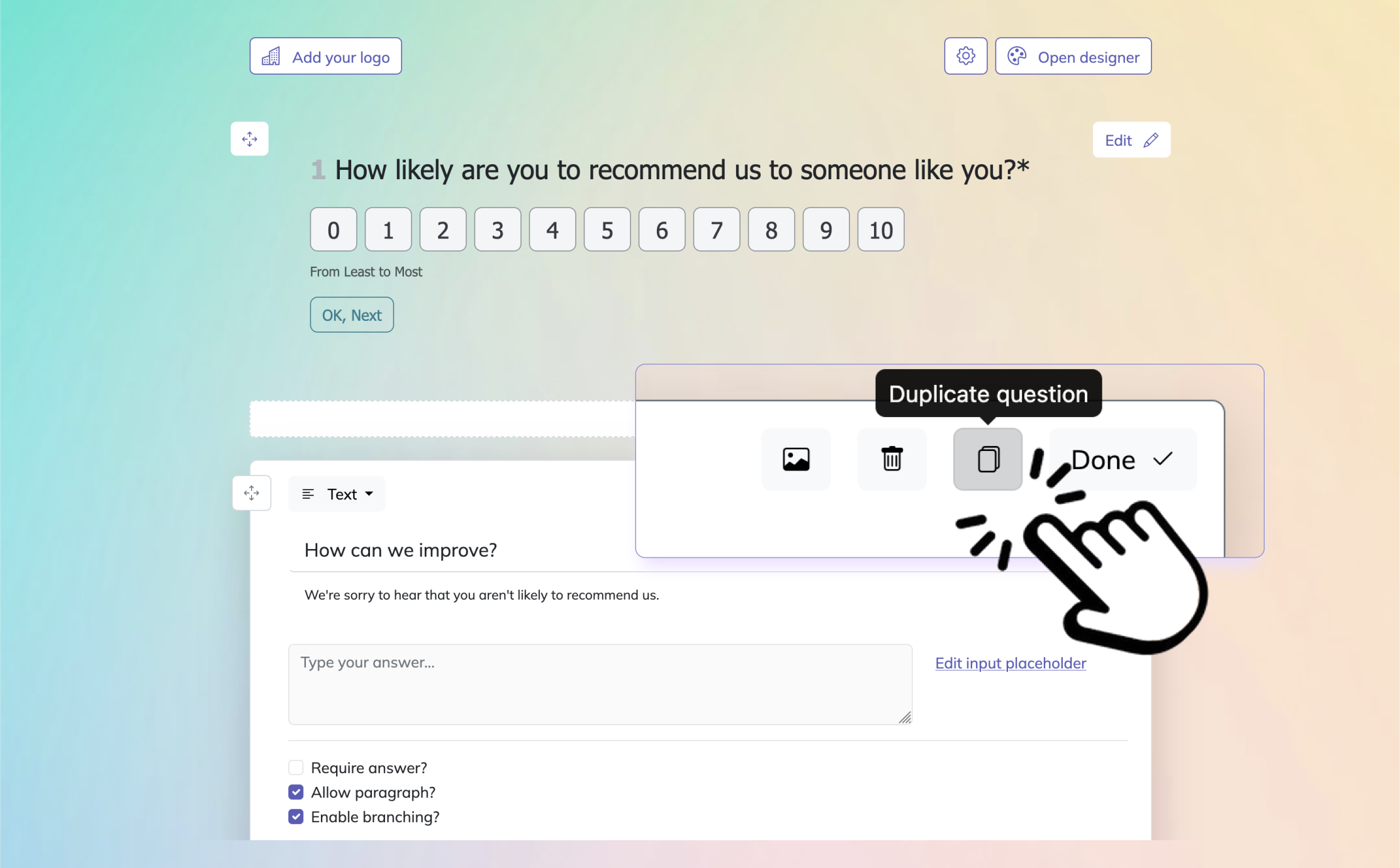
Click Add Question to build your chatbot survey step by step. Use short, conversational wording so it feels like a chat. Mix question types such as Choice, Text, Scale, or Contact Info depending on what you want to learn. You can also mark questions as required, add branching to guide respondents based on their answers, and use answer piping to personalize later questions.
3. Publish survey
Preview your survey to check the flow, then click Publish when everything looks right. HeySurvey will create a shareable link you can send to respondents. After publishing, you can view responses anytime in the Results page.
Customer Effort Chat Survey Questions
Sample questions
How easy was it to complete your task using the chatbot?
Did you have to repeat your question more than once?
How clearly did the chatbot guide you through the process?
How much effort did it take to get the right answer?
What made this chat experience easier or harder than expected?
Effort reveals friction fast and shows you how hard people had to work to get help, which is exactly what strong help desk survey questions should uncover.
Why & When to Use
Use customer effort live chat survey questions after troubleshooting, returns, account updates, billing problems, or any chat that takes a few steps to finish. These are the moments when small bumps in chatbot questions and flow design can feel a lot bigger to your users.
Here’s the thing, effort scores often predict churn better than satisfaction alone because people may say they are "fine" and still never come back. If getting help feels like assembling furniture without instructions, your chatbot survey should catch that early.
Customer effort surveys help you spot friction in places like:
confusing wording in chatbot questions
too many steps in the chat flow
weak clarifying questions in chatbots
messy handoff moments from bot to human
chat points where users abandon the conversation
Plus, these live chat survey questions help you improve navigation, tighten answer paths, and make your chatbot questionnaire easier to complete. On top of that, when you review patterns in repeated questions, vague replies, and drop-offs, you can redesign your chatbot survey and support flow so getting help feels simple, not like a side quest.
Customer effort survey questions matter because high-effort service interactions strongly predict disloyalty, with 96% of customers becoming more disloyal after high-effort experiences (Qualtrics).
Chatbot Resolution and Accuracy Survey Questions
Sample questions
Did the chatbot fully answer your question?
Was the information provided by the chatbot accurate?
Did you need human support after chatting with the bot?
How relevant were the chatbot’s responses to your request?
What answer did you expect but not receive?
Resolution tells you what actually worked because good live chat post survey questions should measure more than whether the bot sounded helpful for five polite seconds.
Why & When to Use
Use these live chat survey questions when you want to know if your bot truly solved the issue and gave the right information, not just a confident-sounding reply. This is especially useful for customer support bots, FAQ bots, and self-service automation where accuracy matters a lot.
Here’s the thing, perceived helpfulness and true resolution are not the same. A chatbot can sound smooth, friendly, and wonderfully robotic, yet still miss the real answer.
These chatbot questions are a smart fit when you are reviewing chatbot questions and answers, testing chatbot responses examples, or improving a chatbot survey after support interactions. Plus, they help you see where the bot handles direct requests well and where open-ended requests get wobbly.
Look for patterns by segmenting responses by intent type, such as:
billing questions
shipping requests
technical support issues
account access problems
On top of that, this data helps you improve fallback responses, tighten knowledge base content, and understand how do chatbots handle open-ended customer questions? That makes your chat survey questions more useful and your bot much better at giving answers people can actually use.
Lead Qualification and Sales Chatbot Questionnaire
Sample questions
What are you looking for help with today?
Which product or service are you most interested in?
What is your biggest challenge right now?
How soon are you planning to make a decision?
Would you like a personalized recommendation or to speak with a specialist?
Good qualification feels like a conversation, not a hostage-style form.
Why & When to Use
Some live chat post survey questions are not really about support feedback at all. They are built to qualify leads, understand purchase intent, and guide people toward the right next step without making you ask for their life story in one go.
These chatbot questions work especially well on pricing pages, demo pages, product recommendation flows, and inbound lead capture chats. Plus, they turn a basic chatbot questionnaire into a practical sales tool that helps you learn what people want and what might help them convert.
Here’s the thing, the best live chat survey questions for sales should feel conversational. If your chatbot survey starts sounding like a tax document, people will vanish faster than free snacks at a meeting.
Use short, goal-driven chat survey questions that keep momentum while still collecting useful signals, such as:
urgency
company size
use case
budget range
interest in human follow-up
On top of that, routing logic can make these chatbot survey questions much smarter. You can send high-intent visitors to sales, direct smaller accounts to self-serve options, or offer tailored recommendations based on their answers.
These are not fun questions to ask chatbots just for entertainment. They are conversion-focused chatbot questions designed to uncover fit, personalize outreach, and move the right prospects forward.
A conversational survey chatbot asking open-ended questions and adaptive probes yielded richer responses than a traditional online survey in experimental research (source).
Product Feedback and Feature Discovery Survey Questions
Sample questions
Which feature were you trying to use today?
Did you find what you needed in the chatbot conversation?
What feature would make this product more useful for you?
What part of the experience felt confusing or incomplete?
How likely are you to continue using this feature?
Great product feedback shows you what users wanted, not just what they clicked.
Why & When to Use
These live chat post survey questions help you learn what people actually want, what slows them down, and where your product may be a little foggy around the edges.
They work best after onboarding, during a trial, right after feature use, or inside in-app support chats where the experience is still fresh in the user’s mind.
Here’s the thing, well-written chatbot questions can do more than collect opinions. They can uncover roadmap clues, highlight weak spots in the user journey, and show which improvements matter most.
Use live chat survey questions to capture both quick ratings and open-ended feedback, because the comments often reveal unmet intent, missing documentation, or feature gaps that analytics alone will never politely confess.
Plus, product and support teams should share this feedback instead of keeping it in separate corners like feuding roommates.
A smart way to organize chat survey questions is to group responses by:
feature area
customer segment
lifecycle stage
trial vs. paid users
On top of that, compare chatbot survey responses with support ticket themes. If the same friction points keep showing up in both places, you have a strong signal for product fixes, clearer guidance, or entirely new feature ideas.
Bot Detection, Trust, and Conversation Quality Questions
Sample questions
At any point, were you unsure whether you were chatting with a bot or a human?
Did the chatbot clearly understand what you were asking?
Did the chatbot ask helpful clarifying questions when needed?
How natural did the chatbot conversation feel?
What made you trust or distrust the chatbot’s responses?
Trust is the quiet little engine that makes chatbot conversations work.
Why & When to Use
These live chat post survey questions help you learn whether people knew they were talking to a bot, trusted the exchange, and felt the conversation flowed like an actual conversation instead of a vending machine with opinions.
They work best when you want to evaluate chatbot transparency, tone, and conversation design, especially after support chats, lead qualification flows, or automated service interactions.
Here’s the thing, good chatbot questions are not about gimmicks. They should reveal whether the bot felt clear, honest, and helpful from the first message to the last.
Use live chat survey questions to measure if your bot handled open-ended customer questions well, asked smart follow-ups, and knew when to stop guessing.
Strong trust signals often include:
clear disclosure that the user is chatting with a bot
helpful clarifying questions in chatbots, like asking which order, product, or account issue the person means
a natural, steady tone that sounds human enough to be easy, but not sneaky
a clear path to a human agent when the bot gets stuck
Plus, some users arrive with their own bot questions or even questions to ask to see if someone is a bot. Fun questions to ask chatbots may suit playful experiences, but business-facing live chat survey questions should focus on usefulness first, because cute banter does not fix confused customers.
Best Practices for Writing Chatbot Survey Questions
Sample questions
Is this question easy to answer in under 10 seconds?
Does this question measure one idea at a time?
Could this wording bias the customer toward a positive answer?
Does this question help a team make a clear decision later?
Is this the right moment in the chat journey to ask this question?
Great survey questions are short, clear, and actually useful later.
Why & When to Use
Even smart survey categories can flop if your live chat post survey questions are leading, too long, or dropped into the chat at the worst possible moment.
Here’s the thing, this section works like a practical checklist for writing better chatbot questions, chatbot survey prompts, and live chat survey questions that people will actually finish.
Use it when you are building a new chatbot questionnaire, cleaning up an old chat survey, or figuring out why response rates are lower than a phone battery at 2 percent.
A few best practices go a long way:
Do keep surveys short and contextual.
Do use plain language.
Do mix quantitative and qualitative questions.
Do trigger surveys at natural conversation endpoints.
Do tailor questions by intent and channel.
On top of that, avoid the common traps that make chatbot questions messy or misleading:
Don’t ask too many questions at once.
Don’t interrupt users before their goal is complete.
Don’t use vague or double-barreled wording.
Don’t collect data without a plan to use it.
Don’t ignore negative feedback or failed bot interactions.
Plus, remember privacy, consent, and response fatigue. If you ask for feedback too often or too early, even strong live chat post survey questions can start to feel like pop quizzes nobody studied for.
How to Turn Chatbot Survey Insights Into Action
Sample questions
Which survey responses point to the biggest customer pain points?
What issues appear most often across chat survey questions?
Which low-scoring conversations should be reviewed first?
What chatbot questions and answers need to be rewritten or expanded?
How will we measure whether changes improve future survey results?
Feedback is only helpful when you actually do something with it.
Why & When to Use
Collecting live chat post survey questions, chatbot questions, and live chat survey questions is only half the job.
Here’s the thing, customer feedback matters when your team uses it to improve support experiences, raise resolution rates, and protect conversions instead of letting insights gather digital dust.
This wrap-up section connects chatbot survey results to real business outcomes, which is where the magic happens and spreadsheets finally earn their keep.
A simple action framework makes this easier:
Collect feedback from chatbot survey and chat survey questions consistently.
Categorize responses by theme, such as confusion, delays, missing answers, or handoff problems.
Prioritize issues based on frequency, customer impact, and revenue risk.
Test updates to chatbot questionnaire flows, prompts, escalation rules, and knowledge content.
Measure whether future live chat post survey questions show better scores and better comments.
On top of that, review open-text responses to spot knowledge gaps and confusing prompts. If you keep seeing the same complaints, your bot is waving a tiny red flag.
Use what you learn to rewrite weak chatbot questions, expand thin answer paths, and tighten escalation rules for open-ended requests. Plus, if you’ve ever wondered how do chatbots handle open-ended customer questions, feedback trends usually show you where they shine and where they stall.
Strong live chat survey questions do more than collect opinions. They help you build better support, smarter automation, and a smoother customer experience.
Next Steps
The right survey type depends on where the conversation happens and what you need to learn, whether that is qualification, satisfaction, usability, loyalty, or simple human verification. If you audit your current flows, you will probably find at least one place where a short, well-timed set of chat survey questions could improve results fast. Start with one micro-survey, test it, and let the feedback shape your next move. If you want a faster launch, use a chatbot questionnaire template to map pre-chat, in-chat, and live chat post survey questions in one simple workflow. Plus, if you build it well, your chatbot survey will feel less like an interrogation and more like a helpful conversation with very good timing.

Conclusion
Chatbot surveys, with their conversational tone and instant presence, are an unbeatable way to capture meaningful feedback. Whether you’re measuring satisfaction, qualifying leads, or digging into abandoned carts, the right questions make all the difference. Stick to these best practices, and you’ll turn every interaction into a chance for learning and growth. With chatbots, insights aren’t just faster—they’re better. Feedback has never felt this friendly!
Related Customer Survey Surveys
29 Restaurant Survey Questions
Explore 25 sample restaurant survey questions to improve customer feedback, boost service quality...

29 Airbnb Survey Questions to Ask Guests
Discover 25 Airbnb survey questions with sample questions, insights, and practical examples to im...
32 Interior Design Survey Questions
Explore 25 interior design survey questions with sample questions to gather client insights, refi...