29 Presentation Survey Questions
Explore 25 sample questions for keyword presentation survey questions, with clear examples to help improve survey design and audience insights.
Want your next survey presentation to feel less like a monologue and more like a smart conversation? Presentation survey questions help you gather useful input before, during, and after a talk so you can boost engagement, sharpen clarity, and get better results, because mind-reading is still not a real feature. In this guide, you’ll explore the most useful types of presentation survey, sample interactive presentation questions, and practical ways to use a presentation feedback survey, presentation questionnaire, or even a presentation survey template to improve every presentation with an online survey tool.
Sample questions
What is your current level of knowledge about this topic?
What is the main challenge you want this presentation to help solve?
Which specific subtopics are you most interested in learning about?
What outcome would make this presentation valuable for you?
Do you have any questions you want addressed during the session?
Pre-Presentation Audience Research Survey Questions
A quick presentation survey before you present can save you from guessing.
Why & When to Use
Use these interactive presentation questions before you build slides or step in front of the room.
They help you understand what your audience already knows, what they need, what is confusing them, and what they expect from the session.
Here’s the thing, a strong survey presentation starts long before slide one.
If you collect answers early, you can shape your examples, pacing, terminology, and depth so the presentation actually fits the people in it, which is a lot nicer than watching eyes glaze over in real time.
This type of presentation questionnaire works especially well for:
training sessions
sales presentations
webinars
classroom talks
conference sessions
Plus, pre-event responses help you spot patterns you might otherwise miss.
You may find beginners need simpler language, decision-makers want outcomes first, or advanced attendees care more about edge cases and strategy.
Keep your presentation survey short so more people finish it.
On top of that, segmenting responses by role, experience level, or goal makes your presentation surveys much more useful.
This section also supports search intent around a presentation questionnaire and practical questions for a presentation, especially if you want a smarter presentation feedback survey process later.
Sample questions
How familiar are you with this concept before today’s session?
Which of these challenges best matches your experience?
What do you think the correct answer is in this scenario?
Which strategy would you choose first in this situation?
How confident do you feel applying this idea right now?
CDC guidance says a training needs assessment identifies audience knowledge gaps and learner characteristics, helping tailor presentation content before delivery (source).
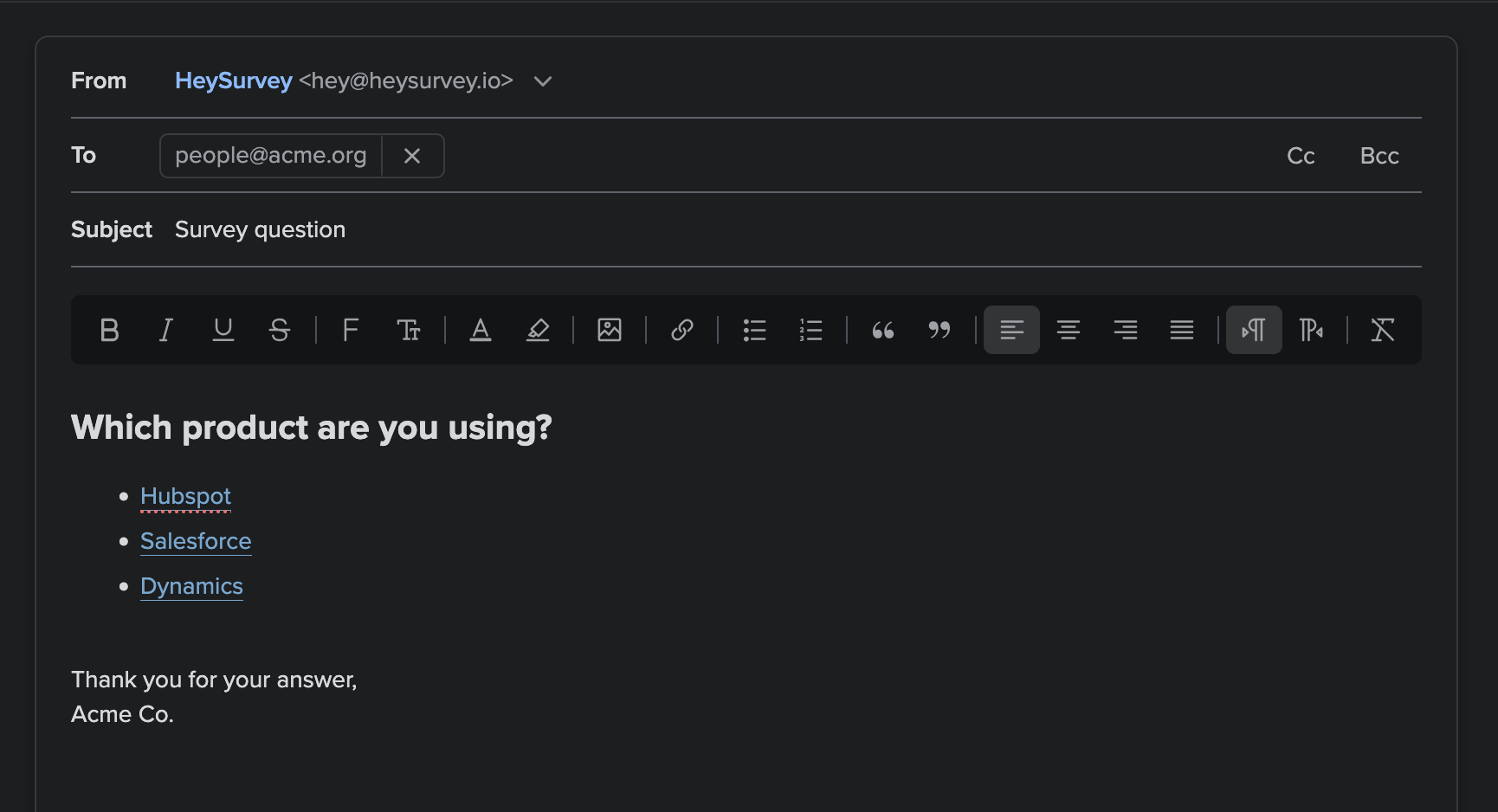
How to create a presentation survey in HeySurvey
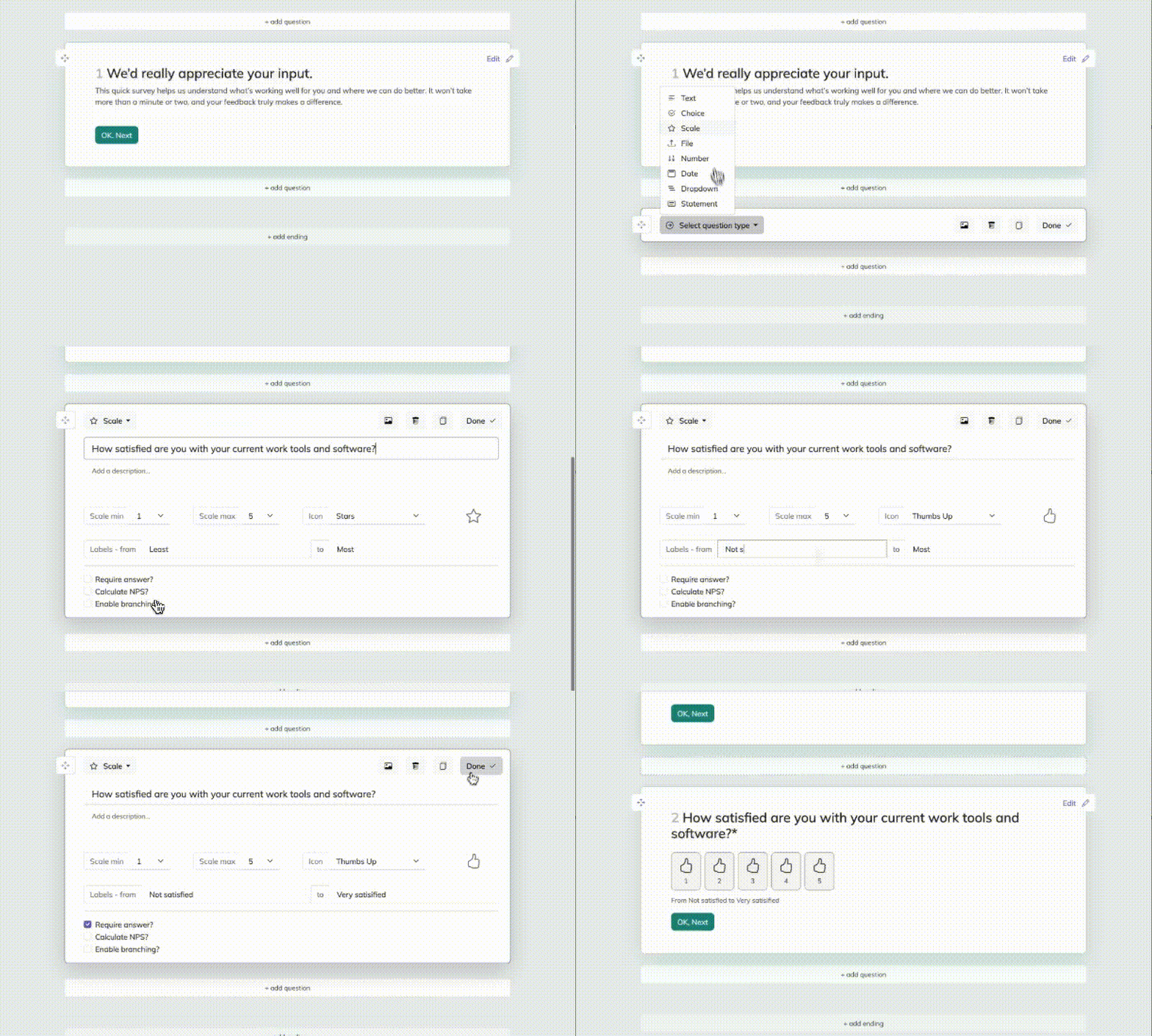
1. Create a new survey
Start by opening a presentation survey template from the button below, or choose a blank survey if you want to build it yourself. HeySurvey works in your browser, so you can begin right away without an account. Once the survey opens, you can rename it in the editor and adjust the basic settings if needed.
2. Add questions
Click Add Question to include the items you want to ask about the presentation. For this type of survey, use Choice, Scale, or Text questions to collect feedback on clarity, pace, design, or overall satisfaction. You can make questions required, add descriptions, and reorder them to match the flow of your presentation review. If you need a quick online survey maker, HeySurvey makes the process simple.
3. Publish survey
When your survey is ready, use Preview to check how it looks, then click Publish to create a shareable link. You can send that link to attendees right after the presentation, or embed the survey on your website or in an email if needed.
Live Poll and Interactive Presentation Questions
A smart survey presentation during the session keeps people awake, involved, and actually thinking.
Why & When to Use
Use these interactive presentation questions while you are presenting, not after the final slide.
That is the big difference between live engagement and a post-session presentation survey, because live questions shape energy in the room, while post-presentation survey questions measure reactions after the fact.
Here’s the thing, when you add a quick poll at the right moment, attention spikes.
People stop passively watching and start choosing, judging, remembering, and comparing their answers, which is exactly why interactive presentation questions can improve participation and retention.
These work best at natural transition points, such as:
after explaining a big concept
before revealing an answer
when shifting to a new section
right before a case study or demo
Keep the wording simple and multiple-choice friendly.
If people need a decoder ring to answer, the moment is too complicated.
Plus, share the results back in a quick sentence or two.
That makes the presentation survey feel meaningful, keeps momentum moving, and helps your audience see where they fit in the group.
On top of that, this style of survey presentation matches what people often want when searching for interactive presentation questions that work in real time, not just a presentation feedback survey template.
Sample questions
How clear was the main message of the presentation?
Which section was easiest to understand?
Which topic needs more explanation or simpler examples?
Did the presentation move at the right pace for your level of understanding?
What is one key takeaway you are leaving with?
Research on audience response systems shows live, in-presentation polling increases participant engagement and activation, supporting better learning experiences than passive presentations (source).
Presentation Clarity and Content Understanding Survey Questions
A strong survey presentation does not just ask whether people liked it, but whether they actually understood it.
Why & When to Use
Use these presentation survey questions to measure comprehension, not just general satisfaction.
Here’s the thing, people can enjoy your slides, like your energy, and still leave wondering what on earth slide seven was trying to say.
This type of presentation questionnaire works best right after a major section or at the end of the full talk.
That timing helps you catch confusion while the content is still fresh, which makes your presentation surveys far more useful.
These questions are especially helpful for:
educational sessions
technical presentations
employee onboarding
stakeholder updates
Plus, make a clear distinction between “they liked it” and “they got it.”
A presentation feedback survey may tell you the speaker was engaging, but interactive presentation questions and open-ended prompts can reveal whether the message landed.
Include at least one open response question, especially one that asks what felt unclear or needed simpler examples.
That gives you practical clues for improving flow, structure, and explanations, not just polishing delivery.
On top of that, this kind of presentation survey template helps you refine content in a way that actually serves the audience, which is the whole point, gold star and all.
Sample questions
How engaging was the presenter throughout the session?
Was the presenter’s pace too slow, too fast, or about right?
How effectively did the presenter explain complex ideas?
Did the presenter encourage participation and questions?
What is one thing the presenter could improve for future sessions?
Presentation Feedback Survey Questions on Delivery and Engagement
A smart presentation feedback survey helps you measure not just what was said, but how well you held the room.
Why & When to Use
This type of survey presentation focuses on delivery details like speaking style, pacing, confidence, tone, energy, and audience connection.
Here’s the thing, even strong content can fall flat if the presenter sounds rushed, stiff, or about as lively as a waiting room plant.
Use these survey questions for presentation feedback after webinars, workshops, internal presentations, and public speaking events.
That timing works well because people still remember how the session felt, not just what appeared on the slides.
To get honest answers, keep your interactive presentation questions specific and neutral.
Ask about observable things like pace, clarity, and participation instead of vague or overly personal opinions.
A strong presentation survey should balance quick rating questions with one open-text prompt that gives people room to explain what would help most next time.
That mix makes your presentation surveys easier to complete and much more useful to review.
Watch for patterns like:
repeated comments about speaking too fast
low scores on audience interaction
mixed feedback on explaining complex ideas
strong energy but weak clarity
Plus, these clues help you improve delivery without guessing, which is exactly what a good presentation questionnaire should do.
Sample questions
Were the slides visually clear and easy to follow?
Did the visuals help you understand the content better?
Was there too much, too little, or the right amount of text on the slides?
Which visual element was most helpful during the presentation?
What would improve the slide design for future presentations?
Research suggests clear speech delivery—especially manageable pace and clarity—improves audience comprehension and engagement, making them essential presentation feedback survey measures (PubMed).
Visuals, Slides, and Questionnaire Presentation Design Survey Questions
A strong survey presentation looks good, sure, but more importantly, it helps you understand faster and remember longer.
Why & When to Use
Use this presentation survey when you want feedback on slide readability, visual support, layout, and overall design effectiveness.
Here’s the thing, good visuals should guide attention and explain ideas, not compete for the spotlight like a chart in sequins.
This section is especially useful if you are improving questionnaire presentation design, refining a presentation survey template, or gathering ideas for presenting survey results more clearly.
On top of that, these interactive presentation questions help you spot whether your slides made the message easier to follow or accidentally muddied the waters.
Focus your presentation questionnaire on practical design points people can actually notice and report, such as:
readability of text and labels
consistency in colors, fonts, and spacing
simplicity of charts and graphs
text density on each slide
clutter, contrast, and basic legibility
A helpful presentation feedback survey should also show whether visuals supported data storytelling or distracted from it.
Plus, when you review presentation surveys like this, you can make smarter slide updates for future sessions without drifting into full-on design theory.
Sample questions
How confident are you in applying what you learned?
What action do you plan to take after this presentation?
Did the presentation answer your most important question or concern?
How likely are you to use these ideas in the next 30 days?
What additional support or information would help you move forward?
Post-Presentation Outcomes and Actionability Survey Questions
A smart survey presentation should tell you what changed, not just whether people smiled politely and reached for the coffee.
Why & When to Use
Use this presentation survey when you want to measure real outcomes after the talk, like improved understanding, stronger confidence, clearer intent, or concrete next steps.
Here’s the thing, interactive presentation questions in this category go beyond basic reactions and help you see whether the presentation actually moved someone forward.
This works especially well when your goal is training adoption, decision-making, behavior change, or lead qualification.
Plus, if your presentation surveys need to prove impact beyond satisfaction, this is where the useful stuff lives.
Outcome-focused interactive presentation questions are often more valuable than generic “Did you like it?” prompts because they show what your audience is ready to do next.
A strong presentation feedback survey or presentation questionnaire can help you spot whether people are prepared to act, still confused, or almost there but need a nudge.
Use responses from this kind of presentation survey to shape practical follow-up, such as:
targeted follow-up emails
extra learning resources
coaching or office hours
sales outreach based on readiness
support for next-step decisions
On top of that, this section fits beautifully in business, education, and workshop settings where action matters more than applause.
Sample questions
Are your presentation survey questions clearly tied to one goal?
Does your survey presentation use a mix of rating, multiple-choice, and open-ended questions?
Are you sending the presentation feedback survey right away while the session is still fresh?
Have you grouped your interactive presentation questions by topic, such as content, delivery, visuals, and outcomes?
Are you using the same presentation survey template across recurring sessions for easier comparison?
Presentation Survey Best Practices
Great interactive presentation questions are clear, quick, and laser-focused on what you actually want to learn.
Why & When to Use
Use these best practices when you want your survey presentation to produce useful feedback instead of a messy pile of polite shrugging.
Here’s the thing, a strong presentation survey helps you improve faster, compare sessions more fairly, and avoid asking questions that sound smart but tell you absolutely nothing. Sneaky little questions can waste everyone's time.
Dos
Keep your presentation survey aligned with the presentation goal.
Use a mix of rating-scale, multiple-choice, and open-ended interactive presentation questions.
Ask right away when recall is strongest. A good rule is 3 to 5 questions for a live poll, 5 to 8 for a post-presentation survey, and 3 to 6 for a pre-event presentation questionnaire.
Keep wording simple, neutral, and specific.
Group questions by purpose, like content, delivery, visuals, and outcomes.
Use a repeatable presentation survey template if your team runs recurring sessions.
Don'ts
Don’t ask vague questions like “Was it good?” Ask “Which part was most useful, and why?” instead.
Don’t overload one presentation survey with too many objectives.
Don’t ask leading questions like “How helpful was this excellent talk?” Neutral wins.
Don’t make every question required, especially open-text items.
Don’t measure speaker performance only. Also measure understanding, confidence, and next-step actionability.
Plus, if you want cleaner presentation surveys across teams, consistency matters a lot.
Sample questions
Was the presentation too long, too short, or about right?
Which question in this survey felt unclear or hard to answer?
Were any important topics missing from the presentation?
Did any survey question feel repetitive or unnecessary?
What is one better question we should ask attendees next time?
Common Mistakes When Writing Presentation Survey Questions
A better survey presentation starts with better questions, not more questions.
Why & When to Use
Use this section when you want your presentation survey to give you feedback you can actually use, not fuzzy opinions that just sit in a spreadsheet looking busy.
It’s especially helpful if you are building a presentation survey template or running a recurring presentation questionnaire across multiple sessions.
Here’s the thing, weak interactive presentation questions create weak decisions. If your survey presentation is confusing, biased, or stuffed with unhelpful prompts, your data will wobble like a folding table at a picnic.
Common mistakes to watch for include:
Asking double-barreled questions like “Was the presentation clear and engaging?” when someone may agree with one part but not the other.
Using biased wording that nudges people toward a nicer answer.
Asking for feedback you cannot act on, which makes presentation surveys longer without making them smarter.
Repeating similar questions that add clutter instead of insight.
Reviewing only presentation performance and not survey performance.
Plus, your presentation feedback survey should improve over time too. If people skip a question, misunderstand it, or give vague answers, revise the presentation questionnaire itself.
On top of that, stronger presentation survey questions lead to clearer priorities, cleaner trends, and less guessing next time.
Sample questions
Which part of the presentation should we improve first based on this presentation survey?
Did any section feel confusing enough that it needs a full rewrite, not just a small fix?
Which slides or visuals made the message clearer, and which ones got in the way?
What follow-up resource would have helped you apply what you learned after the presentation?
If we changed only one thing before the next session, what should it be?
How to Turn Presentation Survey Insights Into Action
A smart survey presentation only pays off when you actually use the feedback.
Why & When to Use
Use this step after collecting responses from your presentation survey, especially when you want more than a polite pile of comments and a false sense of productivity.
Here’s the thing, the best interactive presentation questions help you spot patterns you can act on fast. Sort answers into themes like content, delivery, visuals, engagement, and outcomes so your presentation feedback survey turns into a decision-making tool.
Start by separating small fixes from bigger redesign needs:
Quick fixes include slide cleanups, tighter wording, or clearer examples.
Larger changes include restructuring sections, changing pacing, or rebuilding weak explanations.
Recurring patterns matter more than one-off opinions, because one spicy comment is not a strategy.
From Feedback to Improvements
If multiple people flag the same section as confusing, update the structure. If comprehension scores are low, improve examples or simplify explanations in your presentation questionnaire review.
Plus, if timing feedback keeps repeating, adjust the pace. If visuals feel distracting, refine those slides before your next survey presentation.
Create a Simple Improvement Plan
Turn each theme into one next action:
Fix confusing sections in the flow.
Improve weak examples.
Adjust pacing.
Clean up unclear visuals.
Add follow-up resources for next steps.
On top of that, save a reusable presentation survey template you can adapt for different audiences. The best presentation surveys improve presentations only when feedback is reviewed, prioritized, and applied.
Related Feedback Survey Surveys
29 Catering Survey Questions to Ask Customers
Explore 25 sample catering survey questions to gather feedback, improve events, and understand cl...
29 User Feedback Survey Questions
Explore 25 user feedback survey questions with sample prompts, practical tips, and ideas to impro...
29 Environment Survey Questions to Ask Today
Discover 25 environment survey questions with sample answers to improve feedback, measure awarene...