31 Environmental Survey Questions
Explore 25 environmental survey questions with sample responses to guide research, improve feedback, and understand sustainability concerns.
Want better decisions on sustainability, policies, or workplace habits? An environmental survey is a simple set of environment questions that helps you measure attitudes, behaviors, conditions, and priorities across schools, local governments, workplaces, and research projects.
You might also see it called an environmental questionnaire, enviromental survey, environmental sustainability questionnaire, or environmental quality survey. Plus, this guide walks you through the main types of environmental survey questions, when to use each, sample questions, and how to turn answers into practical action, not just a spreadsheet that collects dust.
Sample questions
How informed do you feel about current environmental issues in your community?
Which environmental issues concern you most: climate change, air pollution, water quality, waste, or biodiversity loss?
How important is environmental sustainability in your day-to-day decision-making?
Do you believe individual actions can make a meaningful environmental impact?
How likely are you to support new environmental policies or sustainability programs?
Environmental Awareness and Attitudes Survey Questions
Measure what people think before you ask what they do.
Why & When to Use
Use this type of environment survey questions when you want a clear read on what people already know, believe, and care about.
It works especially well for schools, nonprofits, community programs, public outreach campaigns, and employee education efforts where awareness is part of the goal.
Here’s the thing, attitude-based environment questions help you segment your audience so you can spot who is highly engaged, who is unsure, and who may need more education before taking action.
These questions also make strong openers in a broader environmental questionnaire because they feel easy to answer and gently warm people up before behavior or policy questions. Nobody likes being hit with the hard stuff first.
For the best results, mix formats so your enviromental survey captures both depth and clarity.
Use rating-scale questions to measure concern, importance, and support levels.
Use multiple-choice questions to identify top issues and compare priorities across groups.
Use the same environmental awareness questions over time to benchmark shifts in public, student, or employee sentiment.
Plus, this kind of environmental sustainability questionnaire is especially useful before launching a new initiative, since it gives you a baseline you can revisit later to see what actually changed.
Sample questions
How often do you recycle paper, plastic, glass, or metal materials?
Which transportation methods do you use most often each week?
How frequently do you take steps to reduce household or workplace energy use?
When shopping, how often do you choose environmentally friendly or low-waste products?
What prevents you from adopting more sustainable habits: cost, convenience, lack of information, or limited access?
Environmental knowledge and values explained 40% of ecological-behavior intention, which predicted 75% of general ecological behavior in survey research. Source
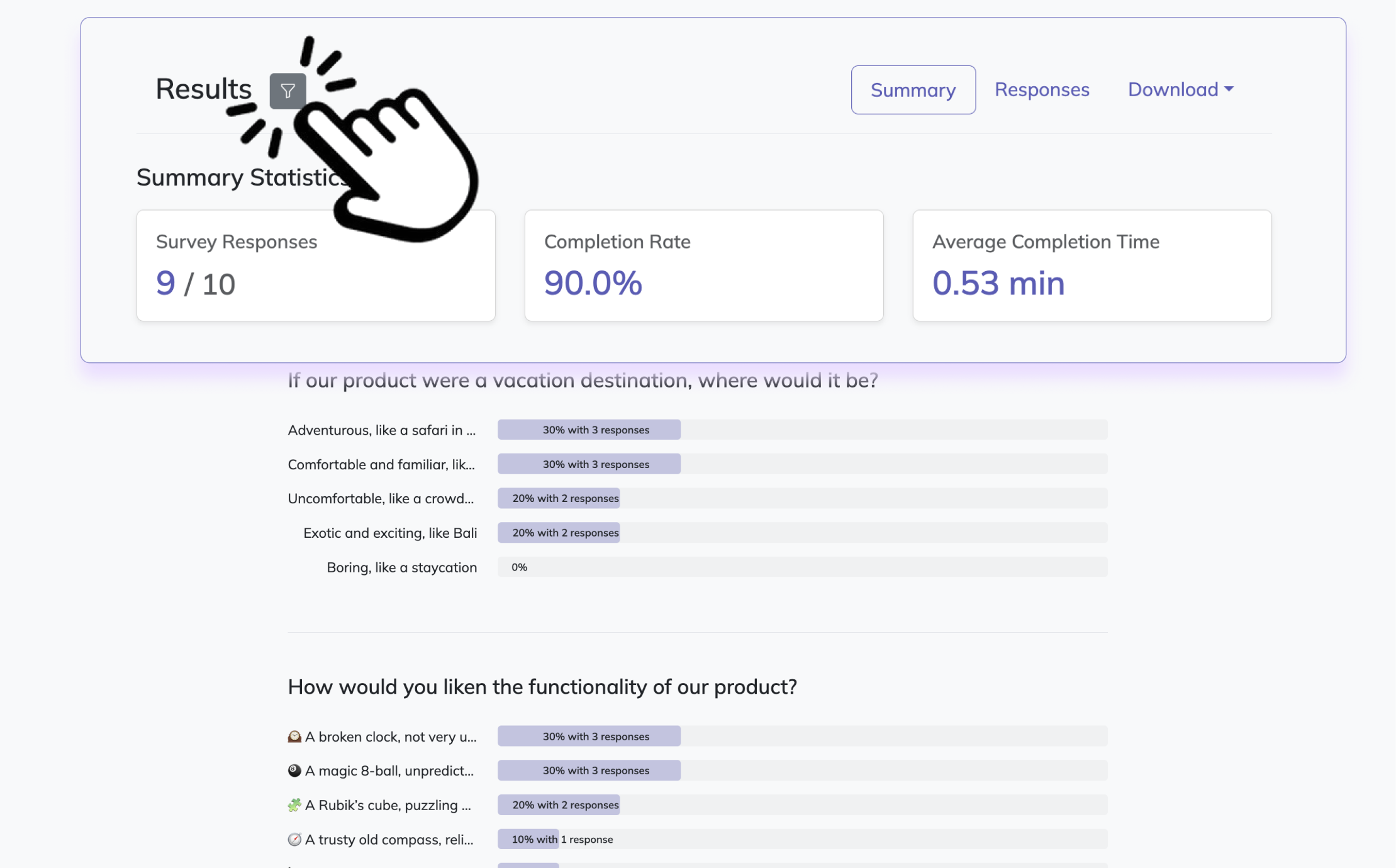
Create an environmental survey in 3 easy steps
1. Create a new survey
Click the button below to start from a template, or choose an empty sheet if you want to build from scratch. Give your survey a clear name, such as “Environmental Habits Survey,” so you can find it later. You can begin without an account, but you’ll need one to publish and view responses.
2. Add questions
Click Add Question to include the questions you need. For an environmental survey, use Choice questions for habits, Scale questions for opinions, and Text questions for comments or suggestions. You can also mark questions as required, add answer options, and rearrange them anytime.
3. Publish survey
When your survey looks ready, click Preview to check it first. Then hit Publish to create your shareable link. Once published, you can send the survey to respondents and start collecting answers right away.
Environmental Behavior and Lifestyle Survey Questions
Track what people actually do, not just what they mean to do.
Why & When to Use
Use these environmental questions when you want to measure real habits, routines, and choices in everyday life.
This part of an environment survey questions is all about behavior, which is different from intention because people often plan to be greener than their calendar, budget, or Tuesday afternoon energy level allows.
It works especially well for sustainability programs focused on recycling, transportation, water conservation, energy use, and purchasing habits.
Plus, it is a smart fit for employers, universities, municipalities, HOAs, and consumer research teams that need practical data they can actually act on.
To make your environmental questionnaire more useful, write questions with a time frame so responses are easier to compare.
Use terms like daily, weekly, monthly, or rarely.
Ask about specific actions instead of vague goals.
Include barrier questions to uncover what is getting in the way.
Compare reported habits across home, school, work, or commuting settings.
Here’s the thing, an environmental sustainability questionnaire gets much stronger when you pair behavior questions with barrier-focused follow-ups, because you learn not only what is happening, but why it is or is not happening.
On top of that, this section is often the core of an enviromental survey or environment survey because habits reveal where real change is most likely to stick.
Sample questions
How would you rate the overall environmental quality of your neighborhood or local area?
How concerned are you about air pollution where you live or work?
How satisfied are you with the cleanliness of local streets, parks, and public spaces?
Have you noticed any environmental problems such as litter, odors, noise, flooding, or poor water quality in the past year?
Which local environmental improvement should be prioritized first?
Time-bounded, behavior-specific environmental survey questions improve data comparability and actionability by capturing actual habits and barriers across settings (WHO World Health Survey Plus).
Environmental Quality and Local Conditions Survey Questions
Find out how people experience the place around them every day.
Why & When to Use
Use this environmental quality survey section when you want to understand how people perceive local conditions, not just what instruments or reports say.
That makes it a smart addition to an environmental survey for city planning, neighborhood reviews, public health studies, campus operations, and community advocacy work.
It is especially useful for exploring air quality, access to green space, noise, litter, drainage, and water cleanliness in a way people can actually respond to.
Here's the thing, perceived environmental quality is not the same as measured environmental data, but both matter because numbers show what is happening and people show how it feels to live with it.
To make your environmental questionnaire more relevant, use location-specific wording so respondents can answer based on their street, building, campus, or neighborhood instead of guessing broadly.
Name the specific area being studied.
Include common local issues like odors, flooding, traffic noise, or trash.
Add an open-ended question so people can mention problems you did not list.
Compare responses by location to spot patterns and priority zones.
Plus, this kind of enviromental survey is a strong fit for community environmental surveys and environmental research surveys, because local insight often catches what the clipboard, sensor, or spreadsheet missed.
Sample questions
How supportive are you of proposed sustainability initiatives in your organization or community?
Which environmental programs should be prioritized: recycling, renewable energy, water reduction, green purchasing, or composting?
Do you feel current environmental policies are clearly communicated and easy to follow?
What concerns do you have about implementing new sustainability measures?
How willing would you be to participate in future environmental programs or training?
Environmental Sustainability Program and Policy Survey Questions
Measure support before you spend the budget and print the posters.
Why & When to Use
Use this part of your environmental survey when you want to evaluate support for sustainability initiatives, environmental policies, or day-to-day operational changes before rollout.
It works especially well for businesses, schools, government agencies, and nonprofits that are planning, updating, or reviewing a sustainability strategy.
Here's the thing, a strong environmental questionnaire does not just ask who supports an idea.
It also asks who feels unsure, overloaded, confused, or quietly resistant, because that is usually where rollout gets wobbly.
This section is helpful when you need to test likely adoption, perceived fairness, and communication gaps across teams, departments, campuses, or community groups.
Plus, it is a smart fit for an environmental sustainability questionnaire or environmental support survey because it helps you spot what people will actually back, not just what sounds nice in a meeting.
To make this enviromental survey more useful, include a mix of support, concern, and prioritization questions.
Ask one question about overall support before introducing specific programs.
Include one question about concerns, barriers, or resistance.
Add one prioritization question to guide budgeting and planning.
Check whether current policies are clearly explained and easy to follow.
Use results to shape communication, training, and rollout plans for each group.
Sample questions
Have you participated in any environmental education, training, or awareness events in the past 12 months?
Which environmental topics would you like to learn more about?
What type of environmental activities are you most interested in joining?
How do you prefer to receive information about environmental initiatives?
What would make you more likely to participate in environmental programs or events?
Survey research on U.S. sustainable construction found financial constraints were the most important barrier, showing environmental questionnaires should include barrier questions, not just support items (source).
Environmental Education and Engagement Survey Questions
Turn interest into action, not just polite nodding.
Why & When to Use
Use this part of your environmental survey when you want to measure participation, training needs, and real interest in environmental activities.
It fits schools, colleges, employers, NGOs, volunteer programs, and public outreach campaigns especially well.
Here's the thing, an environmental questionnaire about education and engagement helps you learn what people actually want to join, not just what sounds admirable on paper.
That makes it easier to design better workshops, events, campaigns, and learning materials without guessing and hoping for the best.
This section is especially useful in school programs and workplace sustainability efforts, where participation often depends on timing, relevance, and clear communication.
Plus, a smart enviromental survey can show whether people want hands-on activities, short training sessions, guest talks, cleanups, challenges, or simple how-to resources.
To make this environment survey useful, connect your environmental questions to real opportunities people can access now or soon.
Ask about preferred topics so your environmental education content matches actual curiosity.
Include questions about communication channels like email, posters, apps, meetings, or social media.
Identify barriers such as lack of time, unclear benefits, inconvenient scheduling, or not knowing where to start.
Tie responses to actual events, clubs, trainings, or volunteer options so your environmental sustainability questionnaire leads somewhere practical.
On top of that, this kind of environmental quality survey works best when it helps you build engagement paths, because enthusiasm is nice, but sign-ups are nicer.
Sample questions
Which workplace or organizational activities create the most environmental impact in your view?
How effective are current waste reduction and recycling practices in your organization?
Do employees or stakeholders have enough support to follow environmentally responsible procedures?
Where do you see the greatest opportunity to reduce energy, water, or material use?
How often are environmental goals discussed, measured, or reported within the organization?
Environmental Impact and Organizational Operations Survey Questions
Find the friction points hiding in plain sight.
Why & When to Use
Use this part of your environmental survey when you want a clear picture of how everyday operations affect sustainability goals.
It works especially well for companies, institutions, facility managers, operations teams, and internal ESG reviews.
Here's the thing, this environmental questionnaire is not about running a full technical audit with clipboards and dramatic sighs.
It is about gathering practical insight from the people who see the workflows, habits, and recurring problems up close every day.
A strong enviromental survey can reveal hidden issues in waste handling, procurement, commuting, energy use, water use, and compliance routines.
Plus, employees often notice bottlenecks long before they show up in reports, dashboards, or budget headaches.
Use this environment survey when you want to spot inefficiencies, unclear procedures, or missing support that may be slowing progress.
It also fits internal sustainability assessment projects where perception-based feedback can guide what to measure more formally later.
To make your environmental questionnaire more useful, pair responses with performance data afterward, not instead of it.
Ask about daily operations in plain language so people can answer based on real experience.
Use environmental questions to uncover where staff feel systems are confusing, wasteful, or hard to follow.
Compare feedback later with metrics like energy use, recycling rates, purchasing data, or travel patterns.
Include this in an environmental sustainability questionnaire when you want practical improvements, not just polished policy talk.
How to Choose the Right Environmental Survey Questions
Sample questions
What is the primary goal of your environmental survey?
Who is the target audience for this survey?
Do you need to measure awareness, behavior, environmental quality, support, or participation?
Will the results be used for benchmarking, decision-making, or program improvement?
What actions can realistically be taken based on the answers collected?
Start with the decision, not just the question.
Why & When to Use
Use this section when you want your environmental survey to do something useful, not just sit in a spreadsheet looking busy.
It works best as the bridge between picking a survey category and actually building an environmental questionnaire people can answer clearly.
Here's the thing, broad surveys help when you need a general snapshot, while a specialized enviromental survey works better when you already know the topic, audience, or problem area.
If your goals are fuzzy, your environmental questions will usually be fuzzy too, and that is rarely a fan favorite.
A smart environment survey matches each question to a decision, metric, or next step.
For example, if answers will not change a policy, improve a process, or guide follow-up, that question may be taking up space rent-free.
Keep language simple and specific to the audience.
Staff may respond better to practical workplace wording in an environmental sustainability questionnaire.
Residents or customers may need plain, everyday environment questions without technical jargon.
If you need easy comparisons, use rating scales or multiple-choice questions.
If you want richer detail, add a few open-ended environmental questionnaire items, but do not let them take over the whole party.
On top of that, choosing the right environmental quality survey format makes analysis faster and action much easier.
Best Practices for Writing Environmental Survey Questions
Sample questions
Is each environmental survey question focused on one idea only?
Would a first-time reader understand this environmental questionnaire without extra explanation?
Are your answer choices complete, non-overlapping, and easy to use on mobile?
Have you included a mix of rating-scale and open-ended environmental questions?
Does every question support a real decision or follow-up action?
Write for answers you can actually use.
Why & When to Use
Use these best practices when you want your environmental survey to be clear, credible, and pleasantly painless to complete.
Here's the thing, a strong environmental questionnaire is not just informative, it is actionable, which is much more fun than collecting data that gathers digital dust.
Dos
Keep each environmental question specific, neutral, and easy to answer.
Define timeframes, locations, or behaviors when they matter.
Group similar items together so the environment survey flows logically.
Use consistent response scales, such as 1 to 5 ratings, so results are easier to compare.
Mix quantitative items with one or two open-ended prompts.
Pilot test the environmental sustainability questionnaire before launch.
Tailor wording for employees, residents, students, or customers, and keep it accessible, inclusive, and mobile-friendly.
Don'ts
Ask double-barreled questions that cover two issues at once.
Overload the survey with too many open-text questions.
Use technical jargon unless your audience already speaks that language.
Collect feedback you will not analyze or act on.
Create overlapping answer choices or skip common options.
Ignore anonymity or confidentiality concerns.
Launch an enviromental survey, often misspelled that way, without a clear purpose, owner, and follow-up plan.
Plus, keep question order simple: start easy, place sensitive items later, and keep the environmental quality survey short enough that people finish before coffee gets cold.
Turning Environmental Survey Insights Into Action
Sample questions
Which findings point to the most urgent environmental issue?
What quick wins can be implemented based on the survey results?
Which results require longer-term planning or budget allocation?
Who should be responsible for acting on each key survey insight?
How will progress be measured and communicated after the survey?
Turn feedback into visible progress.
Why & When to Use
Use this section when your environmental survey is finished and you need to turn responses into real-world improvement.
It works especially well if you need stakeholder buy-in, clearer priorities, and measurable next steps after an environmental questionnaire or environmental quality survey.
Here's the thing, collecting answers is only halftime, and the second half is where the scoreboard actually changes.
Start by sorting your environmental survey results into simple categories so patterns are easier to spot:
awareness gaps, where people do not understand policies, goals, or environmental sustainability questionnaire topics
behavior gaps, where people know what to do but are not doing it consistently
operational issues, where systems, tools, staffing, or processes are getting in the way
Plus, prioritize actions based on what will create the biggest impact, what is feasible now, and what has enough stakeholder support to move forward.
That helps you separate quick wins from bigger projects that need budget, planning, or leadership approval.
On top of that, assign ownership for every action that comes from the enviromental survey, including a timeline and a simple success measure.
Share key findings back with respondents too, because people trust an environment survey more when they see their input led somewhere useful.
Finally, use a follow-up environmental questionnaire to measure progress, adjust your plan, and keep momentum alive.
Related Feedback Survey Surveys
29 Catering Survey Questions to Ask Customers
Explore 25 sample catering survey questions to gather feedback, improve events, and understand cl...
29 User Feedback Survey Questions
Explore 25 user feedback survey questions with sample prompts, practical tips, and ideas to impro...
29 Environment Survey Questions to Ask Today
Discover 25 environment survey questions with sample answers to improve feedback, measure awarene...